
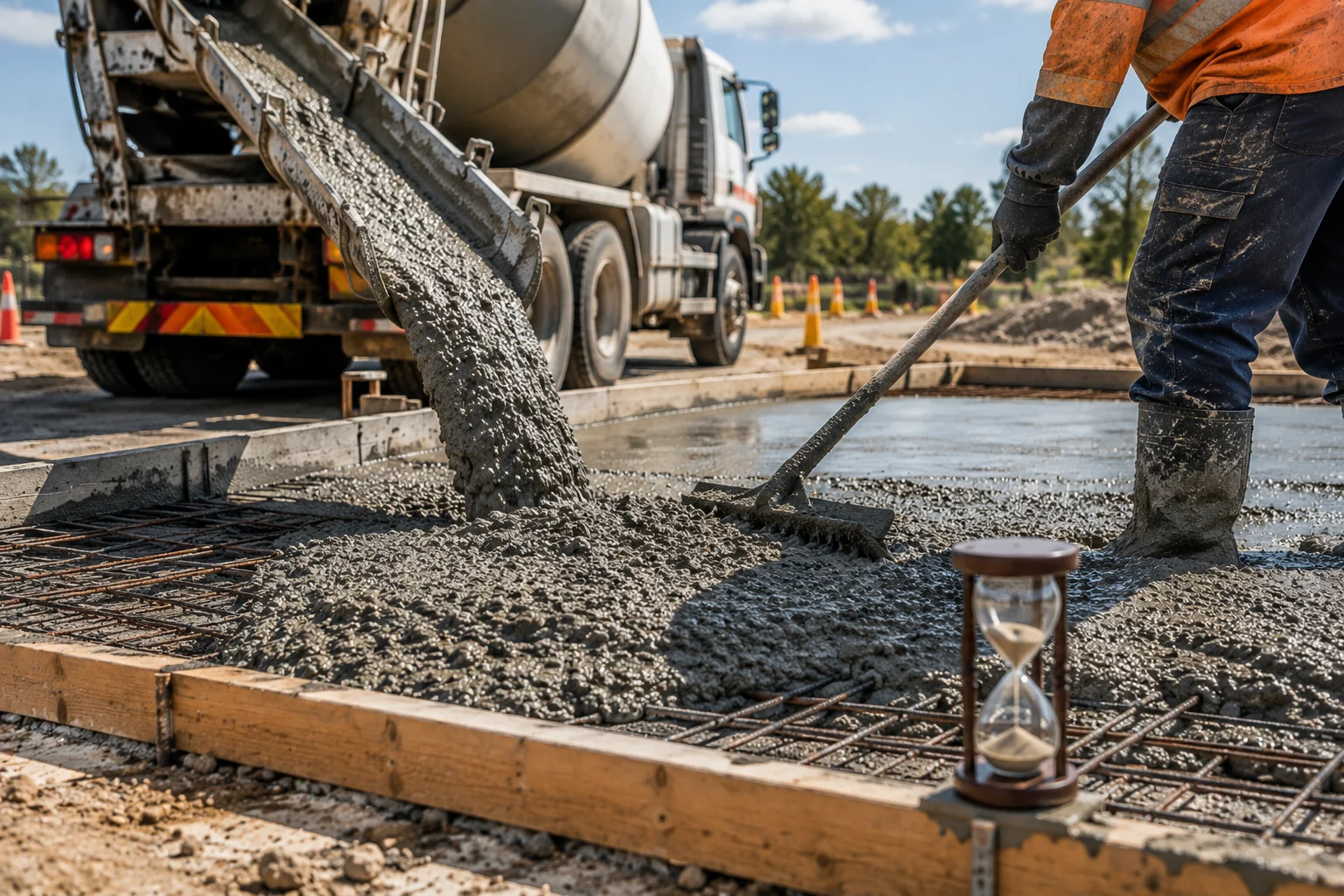
Ready mix concrete stays workable for roughly 90 minutes to 2 hours from the moment it is batched, under normal, mild conditions. That window is the time you have to get it placed, spread, and compacted before it starts to stiffen and set. Heat, wind, and sun shorten it, sometimes to under an hour, while cool weather and a retarding admixture can stretch it. Because the clock starts at the batching plant, not when the truck arrives, travel time eats into your working window, which is one more reason a nearby supplier helps. The table below gives a realistic guide for how long you have in different conditions.
| Condition | Approximate workable time from batching |
| Mild day, 15 to 25 degrees | 90 minutes to 2 hours |
| Hot day, 30 degrees plus, or windy | 45 to 60 minutes |
| Cool day, under 15 degrees | Up to 2 hours or more |
| With a retarder added by arrangement | Extended to suit the job |
What Workable Actually Means
Before planning around the window, it helps to be clear on what workability is, because it is a specific stage in the life of a pour, not the whole thing. Workable simply means the concrete is still soft and plastic enough to move, spread, screed, and compact into place without losing strength.
From the moment cement meets water, a chemical reaction called hydration begins, and the mix slowly stiffens toward its initial set. While it is still plastic, it is workable. Once it starts to go off, forcing it into place or adding water to loosen it will weaken the finished concrete and invite cracking. So the workable time is really the safe window between delivery and the first signs of stiffening, and everything you need to do with the wet concrete, placing, levelling, and compacting, has to happen inside it. A quality pre-mix concrete batched to a consistent slump gives you a predictable window to work with.
The Standard Timeframe and the 90-Minute Guide
Under Australian practice, there is a widely used rule of thumb that ready mix concrete should be discharged and placed within about 90 minutes of batching, and this is where the 90-minute figure comes from. It is a sensible working limit for standard mixes in ordinary conditions.
In practice, a normal mix on a mild day stays workable for around 90 minutes to 2 hours from batching, which is why deliveries are timed so the truck arrives with plenty of that window left. The important detail is that the time is measured from when the concrete is mixed at the plant, so a long drive to site spends part of your working time before the truck even backs up. This is a real advantage of ordering from a local supplier, because shorter travel distances mean more of the workable window is left for you when the concrete lands.
What Shortens the Workable Window
Several everyday factors can cut the working time well below two hours, and knowing them lets you plan rather than get caught out. Temperature is the biggest one, but it is not the only one.
Heat speeds up hydration, so on a 30-degree day the concrete can stiffen in under an hour instead of two. Wind and direct sun dry the surface and pull water out of the mix, stiffening it faster still. The mix itself matters too, since a stiffer, low-slump mix has less working time than a wetter one, and high-cement or rapid-set mixes go off sooner by design. Long travel from the plant, delays in getting set up on site, and a small crew that cannot place the load quickly all burn through the window as well. On a hot or windy day, treat the workable time as short and have everything ready before the truck arrives.
What Can Extend It
Just as some conditions shorten the window, others lengthen it, and on a big or awkward pour that extra time is worth arranging in advance. The main lever is a retarding admixture, which is added to slow the set on purpose.
A retarder pushes back the initial set, giving you a longer plastic window, which is useful for large pours, hot-weather jobs, or sites with difficult access where placing takes longer. Cool weather does the same thing naturally, slowing hydration so the concrete stays workable longer. Plasticisers and water reducers can also keep a mix flowing without weakening it, which helps on jobs that need more placing time. If you know a pour will be slow or the day will be hot, talk to your supplier when you order so the mix can be adjusted, and our owner-builder concrete guide covers the kind of details worth raising before delivery.
Why You Should Never Just Add Water
When concrete starts to stiffen on site, the instinct is to splash in water to bring it back, and this is the single most damaging thing you can do to a pour. It is worth understanding why so the temptation is easy to resist.
Adding water after batching raises the water-to-cement ratio, and that ratio is what controls strength. Extra water means weaker, more porous concrete that is far more likely to crack, dust, and wear prematurely, so a slab that should have reached its rated strength ends up well short. If a mix is too stiff to place, the right fixes are a plasticiser or a properly adjusted slump ordered up front, not a hose on site. This is also why the strength you order, measured in MPa, only holds if the mix is placed as delivered.
How to Make the Most of Your Workable Time
Because the window is fixed once the concrete is batched, good preparation is what turns a tight timeframe into an easy pour. The aim is to have nothing left to organise when the truck arrives.
Have the formwork built and checked, the base prepared, and your tools and crew ready before the delivery time, so placing starts the moment the concrete arrives. Work out your volume in advance so the load is right and there are no gaps, using a concrete calculator if you are unsure. Book delivery for the cooler part of the day in summer, keep the crew moving so the load is placed steadily, and start finishing only once bleed water has gone. Plan it well and the 90-minute to 2-hour window is comfortably enough for most home pours.
Frequently Asked Questions
How long do you have to pour ready mix concrete?
In mild conditions you generally have about 90 minutes to 2 hours from batching to place and compact the concrete. On a hot or windy day it can be under an hour, so have everything ready before the truck arrives.
Does concrete set faster in hot weather?
Yes. Heat speeds up hydration, so on a hot, sunny, or windy day the workable time can drop to 45 to 60 minutes. Booking a cooler part of the day and, if needed, a retarder helps keep the window manageable.
Can you add water to ready mix concrete to keep it workable?
No. Adding water after batching raises the water-to-cement ratio and weakens the concrete, causing cracking and dusting. If more working time is needed, use a plasticiser or an adjusted slump ordered in advance instead.