
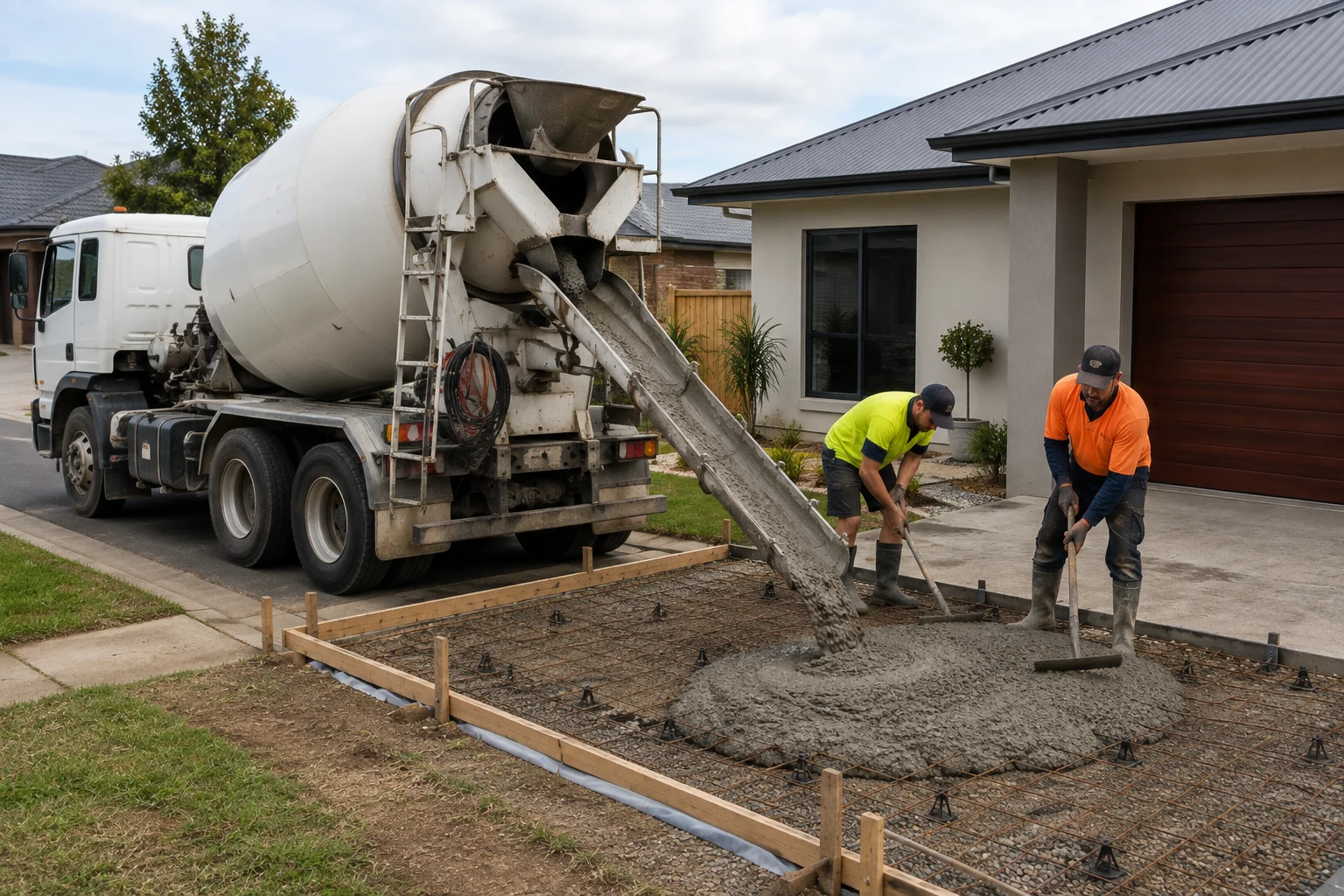
For a small residential pour, the truck that turns up is usually one of two types. A mini mix truck, carrying roughly 1 to 4 cubic metres, is used for small jobs and tight access like narrow or steep driveways. A standard concrete mixer truck, which holds up to about 6 to 8 cubic metres, comes for larger pours or when it can carry a part load to your site. Which one arrives depends on how much concrete you need and how easily a truck can reach the pour. A path, a shed slab, or a small patio might come on a mini mix, while a single garage slab or small driveway is often a standard truck running a part load. The table below sums up the common options.
| Truck type | Typical capacity | Best for | Access needs |
| Mini mix truck | 1 to 4 m³ | Small pours, tight or steep access | Suits narrow driveways and difficult sites |
| Standard mixer, part load | Up to 6 to 8 m³ | Small to medium pours | Needs solid, wide, level access |
| Standard mixer, full load | 6 to 8 m³ | Larger driveways and slabs | Needs the best access and firm ground |
The Two Trucks You Are Most Likely to See
Almost every residential delivery arrives on one of two vehicles, and they are built for different situations, so it is worth knowing how each behaves before you book.
A standard concrete mixer truck, sometimes called an agitator or agi truck, is the large rotating-barrel truck most people picture. It typically holds up to around 6 to 8 cubic metres, though road weight limits often mean a full load sits closer to 6 or 7. It is the workhorse for driveways, garage slabs, and bigger pours, but it is heavy and long, so it needs solid, wide access to get close to the job. A mini mix truck is a smaller version of the same idea, carrying roughly 1 to 4 cubic metres in a compact body that can fit down narrow driveways, around tight corners, and onto steep or awkward blocks where a full-size truck simply cannot go. For a lot of small residential work, the mini mix is the truck that makes the pour possible at all. A local supplier with both in the fleet can match the vehicle to your site rather than forcing the job to suit one truck.
What Decides Which Truck Comes
Two things really settle which truck arrives at your place, and thinking about both before you order lets the supplier send the right vehicle the first time.
The first is volume, or how many cubic metres your pour needs. A small path or a few steps might be well under a cubic metre, a shed slab or patio often lands between 1 and 3, and a small driveway or single garage slab is commonly 3 to 5. Working this out in advance is straightforward with a concrete calculator, and it is the number the supplier needs first. The second is access, meaning how close a truck can physically get to where the concrete has to go. A wide, firm, level driveway suits a standard truck, while a narrow entrance, a steep slope, soft ground, low branches, or tight corners point toward a mini mix. When you order, describing your access honestly is just as important as the volume, because it lets the supplier send a truck that can actually reach the pour.
Truck Size, Weight, and Why Access Matters So Much
It is easy to underestimate just how big and heavy a loaded concrete truck is, and that weight is the reason access planning matters more here than with almost any other delivery.
A fully loaded standard mixer can weigh in the order of 25 to 30 tonnes, and the truck itself is around 8 to 9 metres long, about 2.5 metres wide, and roughly 3.5 to 4 metres high with the chute folded. That combination of length, width, height, and enormous weight is why a standard truck cannot squeeze down a narrow side path or turn in a tight courtyard, and why it should never be driven across a new driveway, a lawn over soft ground, a septic tank, or a covered drain, all of which it can crack or collapse. A mini mix is lighter and more compact, so it does far less harm to surfaces and reaches places the big truck cannot, but even a small truck is heavy, so firm ground still matters. Thinking about the route the truck will take, and any overhead wires or low eaves along it, before delivery day avoids the common problem of a loaded truck arriving and finding it cannot get close enough.
Getting the Concrete From the Truck to the Pour
Even the right truck in the right spot can only discharge so far, so the next question is how the concrete actually gets from the chute into your formwork.
A mixer truck discharges down a chute at the rear, and that chute reaches only about 2 to 3 metres from the back of the truck, with a bit of extra swing to either side. If your pour is within that reach, the concrete can flow straight into place. If it is further away, around the back of the house or over an obstacle, you have a few options. Wheelbarrows are the cheapest for small volumes but are slow and hard work, and you have to keep up with the workable time. A concrete pump or line pump, booked separately, can push concrete over fences, through gates, and to the back of a block, and is often the practical answer for tight sites. For an owner-builder handling their own pour, our owner-builder concrete guide covers how to plan discharge and placement so the load does not catch you out.
Part Loads, Minimum Charges, and Small Orders
Small pours raise a cost question that does not come up on big jobs, and it helps you decide between a mini mix and a part-loaded standard truck.
A standard truck can bring a part load, meaning less than its full capacity, but anything under a full truck usually carries a part-load fee, and very small orders have a minimum charge to cover the trip. This is normal across the industry and simply reflects that sending a truck out has a fixed cost whether it is half full or full. A mini mix can be the more economical choice for genuinely small jobs, since you are not paying to move a large truck for a couple of cubic metres. Our honest guide to concrete cost per cubic metre explains how part loads and minimum charges affect the price, so you can weigh up the options before ordering.
How to Order the Right Truck for Your Job
Pulling it together, getting the right truck is mostly about giving the supplier good information, and the more accurately you describe the job, the smoother delivery day goes.
Work out your volume first, so you know roughly how many cubic metres you need. Look honestly at your access, including driveway width, slope, ground firmness, corners, gates, and any overhead obstacles, and note how far the pour is from where a truck can park. Then call the supplier with both, along with the finish and strength you want, and let them recommend the truck. A good supplier will match a mini mix or standard truck to your site, flag whether a pump is worth it, and make sure the pre-mix concrete is batched to the right strength for the job. That short conversation up front is what turns a tricky small pour into a simple one.
Frequently Asked Questions
What size concrete truck is used for residential jobs?
Residential jobs use either a mini mix truck, carrying about 1 to 4 cubic metres for small or tight-access pours, or a standard mixer holding up to about 6 to 8 cubic metres for larger driveways and slabs. The choice depends on your volume and access.
How much concrete does a mini mix truck hold?
A mini mix truck typically carries around 1 to 4 cubic metres. Its smaller, more compact body suits narrow driveways, steep blocks, and tight sites where a full-size mixer cannot reach, which makes it ideal for small residential pours.
How close can a concrete truck get to the pour?
A mixer truck discharges down a rear chute that reaches only about 2 to 3 metres from the back of the truck. If the pour is further away, you will need wheelbarrows for small volumes or a concrete pump for tight or distant sites.