
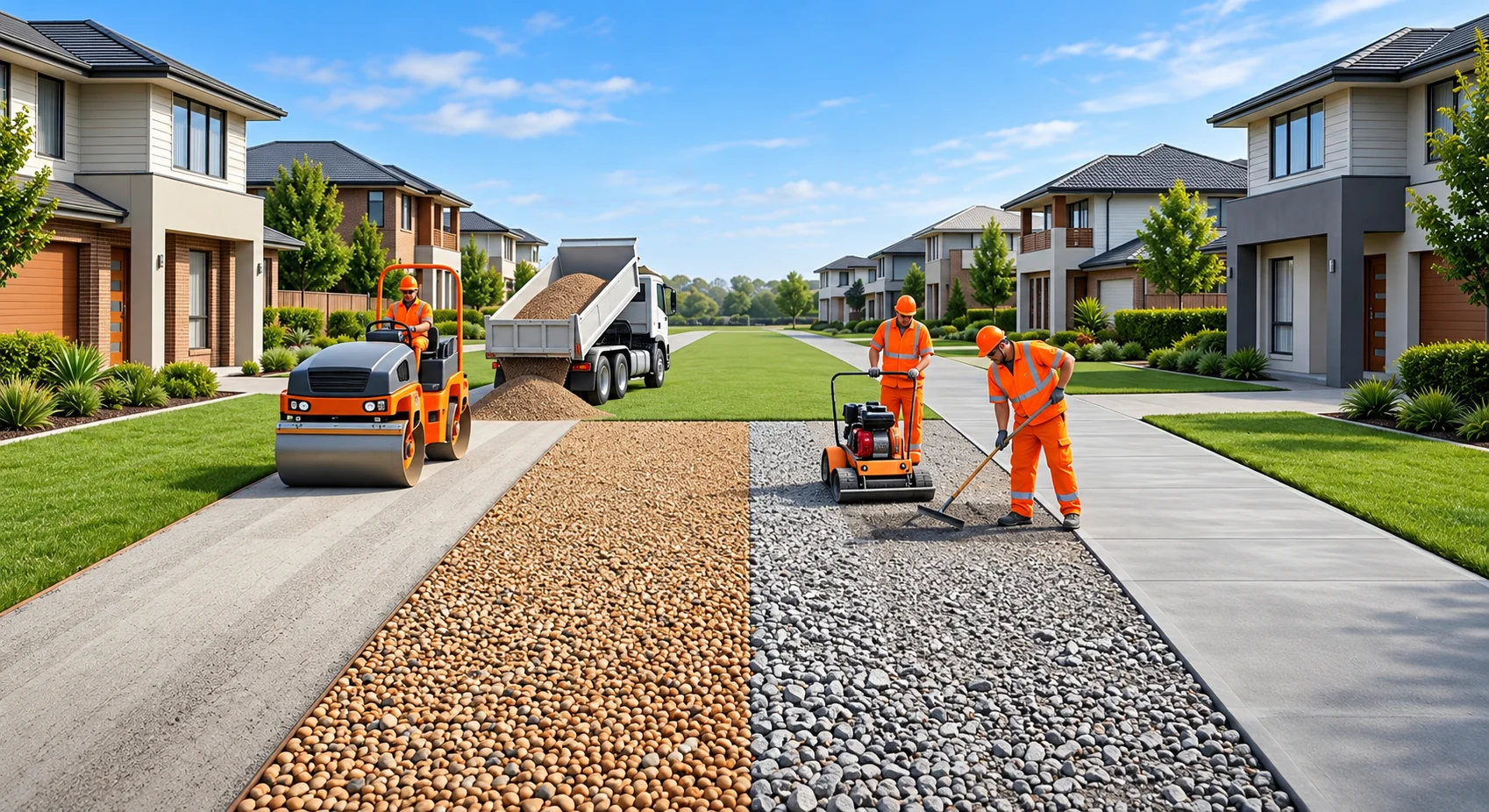
Gravel is the most affordable driveway material to install, but concrete usually costs least over time, since it lasts 30 to 40 years with almost no maintenance. Which of those answers is the right one for you depends mostly on how long you intend to stay and how long your driveway is. A gravel driveway is cheap on day one and keeps asking for money, needing topping up, regrading and weed control for as long as you own it. A concrete driveway costs more at the start and then largely stops costing anything. Over a decade the gap narrows considerably, and over thirty years concrete is frequently the cheaper option in total. Length changes everything too, because a 200 metre rural driveway and a 40 square metre suburban one are not the same problem.
Cheapest Upfront Is Not Cheapest Overall
This is the distinction that makes the question answerable, and skipping it is why so many people end up disappointed with a decision that looked sensible at the time.
A driveway is a long-lived asset, so the useful comparison is cost per year rather than cost on day one. Gravel wins the day-one comparison by a wide margin and loses the thirty-year one, because loads of gravel, machine hire for regrading and your own weekends spent raking are real costs even when they do not arrive as a single invoice. Concrete works the other way, front-loading almost the entire cost and then asking for very little. Asphalt sits between the two. If you are selling in three years, upfront cost is the number that matters and gravel is a reasonable answer. If this is the house you are staying in, run the numbers over the time you will actually be there.
Gravel and Crushed Rock
Gravel is the genuine budget answer and there is no point pretending otherwise. It is also the right answer more often than a concrete supplier might like to admit.
The material is inexpensive, it needs no specialist trade to lay, it drains freely, and it can be extended or repaired by tipping more on. For long rural driveways, paddock access and secondary entrances it is the only sensible option, since surfacing hundreds of metres in anything else is not a realistic budget. The costs come later and they never stop. Gravel migrates under tyres, so it thins in the wheel tracks and builds up at the edges and needs regrading. It needs topping up every year or two. It grows weeds unless you control them. It ruts in wet weather and dusts in dry, it tracks into the house on shoes and into gardens under tyres, and it is difficult to keep tidy at the point where it meets a road or a garage.
Recycled Crushed Concrete
Recycled crushed concrete deserves more attention than it gets, and it is often the cheapest usable surface available. Plenty of people have not heard of it as an option.
It is crushed and graded demolition concrete, sold as a road base or driveway material, and it is typically cheaper than virgin quarried gravel while performing at least as well underfoot. It compacts firmly, binds better than loose river gravel because of the fines content, and produces a more stable surface that ruts less. It is also the environmentally preferable choice, since it diverts material from landfill and avoids quarrying. The appearance is utilitarian rather than decorative, which rules it out for a front driveway on a house where kerb appeal matters, but for rural access, sheds, side driveways and long runs it is hard to beat on value.
Spray Seal and Asphalt
These two sit between gravel and concrete on both cost and durability, and they are worth understanding as distinct options rather than as one category.
Spray seal, also called chip seal or bitumen seal, sprays hot bitumen onto a prepared base and covers it with aggregate. It is considerably cheaper than asphalt, common on rural driveways, and gives a sealed dust-free surface for a modest outlay. It is thinner and less durable than asphalt, typically lasting 7 to 15 years, and edges break up over time. Asphalt is a proper hot-mix pavement, more durable and more expensive, generally giving 15 to 25 years. Both need resealing periodically, and both soften noticeably in Australian summer heat, which can leave marks where a trailer jockey wheel or a motorbike stand sits on a hot day.
Concrete
Concrete is not the cheapest driveway to install and it is usually the cheapest to own, which is the honest way to put it. The case is durability rather than price.
A properly specified and correctly poured concrete driveway lasts 30 to 40 years or more with essentially no maintenance beyond occasional cleaning, and a plain broom finish needs no sealing to survive. There is no topping up, no regrading, no resealing cycle if you go plain, and no weeds. It handles vehicle loads and turning far better than any flexible surface, and it does not soften in heat or rut in wet weather. Decorative options such as exposed aggregate cost more and add a resealing cycle, so if affordability is the priority, plain pre-mix concrete with a broom finish is the version to price. Our driveway MPa guide covers the specification and our concrete calculator will help you estimate volume for a quote.
Pavers
Pavers are rarely the affordable option, though they have one genuine cost advantage worth knowing about.
The material and the labour are both expensive, since every unit is placed by hand over a prepared and screeded bed, which makes pavers among the dearest ways to surface a driveway. What you get for it is the ability to lift and relay sections, so a trench for services or a settled area can be repaired invisibly in a way no poured surface allows. Joints need weed control and sand topping up, and paved driveways can settle unevenly if the base was not prepared well. If budget is the deciding factor, pavers are not the answer, though for a small feature area they can be worth the money.
Length Changes the Answer Completely
The right material for 40 square metres is often the wrong material for 400, and this is the factor most comparisons ignore entirely.
For a standard suburban driveway of roughly 30 to 60 square metres, concrete is genuinely competitive on whole-of-life cost and the upfront difference against gravel is manageable. For a long rural driveway running a few hundred metres from the road to the house, concrete is simply not a realistic proposition on cost, and gravel or recycled crushed concrete is the sensible answer regardless of how the per-year maths looks. A common and sensible compromise across Central Victoria is to concrete the section near the house, the turning area and the garage approach, where traffic concentrates and appearance matters, and to run gravel for the long stretch.
The Cost You Cannot Avoid
Whatever you surface with, a large share of the price is the same, and understanding this stops you overestimating what a cheaper material saves.
Every durable driveway needs the topsoil and organic material removed, the subgrade compacted, a crushed rock base laid and compacted in layers, and the whole thing graded to drain. That excavation and base work is common to gravel, asphalt and concrete alike, and it is a meaningful portion of the total on any properly built driveway. So choosing gravel over concrete does not halve your cost, it saves the difference between the surfacing materials only. It also means that skimping on the base to save money undermines whichever surface you choose, which is the most expensive false economy available on a driveway.