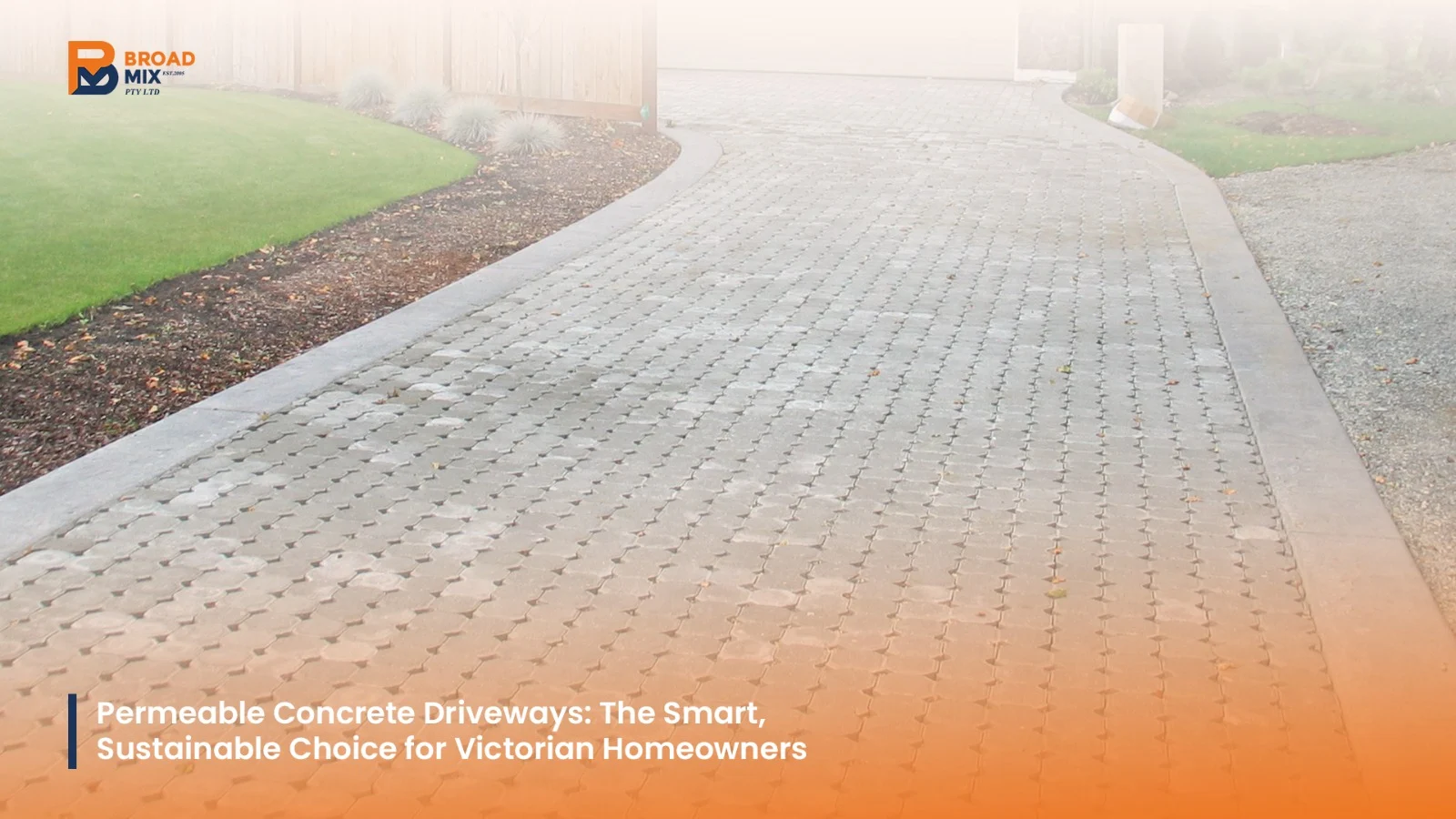
Every time it rains on a standard concrete driveway, that water has to go somewhere and where it usually goes is into stormwater drains, local waterways, and sometimes your neighbours’ properties. Permeable concrete takes a fundamentally different approach. Instead of shedding water, it absorbs it letting rain pass through the surface into the ground beneath. For Victorian homeowners, particularly in the fast-growing Central Victoria region, permeable concrete is an option worth understanding properly before your next driveway project.
What Is Permeable Concrete?
Permeable concrete also called pervious concrete or no-fines concrete is a specialised mix designed with a higher void content than standard concrete. Rather than the dense, low-void structure of conventional premix, permeable concrete has an open pore structure that allows water to pass through at a rate fast enough to manage most rainfall events.
The basic composition is Portland cement, coarse aggregate, and water without the fine sand that fills the voids in standard concrete. This creates a matrix of interconnected air pockets, typically comprising 15% to 25% of the total volume, through which water can drain freely.
How Permeable Differs From Standard Concrete
Standard concrete is designed to shed water from its surface via slope and drainage. Permeable concrete is designed to accept water through its surface and pass it into a prepared aggregate base, which then infiltrates into the soil or diverts to a controlled drainage point. The two products look similar on the surface both are concrete but their structure, installation requirements, and best-use applications are quite different.
Why Permeable Concrete Is Gaining Traction in Victoria
Victoria’s councils and development authorities are increasingly requiring developers and homeowners to manage stormwater at the source meaning on the property where it falls, rather than passing it into the stormwater system. Permeable concrete is one of the most practical ways to achieve this for residential driveways and paths.
Melbourne Water and many regional Victorian councils have stormwater management guidelines that award credits for permeable surfaces as part of development application requirements. Some councils in the growth corridor including parts of Mitchell Shire now factor permeable surfacing into approval assessments for new subdivisions.
Beyond compliance, there is a practical benefit: permeable concrete driveways do not flood in heavy rain the way sealed surfaces do. That puddle-free surface is not just more pleasant to walk on it reduces the slip hazard that standing water creates on conventional concrete.
Environmental and Amenity Benefits
By returning rainwater to the soil rather than the stormwater system, permeable concrete helps replenish groundwater, reduces the thermal and chemical load on local waterways, and lowers the volume of water that reaches drainage infrastructure during storm events. In a region experiencing population growth and increased impervious surface area, every permeable driveway in Wallan, Kilmore, or Broadford makes a small but genuine contribution.
Is Permeable Concrete Right for Your Driveway?
Permeable concrete is not the right choice for every site. Before committing, there are a few conditions worth evaluating.
Soil Infiltration Rate
Permeable concrete works best when the underlying soil has reasonable infiltration capacity the ability to absorb water. Soils with very high clay content, like some reactive clays found across parts of Mitchell Shire, may not infiltrate quickly enough to handle the drainage volume, requiring a modified installation with a detention layer beneath the concrete rather than direct soil infiltration. A soil assessment or engineer’s input can clarify this for your specific site.
Load Requirements
Permeable concrete has lower compressive strength than standard premix concrete of equivalent specification. For light residential use — standard passenger vehicles modern permeable mixes perform well. For heavy vehicles, frequent large truck access, or sites that will carry concentrated point loads, permeable concrete may not be the right specification. Discuss load requirements with us before ordering.
Slope
Permeable concrete driveways should ideally be installed on relatively flat sites. On steep slopes, much of the water will flow across the surface before it can infiltrate, reducing the effectiveness of the permeable design. A gradient of up to 5% is generally manageable; steeper slopes may require alternative drainage solutions.
Installing a Permeable Concrete Driveway in Central Victoria
The installation process for permeable concrete is similar to standard concrete in several respects but differs in the subbase preparation and the avoidance of finishing techniques that would close the surface pores.
Subbase Preparation
A permeable concrete driveway requires a well-prepared open-graded aggregate subbase typically 150mm to 300mm of clean, washed aggregate with minimal fines. This layer acts as a reservoir for water passing through the surface, providing temporary storage and allowing time for infiltration into the underlying soil. The subbase specification depends on your local infiltration rate and the expected rainfall intensity.
The Pour and Finishing
Permeable concrete is placed and compacted carefully not trowelled smooth as standard concrete would be. Surface finishing must preserve the open void structure. This is not a DIY-friendly concrete type for most homeowners; the installation is more nuanced than a standard driveway pour and benefits from a concreter with permeable concrete experience. The supply side, however, is straightforward Broadmix can supply permeable concrete to your site from our Broadford depot across Central Victoria.
For more information on our permeable concrete supply, visit broadmix.com.au/permeable-concrete/.
Maintaining a Permeable Concrete Driveway
The main maintenance requirement for permeable concrete is periodic cleaning to remove sediment that can clog the surface pores over time. Leaf litter, fine soil, and other organic material can gradually reduce the drainage capacity if not managed. Jet washing annually — and more frequently if your site has significant organic debris is the primary maintenance task. Unlike standard concrete, permeable concrete should not be sealed with a film-forming sealer, as this closes the pores and defeats the purpose of the product.
Studies have shown permeable concrete surfaces can maintain up to 90% of their original infiltration capacity for 10+ years with appropriate maintenance. Clogged surfaces can often be restored to full function with professional cleaning.
Frequently Asked Questions
Q: 1 Does permeable concrete cost more than standard concrete in Victoria?
Permeable concrete typically costs more per m³ than standard premix due to the specific mix design and the more involved subbase preparation required. Installed cost is higher than plain concrete but often comparable to exposed aggregate particularly when you factor in the stormwater management value and potential savings on drainage infrastructure for some sites. Contact Broadmix for current supply pricing.
Q: 2 Is permeable concrete approved by Mitchell Shire Council?
You should confirm the current requirements directly with Mitchell Shire Council for your specific development. In general, permeable surfaces are viewed positively by councils implementing water sensitive urban design (WSUD) principles. Some development applications may require documentation of the permeable surface’s infiltration performance. We can provide product specifications to support your application.
Q: 3 Can I use permeable concrete for a pathway as well as a driveway?
Yes. Permeable concrete is well-suited to pathways, pedestrian areas, car parks, and outdoor entertainment spaces, in addition to driveways. The key consideration is always the subbase design and the site’s drainage capacity. For lighter-use applications like pathways, permeable concrete performs very well and is an increasingly popular choice for sustainable residential design.
Q: 4 Does Broadmix deliver permeable concrete outside Broadford?
Yes. Broadmix supplies permeable concrete across our full delivery area, including Kilmore, Wallan, Seymour, Yea, Heathcote, and surrounding Central Victoria communities. Contact us to confirm delivery availability and lead times for your project location.
Talk to Us About Permeable Concrete for Your Project
Broadmix supplies permeable concrete to homeowners, builders, and landscape designers across Central Victoria. If you are considering a permeable driveway or path, we can provide the product specifications, discuss your site’s suitability, and arrange supply to suit your project timeline.
Reach us at broadmix.com.au/permeable-concrete/ or call our Broadford depot. We are happy to talk through your options.