
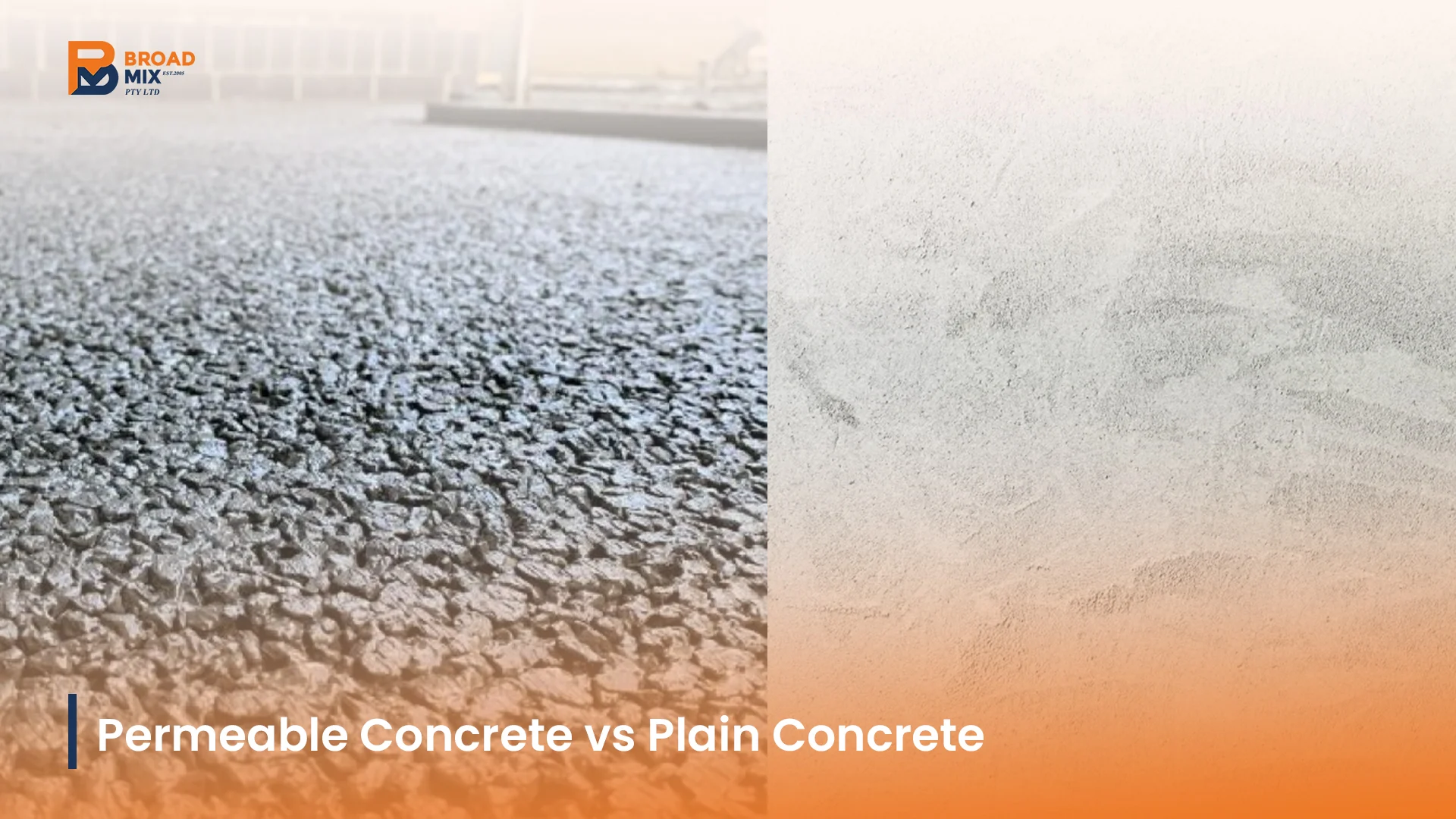
Permeable concrete lets water drain through the surface into the ground below. Plain concrete sheds water from its surface via slope and drainage channels. Both are legitimate driveway materials, but they suit different sites, budgets, and priorities. This guide gives you the straight comparison so you can make the right call for your Central Victoria property.
What Is Permeable Concrete?
Permeable concrete, also called pervious concrete or no-fines concrete, is a specially mixed concrete with a high void content (15 to 25% air voids) that allows water to pass through the surface at a meaningful rate. It achieves this by omitting the fine sand that fills the gaps in standard concrete, leaving an interconnected pore structure. The water drains through the surface into a prepared aggregate base underneath, then infiltrates into the soil or diverts to a drainage point.
What Is Plain Premix Concrete?
Plain premix concrete (also called ready mix) is a dense, low-void product designed for strength and surface durability. It sheds water from its surface via slope, which is why concrete driveways are always laid with a slight gradient toward a drain or kerb. It does not absorb water; it redirects it.
Head-to-Head Comparison
Water Management
Permeable concrete wins clearly here. It eliminates surface runoff during rain events, so water goes through the surface rather than pooling, flowing toward drains, or sheeting into neighbouring properties. Plain concrete can cause significant runoff on large driveway areas, which is increasingly an issue for council stormwater management requirements in growing areas like the Mitchell Shire.
Strength and Load Capacity
Plain concrete wins here. Standard 25MPa premix has higher compressive strength than permeable concrete of similar specification because its void structure necessarily reduces strength. For light to medium residential vehicles, modern permeable concrete performs well. For heavy or frequent large vehicle access, plain concrete is the safer structural choice.
Surface Appearance
Plain concrete gives a smoother, more uniform surface, either flat grey or in exposed aggregate finishes. Permeable concrete has an open, textured surface that looks somewhat rougher. It is not available in exposed aggregate finishes. For homeowners where kerb appeal and surface aesthetics are a priority, plain concrete (particularly exposed aggregate) offers more options.
Maintenance
Permeable concrete requires periodic pressure washing to clear sediment from the surface pores, as leaf litter, dust, and fine soil gradually reduce drainage capacity if not managed. Plain concrete needs regular cleaning but has no pore maintenance requirement. For most homeowners in Central Victoria, plain concrete is lower-maintenance overall.
Cost
Permeable concrete typically costs slightly more than plain premix in material cost per m3, and its installation requires specific subbase design that adds to the total project cost. The cost difference is partially offset in some situations by savings on drainage infrastructure, particularly on sites where council stormwater compliance is otherwise expensive to achieve. For a full breakdown of pricing, see our concrete cost per m3 guide for Victoria.
Permeable concrete installed cost in Victoria is typically 10 to 20% higher than equivalent plain concrete, depending on subbase specification and site conditions.
Which Should You Choose?
Choose permeable concrete if: your council or development application requires on-site stormwater management; you have a large driveway area where runoff is a practical problem; or sustainability is a genuine priority for your build.
Choose plain concrete if: you need maximum strength for heavy vehicles; aesthetics and surface finish options matter; your site drainage is already well-managed; or you want the lower-maintenance option. For most residential driveways in Broadford, Kilmore, Wallan, and Seymour, plain concrete remains the most practical and popular choice, with exposed aggregate as the most popular decorative option.
Frequently Asked Questions
Is permeable concrete approved by councils in Victoria?
Generally yes. Permeable surfaces are viewed positively under water sensitive urban design (WSUD) frameworks used by Victorian councils. Some development applications award credits for permeable driveways against stormwater management requirements. Confirm requirements with your local council. Broadmix can provide product specifications to support applications.
Does permeable concrete cost more?
Yes, slightly more per m3 in material cost, plus additional subbase specification. The total project cost is typically 10 to 20% higher than plain concrete. Whether that premium is worthwhile depends on your drainage situation and any council requirements.
Can I get exposed aggregate in permeable concrete?
No. Exposed aggregate is a finishing technique applied to dense concrete and it is not compatible with the open void structure of permeable concrete. If you want both drainage management and decorative surface, there are alternative paving solutions such as permeable pavers, but permeable concrete itself does not offer an exposed aggregate finish.
How long does permeable concrete last?
A well-installed permeable concrete driveway with proper subbase design and regular cleaning can last 20+ years. Maintenance, primarily annual jet washing, is important to preserve drainage performance. Unlike plain concrete, it should not be sealed with a film-forming sealer, as this closes the surface pores.
Talk to Broadmix About Your Driveway Options
Broadmix supplies both plain premix concrete and permeable concrete to residential and commercial customers across Central Victoria. Visit our permeable concrete for more on our permeable range, or contact us to discuss which product suits your specific site and project goals.