
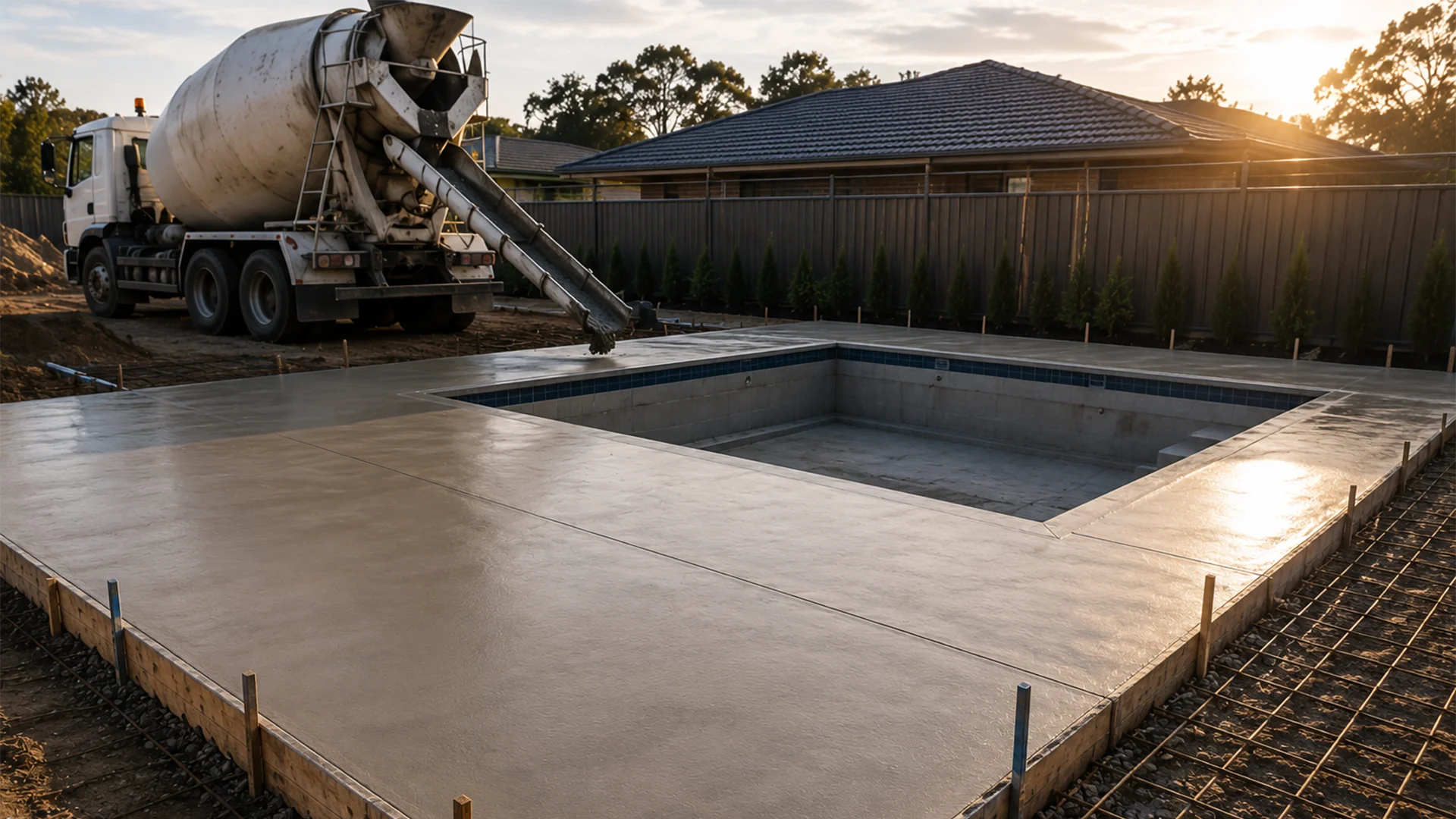
A concrete pool surround in Victoria costs roughly $100 to $230 per square metre installed, depending on the finish, with exposed aggregate, the most popular pool surround finish, sitting around $140 to $220 per square metre. If you are supplying the concrete yourself, the mix costs about $220 to $350 per cubic metre delivered, since pool surrounds use a stronger 32 MPa mix for salt and chlorine resistance. The table below breaks the installed cost down by finish.
| Pool surround finish | Installed cost per m² | Slip rating |
| Plain finish | $100 to $160 | Lower |
| Broom finish | $110 to $170 | P4 |
| Coloured concrete | $130 to $190 | Varies |
| Exposed aggregate (most common) | $140 to $220 | P5 |
| Stamped pattern | $150 to $230 | P3 to P5 |
Coping, the capping along the pool edge, is priced separately at about $150 to $300 per linear metre for cantilever or bullnose profiles.
How Much Does a Concrete Pool Surround Cost in Total?
For a typical 50 square metre surround, the concrete work usually lands between $5,500 and $11,000 installed, before coping. A broom finish sits at the lower end, around $5,500 to $7,800, while exposed aggregate runs closer to $8,100 to $11,100 because it takes more material and skilled labour to lay and wash back.
Add coping and the number climbs. Twenty-four linear metres of cantilever or bullnose coping adds roughly $3,600 to $7,200. So a finished exposed aggregate surround with coping on a mid-sized pool can total $12,000 to $18,000 installed. Every site is different, and the finish you choose is the single biggest lever on the price.
Concrete Supply Cost for a Pool Surround
If you or your concreter are pouring the surround and only need the concrete supplied and delivered, you are paying per cubic metre rather than per square metre. Pool surrounds are usually specified in 32 MPa concrete because the higher strength resists chloride from salt and chlorinated water better than a standard residential mix.
As a guide for Central Victoria, 32 MPa concrete is about $220 to $290 per cubic metre before delivery. If you want an exposed aggregate finish, that mix carries a premium of roughly $30 to $60 per cubic metre on top. Delivered from our Broadford plant, a typical pool surround pour works out to about $250 to $350 per cubic metre once the mix and delivery are combined.
How Much Concrete Does a Pool Surround Need?
To estimate the concrete, work out the surround area and multiply by the thickness. Most pool surrounds are a band of paving around the pool, commonly 1 metre to 1.5 metres wide, poured at 100 millimetres thick.
A 1.2 metre wide surround around an 8 metre by 4 metre pool covers about 30 square metres, which at 100 millimetres is roughly 3 cubic metres of concrete. A larger entertaining deck of 50 square metres needs about 5 cubic metres. Add around 10 percent for wastage and uneven ground, so a 3 cubic metre job is best ordered as about 3.3 cubic metres.
Why Exposed Aggregate Is the Top Choice for Pool Surrounds
Exposed aggregate is the most popular pool surround finish for one main reason, which is grip. The washed surface exposes the stone in the mix, creating a textured, non-slip surface that rates P5, the highest common slip rating, even when wet. Around a pool, where bare feet meet splashed water, that safety margin matters more than anywhere else in the yard.
It also handles pool conditions well. The stone surface hides the marks and wear that show on plain concrete, it stays cooler underfoot than dark finishes when you choose lighter aggregate, and it resists the salt and chlorine that pool water carries. A broom finish is a cheaper alternative at a P4 rating and still safe, while smooth trowelled or polished finishes are best avoided around water because they can become slippery.
What Affects the Cost of a Concrete Pool Surround?
Several factors decide where your surround lands in the range:
- Finish type: this is the biggest driver, from plain broom at the low end to exposed aggregate and stamped patterns at the top.
- Concrete strength: the 32 MPa mix specified for chloride resistance costs more per cubic metre than a standard slab mix.
- Coping: the pool edge capping is a separate cost of $150 to $300 per linear metre and adds up quickly on a large pool.
- Drainage and falls: surrounds must fall away from the pool, and cutting in strip drains adds labour and materials.
- Site access: pools are often in backyards with tight access, which can mean a line pump to reach the pour and higher labour costs.
- Sealing: a sealer to protect against salt and staining is sometimes quoted separately.
- Size and shape: curved or freeform pools take more cutting and finishing than a simple rectangle.
Drainage and Falls Around a Pool
A concrete pool surround has to move water away from the pool, not toward it. The standard is a fall of about 1 in 50, which is 2 percent, sloping away from the coping. Strip drains are commonly set 100 to 200 millimetres back from the pool edge to catch splash and runoff before it pools on the surface.
Where drainage is a challenge, or where you want to reduce runoff into garden beds, permeable concrete is an option worth considering. It lets water drain through the surface rather than running off, which can simplify stormwater compliance and keep the surround drier underfoot. It suits the outer areas of a surround better than the immediate pool edge, so many jobs combine a standard finish near the coping with permeable sections further out.
Sealing a Concrete Pool Surround
Sealing is what protects the surface from the salt, chlorine, and staining that come with pool use. A quality sealer soaks into or coats the concrete, reducing water absorption, slowing efflorescence, and making the surface easier to clean.
For pool surrounds, a penetrating sealer is usually preferred because it protects without adding a glossy film that could reduce grip. Most surrounds benefit from resealing every few years, and exposed aggregate in particular holds its colour and finish far longer when it is sealed and maintained.
Frequently Asked Questions
Is concrete slippery around a pool?
Smooth, trowelled, or polished concrete can be slippery when wet, so it is not ideal around a pool. Textured finishes like exposed aggregate (rated P5) and broom finish (rated P4) provide grip even when wet and are the safe choices for a pool surround.
What is the best concrete finish for a pool surround?
Exposed aggregate is the most popular and safest choice because it is naturally slip-resistant, resists salt and chlorine, and hides wear. A broom finish is a lower-cost alternative that is still safe underfoot.
What strength concrete should a pool surround be?
Pool surrounds are usually poured in 32 MPa concrete. The higher strength resists the chloride from salt and chlorinated water better than a standard 25 MPa residential mix.