
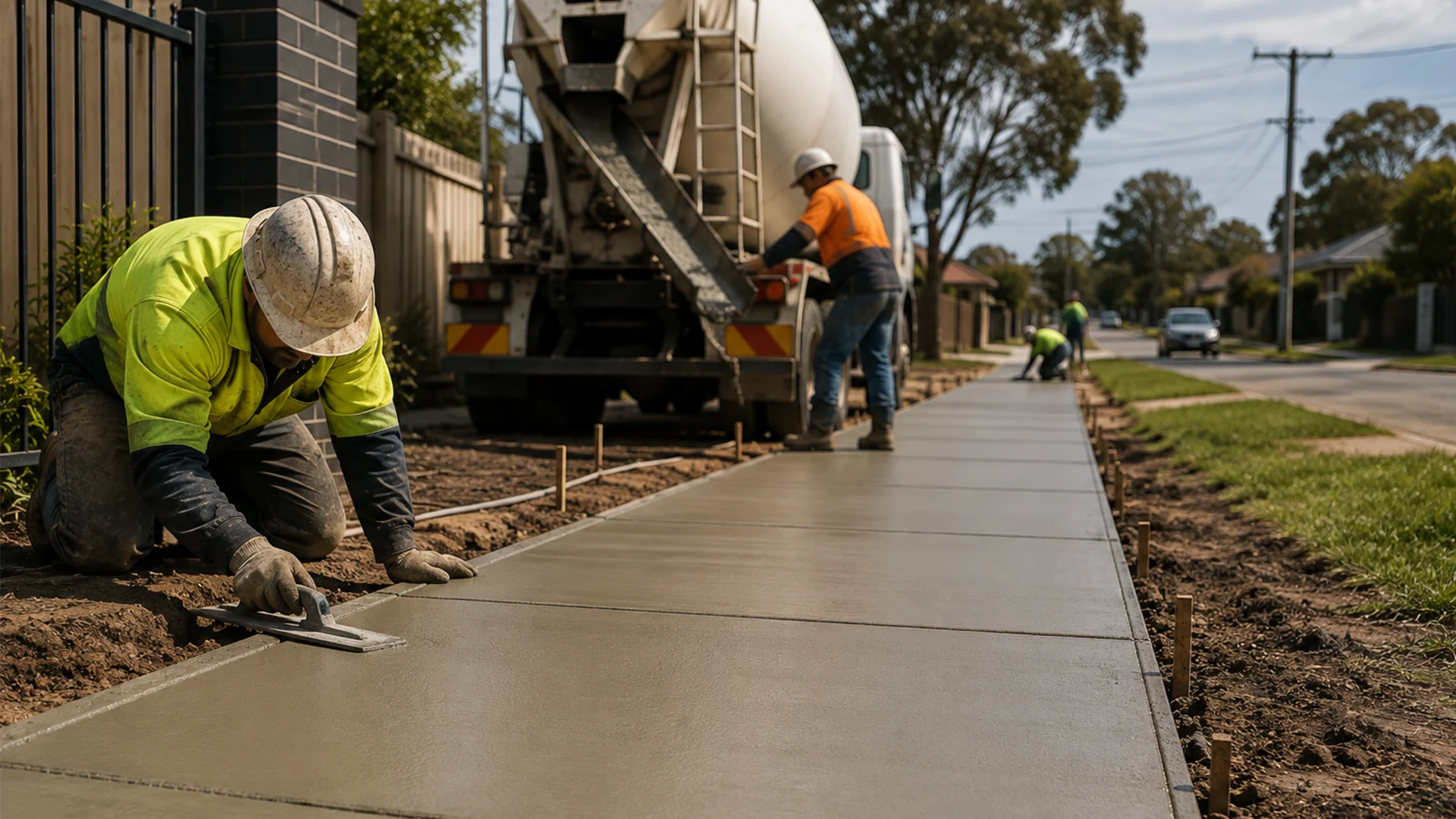
For a standard concrete footpath, budget around $90 to $160 per square metre installed, which works out to roughly $90 to $200 per linear metre once you account for width and finish. The catch with footpaths is that they are small jobs, so most residential paths carry a minimum project cost of about $1,200 to $2,000 no matter how short they are. In practice, that means a typical residential path lands somewhere between $1,300 and $3,500 installed, depending on its length, width, and the finish you choose.
The table below gives a realistic budget for common footpath jobs in Victoria, based on a broom finish.
| Footpath job | Approximate area | Budget installed |
| Small side path (0.9m wide) | around 12 m² | $1,300 to $1,900 |
| Front entry path (1.2m wide) | around 30 m² | $2,650 to $3,450 |
| Longer or wider path | 40 m² and up | $3,500 and up |
Choosing exposed aggregate or a decorative finish instead of broom will lift these figures. The sections below break down the cost per metre, why short paths cost more, and what to do if you want to supply the concrete yourself.
How Much Does a Concrete Footpath Cost Per Metre?
Footpaths are usually priced per square metre, and the finish is the main driver. Here are typical installed rates in Victoria.
| Finish | Installed cost per m² |
| Plain finish | $80 to $120 |
| Broom finish | $85 to $125 |
| Coloured concrete | $95 to $140 |
| Exposed aggregate | $110 to $160 |
| Stamped pattern | $110 to $170 |
To turn that into a per linear metre budget, multiply the rate by the width of your path. A 1.2 metre wide broom-finish path at $100 per square metre costs about $120 per linear metre. A narrow 0.9 metre side path at the same rate is closer to $90 per linear metre, while a wide 1.8 metre entry path pushes past $180 per linear metre.
Why Short Footpaths Cost More Per Metre
This is the part that surprises most people budgeting for a path. A short footpath costs more per square metre than a long one, because the fixed costs of the job are spread over a smaller area.
Every path job carries the same basic overheads whether it is 6 metres or 26 metres long. The concreter still has to travel to site, set up, order a concrete delivery, prepare the base, build the formwork, and finish the surface. Those costs do not shrink much on a small path, so a tiny job can attract a minimum charge of $1,200 to $2,000 even when the per-square-metre maths suggests less. If you are planning several small concrete jobs, pouring them together spreads those fixed costs and lowers the price of each.
How Thick Should a Footpath Be?
A concrete footpath does not carry vehicles, so it does not need to be as thick as a driveway. Most residential paths are poured at 75 to 100 millimetres thick with light steel mesh reinforcement, usually SL62 or SL72. That is enough for foot traffic, wheelbarrows, and mowers.
Go to 100 millimetres where the path might occasionally take heavier loads, such as a path a small trailer or ride-on mower crosses. Council footpaths on the nature strip are held to a higher standard, commonly 100 millimetres thick with heavier mesh and a stronger 32 MPa mix.
Supplying the Concrete Yourself
If you are building the path yourself, or arranging your own labour, you only need the concrete supplied and delivered, priced per cubic metre rather than per square metre. A footpath is a small pour, so it usually falls into part-load territory.
As a guide, a standard 20 to 25 MPa path mix is about $180 to $250 per cubic metre before delivery in Central Victoria. A 15 metre path, 1.2 metres wide at 90 millimetres, needs roughly 1.6 to 1.8 cubic metres of concrete once you allow for wastage. Delivered from our Broadford plant, and including a part-load fee for the small volume, the concrete for that path works out to around $450 to $750. That covers the concrete only, not the mesh, formwork, or labour to lay and finish it.
What Affects Your Footpath Budget
Beyond length and finish, several things move the number:
- Width: a wider path uses more concrete and labour for every metre of length.
- Thickness and reinforcement: 100 millimetres with heavier mesh costs more than a light 75 millimetre path.
- Base preparation: removing turf, levelling, and adding a compacted base all add time, especially on uneven ground.
- Removing an old path: breaking out and disposing of existing concrete is an extra cost.
- Access: tight backyard access or a path that a truck cannot reach may need concrete barrowed or pumped.
- Slope and steps: sloping sites and step transitions cost more per metre than a flat run.
Finish Options and What They Add
A plain or broom finish is the most affordable and the most common choice for a functional path. Broom finish adds a light texture that improves grip in wet weather and costs only a little more than plain.
Exposed aggregate is the popular upgrade for a front or garden path where looks matter. It gives a decorative stone surface with good grip, and it hides marks and wear better than plain concrete. Expect it to add roughly $25 to $40 per square metre over a broom finish. Coloured and stamped finishes sit in a similar range and suit paths you want to match to a home or landscaping scheme.
Private Path or Council Footpath?
It is worth being clear about which footpath you mean, because the rules differ. A private path on your own property, such as a side or garden path, is straightforward and rarely needs approval.
A footpath on the council nature strip, or a crossing over it, is a different matter. Councils set the width, thickness, mix strength, and finish for work in the road reserve, and you usually need approval before you build. If your project touches the nature strip, check your local council requirements first, since work that does not meet the standard may have to be removed and redone.
Frequently Asked Questions
How thick should a concrete path be?
Most residential footpaths are 75 to 100 millimetres thick with light steel mesh. Foot traffic only can sit at 75 millimetres, while 100 millimetres suits paths that take heavier loads or the occasional small vehicle.
How much should I budget for a 15 metre path?
For a standard 1.2 metre wide path in broom finish, budget roughly $1,800 to $2,800 installed for 15 metres. Exposed aggregate or a decorative finish will push it higher, and a minimum job charge may apply on shorter runs.
Is a concrete path cheaper than pavers?
Poured concrete is usually cheaper to install than quality pavers over the same area, and it has fewer joints for weeds and movement. Pavers can be easier to lift and repair, but concrete generally wins on upfront cost and low maintenance.