
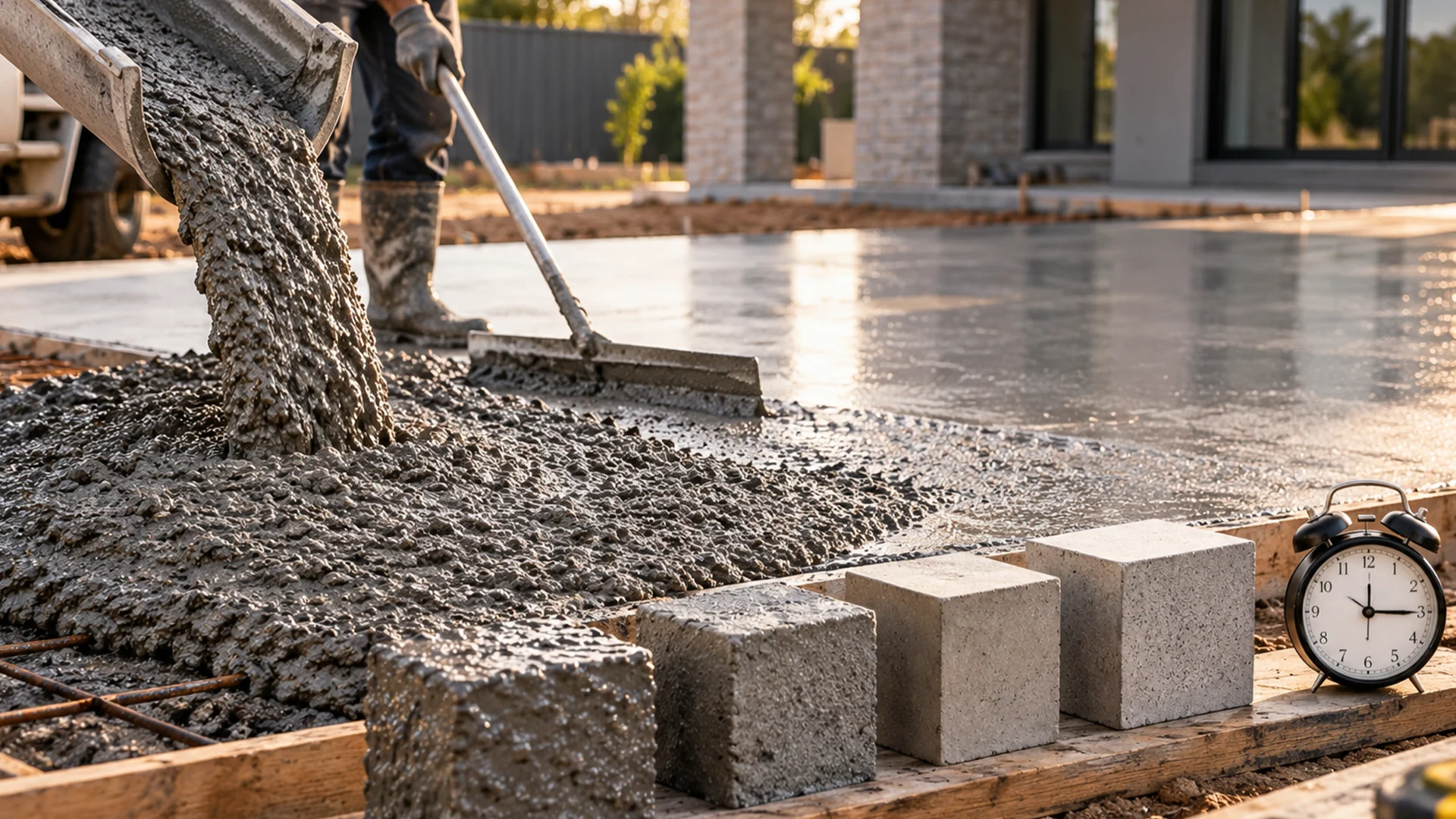
Premix concrete starts to set within about 1 to 2 hours of being poured, which is when it stiffens and the finishing window closes. It becomes firm enough to walk on after 24 to 48 hours, reaches around 70 percent of its strength at 7 days, and reaches full design strength at 28 days. So while the surface feels hard within a day, the concrete keeps gaining strength underneath for a full month. The table below sets out the stages.
| Stage | Time after pouring | What is happening |
| Initial set | 1 to 2 hours | Concrete stiffens, finishing must be done |
| Final set | 4 to 8 hours | Surface is hard, you cannot indent it |
| Safe to walk on | 24 to 48 hours | Holds foot traffic, formwork can usually come off |
| Light loading | 7 days | About 70 percent strength, light vehicles |
| Full strength | 28 days | Around 100 percent, ready for heavy loads |
These times assume a standard residential mix in mild weather of about 20 degrees. Hot or cold conditions, the mix strength, and how the slab is cured can all move them, as covered further down.
Setting Versus Curing: What Is the Difference?
The most common mix-up with concrete timing is treating setting and curing as the same thing. They are not.
Setting is the concrete going from a liquid to a solid. It happens in hours. Once premix has set, it holds its shape and feels hard to the touch.
Curing is the slower chemical reaction that gives concrete its strength, and it runs for weeks. The cement keeps reacting with water long after the surface is hard, which is why a slab is not at full strength until around 28 days even though it looks and feels done after a day. Keeping the concrete moist during this period is what lets it reach its designed strength, so curing is something you manage, not just wait out.
When Can You Walk On, Drive On, and Build On It?
The practical milestones most people care about are these:
- Walking on it: wait 24 to 48 hours. After a day the surface will usually take careful foot traffic, though longer is safer in cool weather.
- Removing formwork: edge forms can generally come off after 24 to 48 hours. Structural formwork should stay longer and follow the engineer’s advice.
- Driving a car on it: wait at least 7 days. By then the slab has reached roughly 70 percent of its strength, enough for a normal vehicle.
- Heavy vehicles and full loads: wait the full 28 days. Trucks, machinery, and heavy storage should stay off until the concrete has reached design strength.
When in doubt, waiting longer costs nothing and protects the slab. Loading concrete too early is a common cause of early cracking.
What Affects How Fast Premix Concrete Sets?
Several things speed up or slow down the set:
- Temperature: this is the biggest factor. Heat speeds the reaction and shortens the finishing window, while cold slows everything down.
- Concrete strength: higher strength mixes with more cement tend to set and gain early strength faster than lower grades.
- Water content and slump: a wetter, higher-slump mix takes a little longer to set and dry than a stiffer mix.
- Additives: accelerators are used to speed setting in cold weather, and retarders slow it down in hot weather or for long pours.
- Slab thickness: thicker sections hold heat from the curing reaction and can set faster in the core, while thin sections lose moisture quickly.
- Wind and humidity: dry, windy days pull moisture from the surface fast, which affects finishing and can cause surface cracking if the slab is not protected.
Setting Concrete in Hot and Cold Weather
Central Victoria gives concrete both extremes across the year, and each needs a different approach.
In hot northern summers around Seymour, Kilmore, and the Goulburn Valley, concrete sets faster and the finishing window shrinks. Fast drying at the surface can cause plastic shrinkage cracking before the slab has set. On hot days it helps to pour earlier in the day, to keep the concrete covered and moist after finishing, and in some cases to use a retarder to extend the working time.
Cold and frost are the bigger risk through the Central Highlands, the Macedon Ranges, and around Ballarat, where winter nights regularly drop below zero. Concrete that freezes within the first 24 hours can suffer permanent strength loss that cannot be fixed short of replacing the slab. Winter pours in these areas should avoid forecast frost, and the fresh slab should be protected with insulating blankets if a cold snap is expected. Cold weather also slows the set, so finishing and formwork removal take longer than the standard times.
How to Cure Premix Concrete Properly
Curing is simply keeping the concrete moist while it gains strength, and it makes a real difference to how hard-wearing the finished slab is. The first 7 days matter most, since that is when the concrete does most of its strengthening.
Common curing methods include spraying on a curing compound that seals moisture in, covering the slab with wet hessian or plastic sheeting, or lightly ponding water on flat slabs. Any of these keeps the surface from drying out too quickly. Avoid heavy loads during this week, keep the surface damp rather than letting it dry and rewet repeatedly, and resist the urge to test the slab early. A slab that is cured well in its first week will outlast and outperform one that is left to dry out on its own.
Frequently Asked Questions
How long before you can walk on premix concrete?
Most premix concrete is firm enough to walk on carefully after 24 to 48 hours. In cold weather it can take longer, so give it the full 48 hours if you can.
Does concrete set faster in hot weather?
Yes. Heat speeds up the chemical reaction, so concrete sets faster and the finishing window is shorter on hot days. That is why hot-weather pours are often done early in the morning and kept covered and moist.
Can premix concrete set in the rain or cold?
Light rain after the concrete has set is not usually a problem, but heavy rain on a fresh surface can damage the finish. Cold slows setting, and frost in the first 24 hours can permanently weaken the slab, so fresh concrete should be protected from freezing.
Is concrete fully cured once it looks dry?
No. A dry-looking surface only means the top has firmed up. The concrete keeps gaining strength underneath for about 28 days, so looking dry is not the same as being fully cured or ready for heavy loads.