
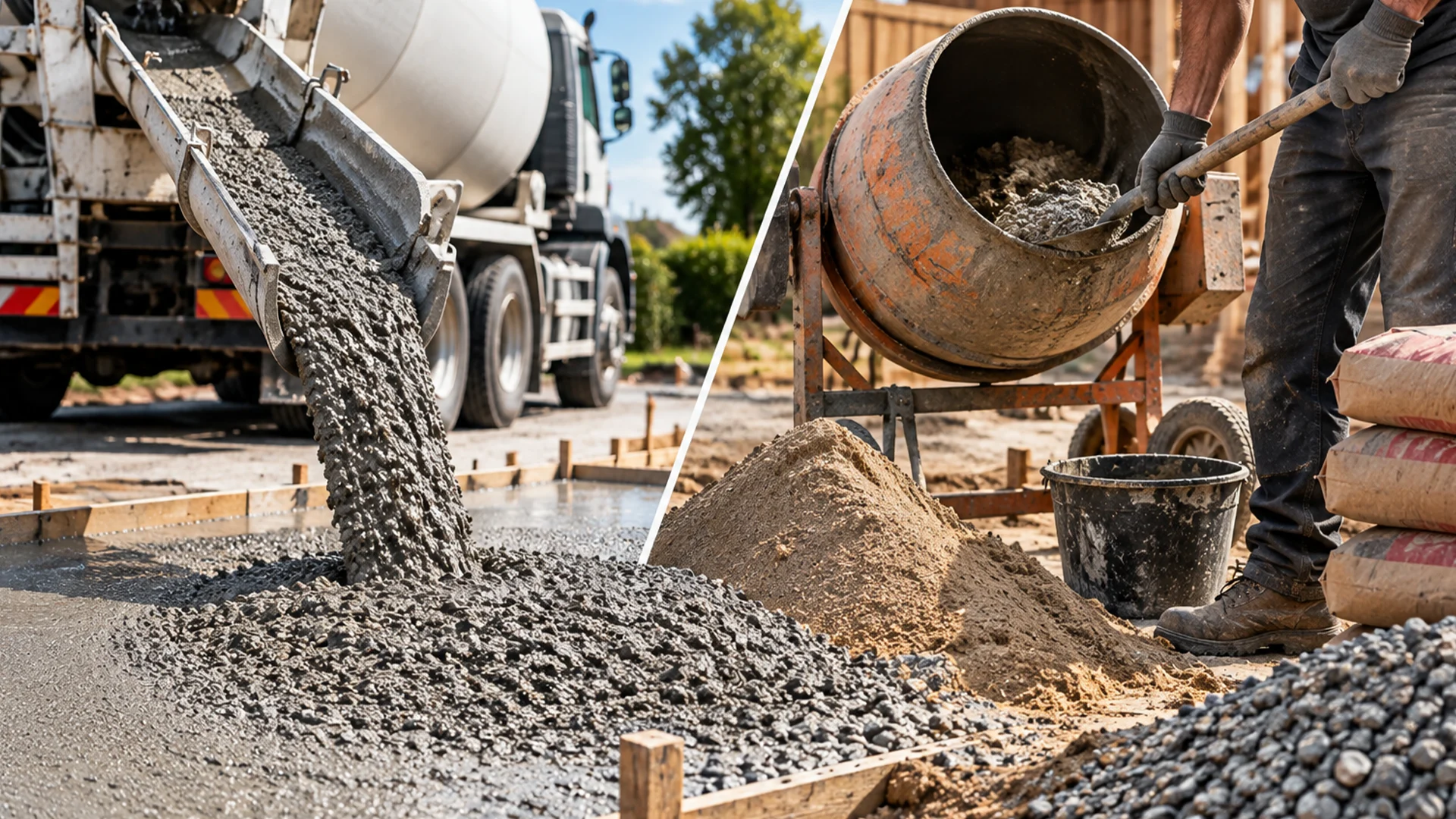
For any job larger than about half a cubic metre, yes, it is cheaper to buy ready mix concrete than to mix your own from bags, once you count the materials, the mixer hire, and your own time. Bagged concrete only wins on very small jobs, like setting a few fence posts. The reason is simple. It takes around 108 twenty-kilogram bags to make a single cubic metre, so the materials alone for bagged concrete cost far more per cubic metre than a load delivered by truck. The crossover point, where ready mix becomes the cheaper option, sits at roughly 0.5 to 1 cubic metre. The table below shows how the three main options compare.
| Option | Effective cost per m³ | Labour | Best for |
| Ready mix delivered | $250 to $350 (small loads) | Minimal, poured for you | Anything above about 0.5 m³ |
| Bagged concrete (20kg) | $860 to $1,300 in bags alone | Very high, mix each bag | Tiny jobs under 0.3 m³ |
| Mix from raw materials | $150 to $250 in materials | Extreme, plus quality risk | Rarely worth it |
Ready Mix Versus Bagged Concrete: The Real Cost Per m³
The comparison most people never do is the cost per cubic metre, and it is where bagged concrete falls apart on anything but the smallest job.
A standard 20kg bag of premix makes only about 0.009 to 0.010 cubic metres of concrete, which is roughly 9 to 10 litres. That means you need about 108 bags to make one cubic metre. At $8 to $12 a bag, the bags alone cost you $860 to $1,300 for that cubic metre, before you have hired a mixer or lifted a single bag.
Ready mix delivered is a fraction of that. As a guide in Central Victoria, a standard 25 MPa mix is around $200 to $250 per cubic metre before delivery, and even a small delivered load with a part-load fee usually works out to about $250 to $350 per cubic metre. So on a per-cubic-metre basis, bagged concrete costs roughly three to four times as much as ready mix. Our honest guide to concrete cost per m³ breaks the delivered prices down by grade.
The Crossover Point: When Bags Are Actually Cheaper
Bags are not always the wrong answer. For a very small job, ready mix carries fixed costs that make a tiny delivery expensive per cubic metre. A concrete truck has a minimum charge and a part-load fee for anything under a full load, so ordering 0.3 of a cubic metre delivered can cost more than the concrete is worth.
For jobs under about 0.3 cubic metres, which is a few post holes, a small mower ramp, or a single step, bags usually win. You buy only what you need, there is no delivery or part-load fee, and the small volume is manageable to mix by hand. Around 0.5 to 1 cubic metre is the crossover zone, where the two options land close together and other factors like your time and access decide it. Above one cubic metre, ready mix is clearly cheaper and easier every time.
When Ready Mix Is the Cheaper Choice
Once your job needs a cubic metre or more, ready mix wins on cost, and the gap widens fast as the job grows. A standard single garage slab, a small driveway, a shed slab, or a decent path all sit well above the crossover point.
Take a small concrete driveway that needs about 4 cubic metres. Done with bags, that is around 432 bags. The bags alone run to roughly $3,500 to $5,200, plus mixer hire, plus days of heavy mixing, so the true cost climbs past $5,000 once your time is counted. The same 4 cubic metres delivered as ready mix costs in the order of $1,000 to $1,500 all up, poured in a couple of hours. That is a saving of around $3,000, and you avoid days of back-breaking work. If you are pricing a job like this yourself, our concrete calculator will tell you how many cubic metres you actually need.
What the Ready Mix Price Includes, and the Hidden Costs of DIY
Part of why ready mix looks cheaper once you run the numbers is that its price already covers things DIY does not.
A ready mix price includes the cement, sand, aggregate, and water, batched to a set strength and delivered mixed and ready to pour. Mixing your own means paying for each of those pieces separately and adding costs that are easy to forget:
- Mixer hire, which runs around $120 a day, or the far slower option of hand mixing in a wheelbarrow.
- Your own time, which for a multi-cubic-metre job is measured in days, not hours.
- Wastage from spilled bags, part-used bags, and mixing errors.
- Fuel and trailer trips to cart heavy bags home, often more than one load.
Add those in and the bagged option costs more in money as well as effort on any real slab.
Mixing From Raw Materials: Cheaper Per m³, Rarely Worth It
Buying cement, sand, and aggregate separately and batching your own is the cheapest option on paper, at maybe $150 to $250 per cubic metre in raw materials. In practice it is rarely worth it for a homeowner.
Getting the proportions right by hand is difficult, and a mix that is too wet or too dry, or short on cement, will be weak and prone to cracking. You still need a mixer, storage for the materials, and a lot of time. For a structural slab that has to last decades, the small material saving is not worth the risk of a poor result. It only makes sense for the smallest, least critical jobs where a bag of premix would do the same thing with less fuss.
Quality Is Part of the Price
Cost is not the only reason ready mix wins on a real job. A ready mix supplier batches to Australian Standard AS 1379, so every cubic metre is the same engineered mix at the strength you ordered. That consistency is hard to match by hand.
Choosing the right strength matters too. A driveway or slab needs the correct MPa for the load it will carry, and our guide to choosing the right concrete explains how to match the mix to the job. Just as important, a delivered load lets you pour the whole slab in one go. Mixing bag after bag means the first batch starts to set before the last is poured, creating cold joints and weak seams that a single continuous pour avoids completely.
How to Work Out Which Is Cheaper for Your Job
The quick way to decide is to work out your volume first, then compare.
Measure the length, width, and depth of your pour in metres and multiply them together to get the cubic metres, or use a concrete calculator to do it for you. Once you know the volume, the rule of thumb is straightforward. Under about 0.3 cubic metres, price up bags. Between 0.3 and 1 cubic metre, compare both, and let access and your time break the tie. Above 1 cubic metre, ready mix will almost always be cheaper and far less work, so get a delivered price.
Because Broadmix batches locally and delivers across Central Victoria, ordering from a local supplier keeps delivery distances and costs down, which helps ready mix stay the cheaper choice even on smaller pours. Owner-builders can find more on ordering supply-only concrete in our owner-builder guide.
Frequently Asked Questions
How many bags of concrete are in a cubic metre?
About 108 twenty-kilogram bags make one cubic metre, since each bag yields only around 0.009 to 0.010 cubic metres. At $8 to $12 a bag, that is $860 to $1,300 in bags alone, which is why ready mix is far cheaper per cubic metre.
Is ready mix cheaper than bags for a slab?
Yes. For any slab above about half a cubic metre, ready mix is cheaper once you add up bags, mixer hire, and labour. On a 4 cubic metre driveway, ready mix can save around $3,000 compared with bagging it yourself.
What is the minimum ready mix delivery?
Suppliers can deliver small loads, but anything under a full truck usually carries a part-load fee, and very small orders have a minimum charge. That is why bags can be cheaper for jobs under about 0.3 cubic metres.
Is it cheaper to mix concrete yourself?
Only for very small jobs. Mixing from bags or raw materials can work out cheaper under about 0.3 cubic metres, but above that the materials, equipment hire, time, and quality risk make delivered ready mix the cheaper and better option.