
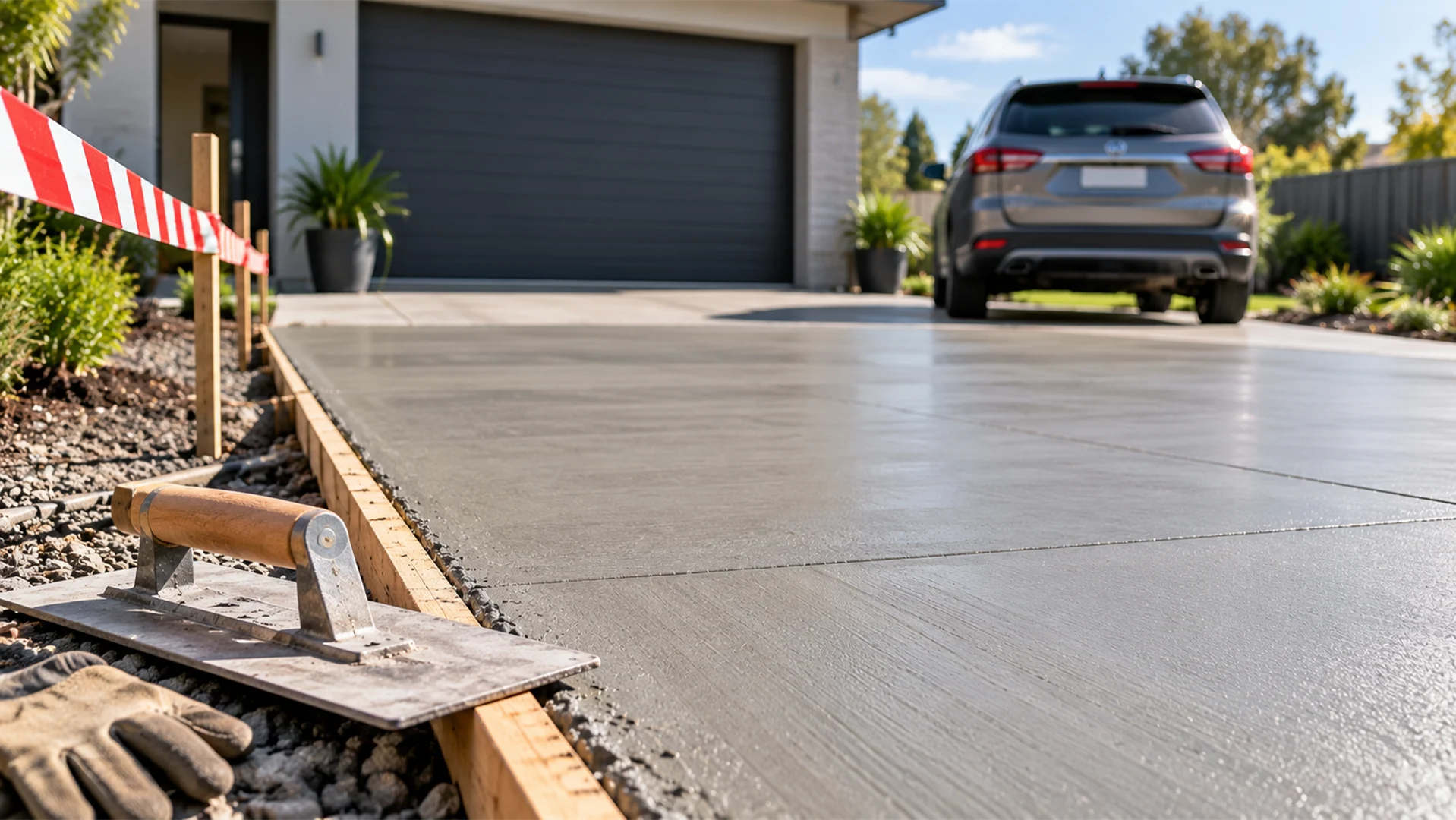
You can drive a car on new concrete after seven days, but heavy vehicles, trailers and skip bins should wait the full 28 days for the concrete to reach design strength. Seven days is the point where concrete has gained roughly two thirds of its final strength, which is enough for a normal passenger vehicle used gently. It is not enough for a loaded ute, a caravan or a removalist truck. The distinction that matters most is not total weight but how the weight is applied, because a trailer jockey wheel or a skip bin corner concentrates load onto a few square centimetres and that is what cracks slabs. Cold weather stretches every figure here, and damage done in the first month often does not become visible until much later.
| Time after pour | Approximate strength gained | What it will take |
|---|---|---|
| 24 to 48 hours | Around 15 to 20 percent | Careful foot traffic only |
| 3 days | Around 40 percent | Normal walking |
| 7 days | Around 65 to 70 percent | One car, driven gently |
| 14 days | Around 90 percent | Regular car use |
| 28 days | Around 99 percent | Heavy vehicles, trailers, deliveries |
Percentages are typical for a standard mix in mild conditions and will vary with cement type, mix design and temperature.
Why Seven Days for a Car
Seven days is the accepted minimum across the industry, and it is worth understanding what it actually buys you rather than treating it as an arbitrary wait. It is a strength threshold, not a calendar convention.
By day seven a standard mix has typically reached around two thirds of the strength it will eventually have, which gives enough margin to carry a normal car without cracking. Drive on it gently at that stage. Come in straight rather than swinging in at an angle, keep to the middle of the slab rather than running a wheel near the edge, and do not park in the same spot for days on end while it is still young. If you can wait longer, wait. There is nothing to lose by leaving a new driveway alone for two weeks and quite a lot to lose by using it on day four.
Why 28 Days for Anything Heavier
Twenty eight days is when concrete reaches its design strength, and for anything beyond a passenger car it is a hard line rather than a recommendation. This is the rule most often broken on residential sites.
Concrete is specified by its 28 day compressive strength, so a 25 MPa mix is 25 MPa at 28 days and something considerably less before that. Until it gets there, the slab has less capacity than the engineer or the supplier assumed. Removalist trucks, soil and sand deliveries, skip bin drops, concrete trucks servicing a later stage of the build, tradesman utes carrying loads, caravans, boats and horse floats all belong on the other side of that 28 day line. If a delivery is unavoidable, have it stop on the street rather than the new slab. Our driveway MPa guide explains what the strength grade means and why the 28 day figure is the reference point.
Concrete Gains Strength on a Curve, Not a Line
Understanding the shape of the strength curve explains why the early days matter so much more than the later ones. Progress is front-loaded but the early figures are low.
Concrete gains strength quickly at first and then slows, so a slab picks up a large share of its capacity in the first week and creeps toward the rest over the following three. That is why day two and day seven are worlds apart while day 21 and day 28 are fairly similar. It also explains why driving on a slab at four days is genuinely risky rather than mildly early, since the concrete may only have around half the strength it will have three days later. The curve keeps rising slowly for months and years afterwards, but 28 days is the practical milestone everything is specified against.
Point Loads Do More Damage Than Total Weight
This is the most useful thing on the page and the reason plenty of new driveways crack despite nobody driving anything heavy on them. It is about contact area, not tonnage.
A car spreads its weight across four tyres with a decent contact patch each, so the pressure on any one point is modest. A trailer jockey wheel, a caravan stabiliser leg, a car jack, an axle stand or the corner of a skip bin puts a similar or greater load through an area the size of a coaster. That concentrated pressure punches into concrete that would carry a car comfortably. The same applies to scaffolding feet, a trailer with a single small castor, and heavy items dragged rather than lifted. If something has to sit on a young slab, spread the load with a thick timber sheet or steel plate underneath. Keep skip bins off a new driveway entirely, whatever the age.
Cold Weather Changes the Timeline
Curing is a chemical reaction and reactions slow down when they get cold, which means a winter pour in Central Victoria needs meaningfully longer than the same slab in summer. The calendar does not tell the whole story.
Below about ten degrees the reaction slows noticeably, and closer to five degrees it slows further again, so a slab poured in July may be days behind where a February slab would be at the same point. Add several days to every milestone for a cold weather pour, and more if there have been consecutive cold nights. Damp overcast conditions are less of a problem than cold ones, since moisture actually helps curing while cold retards it. If you poured in the middle of winter and are counting to seven days, count to ten instead. Our guide on how long concrete takes to dry and cure covers the full timeline from pour to sealing.
Habits That Damage a New Driveway
A few common driving habits cause more surface damage than the timing itself, and they are all easy to avoid once you know about them.
Turning the steering wheel while the car is stationary, sometimes called dry steering, grinds the tyre against one spot and scuffs the surface. It marks even mature concrete and it can tear the surface of a young slab. Always be rolling, even slowly, when you turn. Reversing a trailer with repeated small corrections does the same thing. Avoid parking in exactly the same position every day in the first month, since a permanent standing load in one place is harder on a young slab than intermittent traffic. Keep oil drips off it, because a fresh slab is unsealed and porous and absorbs them readily, and take care not to drag anything metal across the surface.
What Happens If You Drive on It Too Early
The consequences are worth knowing because they are largely invisible at the time, which is exactly what makes this mistake so common.
Driving on concrete before it is ready causes micro-cracking through the slab that you will not see on the day. It shows up months or years later as cracks that appear for no apparent reason, or as an area that deteriorates faster than the rest. Surface damage is more immediately obvious, appearing as tyre scuffing, marks at the edges, or crumbling where a wheel ran close to an unsupported edge. Edge damage is the most common visible result, since edges have the least support and are the first thing a wheel touches. None of it can be repaired invisibly on a driveway, and a patch never matches the surrounding slab in colour or texture, which is why prevention is the entire strategy.
How to Protect It in the First Month
A month of care buys decades of driveway, and the measures are simple rather than onerous. Most of it is just keeping things off it.
Keep the slab damp through the first week rather than letting it dry out fast, since curing needs moisture and a slab that dries too quickly ends up weaker. Barricade the driveway so nobody parks on it out of habit, and warn tradespeople, because a plumber’s van on day three does not know the slab was poured on Monday. Reschedule any deliveries that were due to cross it. Keep skips, trailers and building materials off entirely. If you have a decorative finish such as exposed aggregate or coloured concrete, plan the sealer for after the 28 days, since sealing early traps moisture. Planning a new driveway and want the mix right from the start? Call us on +61 3 5784 1500 or send your details through our contact page, and our overview of concrete driveway types covers the finishes available.
Frequently Asked Questions
Can I drive on concrete after 3 days?
No. At three days concrete has typically gained only around 40 percent of its final strength, which is not enough to carry a vehicle safely. Wait a minimum of seven days for a car, and longer in cold weather.
How long before I can park a caravan or trailer on new concrete?
Wait the full 28 days. Jockey wheels and stabiliser legs concentrate load onto a very small area, which is far harder on a slab than a car, and they will punch into concrete that carries a vehicle without trouble. Use a spreader plate underneath even after 28 days.