
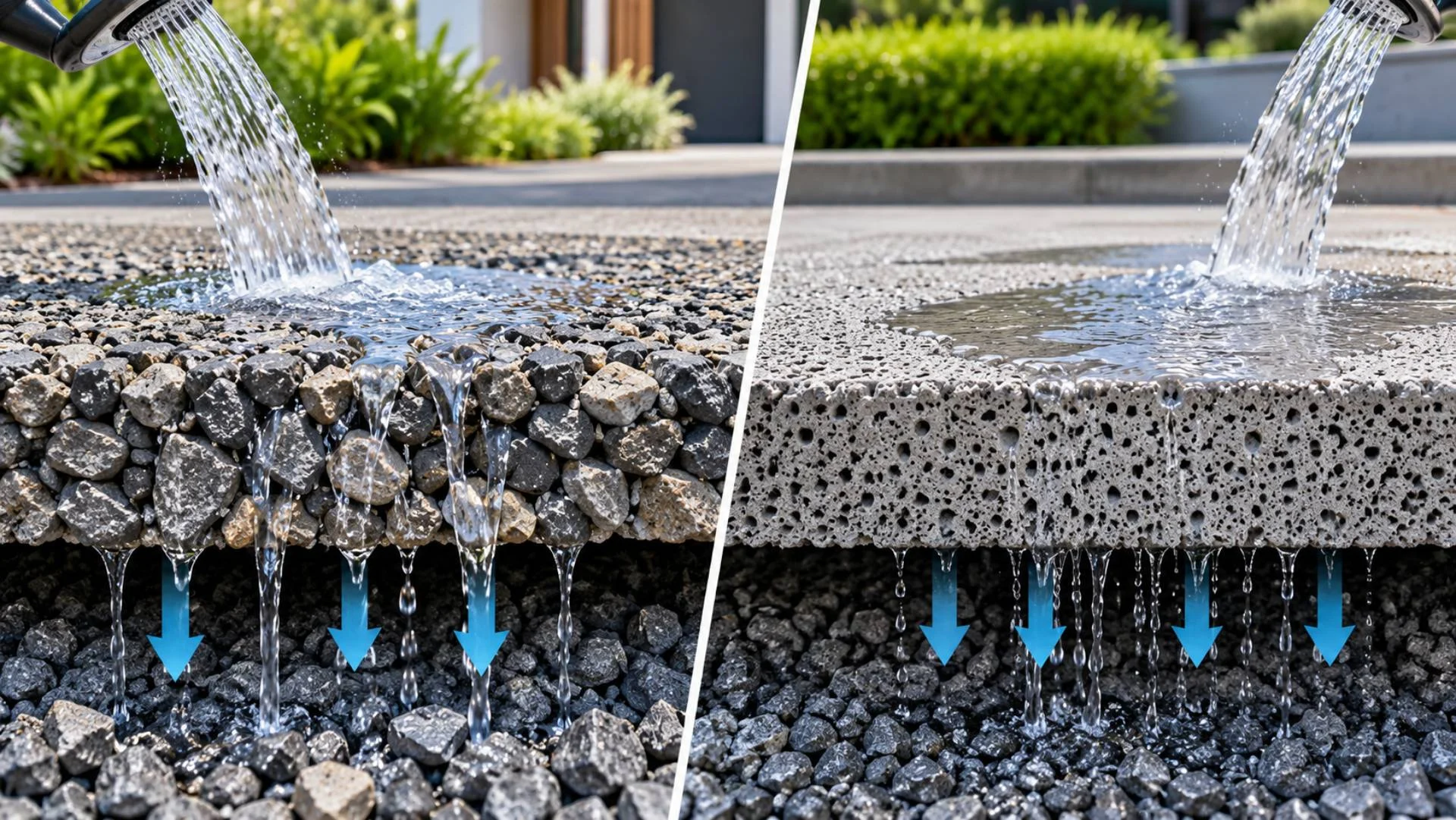
A porous material contains empty spaces, or pores. A permeable material lets water pass through it. Most of the time, the concrete people call “porous” and the concrete they call “permeable” is the same product. But the two words are not quite the same, and the difference explains why some concrete drains and some does not.
In everyday use, permeable, porous, pervious and no-fines concrete all describe one type of mix. It leaves out fine sand, which creates open voids so rainwater can drain straight through. When you order, any of these names will usually get you the same product. What matters more is the mix’s void content and drainage rate.
The four names explained
| Term | What it emphasises | Where you will see it |
| Permeable concrete | Water passing through | Australian suppliers, council documents, homeowners |
| Pervious concrete | Water passing through | Engineering standards and international literature |
| Porous concrete | The voids in the material | Everyday speech, some suppliers |
| No-fines concrete | How it is made: no fine sand | Australian trade use, batching plants, older documents |
“Permeable” and “pervious” mean essentially the same thing. “Porous” focuses on the empty space, and “no-fines” focuses on the recipe. All four describe one product. Our Broadmix no-fines range is supplied under that name for exactly this purpose.
Porosity and permeability are different
In engineering terms, the two words measure different properties.
Porosity is how much of the material is empty space, measured as a percentage. Permeable concrete typically has 15 to 25% air voids.
Permeability is how easily water moves through the material, usually measured as an infiltration rate, such as millimetres per hour.
The key point is that a material can be porous without being permeable. That happens when its pores are sealed off from each other rather than connected.
Porous but not permeable
Two everyday examples show the difference clearly.
Standard concrete contains tiny pores, but they are microscopic and poorly connected. It can absorb a little moisture, yet water cannot flow through it at any useful rate. That is why concrete driveways need a slope to shed rain.
Aerated concrete blocks, the lightweight blocks used in some homes, are full of air bubbles. They are very porous, but the bubbles are closed cells, so water does not drain through them.
Permeable concrete works because its voids are large and connected, forming a continuous path from the surface to the base below. That pathway is what has to be protected over time, which is why what blocks the voids over time matters so much for long-term drainage.
Permeable concrete or permeable paving?
There is one more term to watch for. “Permeable paving” or “permeable pavement” is a broader category that includes several products:
- Permeable concrete, poured in place as a continuous slab
- Permeable pavers, solid concrete pavers laid with gaps filled with gravel so water drains between them
- Porous asphalt, an open-graded asphalt used on some roads and car parks
- Reinforced gravel and grass systems, plastic or concrete grids filled with gravel or turf
All of these let water into the ground, but they look, cost and perform differently. If a plan or permit condition says “permeable paving”, check which type is intended before ordering.
Why the base matters for every type
Whatever it is called, water passing through the surface needs somewhere to go. Every permeable system relies on the stone layer that stores drained water before it soaks into the soil. A porous surface on top of a dense base will not drain properly.
What to ask for when ordering
The name matters less than the specification. When you contact a supplier, ask about:
- Void content: typically 15 to 25%.
- Infiltration rate: how quickly water passes through.
- Compressive strength: important if vehicles will use the surface.
- Aggregate size: this affects texture, appearance and drainage.
If your engineer or council has supplied a specification, send it with your enquiry. You can also ask for permeable concrete specifications to include in your permit or engineering documents.
Frequently asked questions
Is pervious concrete the same as permeable concrete?
Yes. Both terms describe concrete with connected voids that let water drain through. “Pervious” is more common in engineering documents.
Is no-fines concrete the same as permeable concrete?
In practice, yes. The name describes how it is made: without fine sand, which leaves open voids.
Can normal concrete be porous?
It has tiny pores, but they are not connected well enough to let water drain through. It is slightly porous but effectively impermeable.