
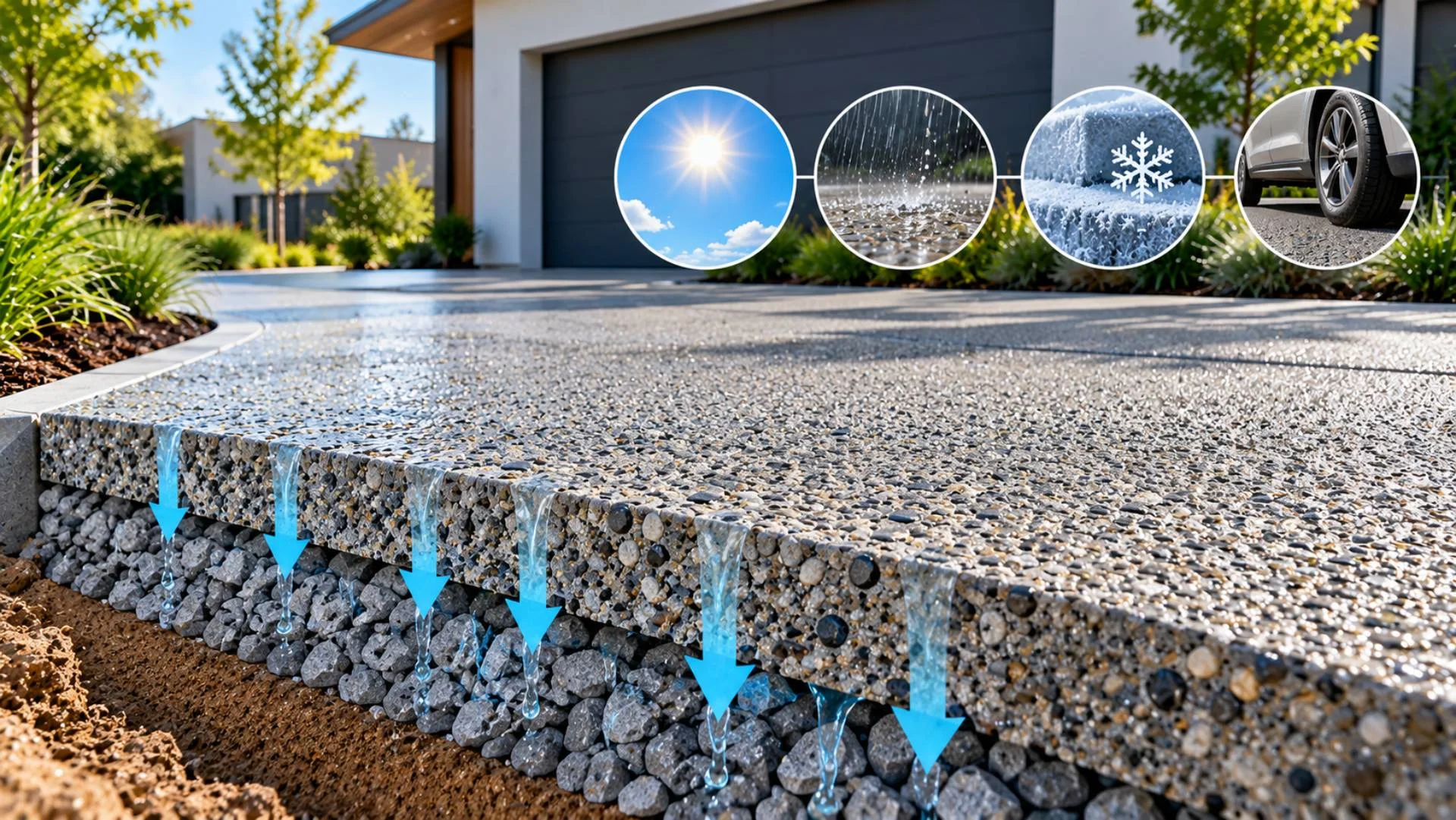
Picture two permeable driveways poured on the same day with the same mix. One sits on a properly built stone base, with lawn edging around it and a quick sweep every month. The other was poured early in the build, has a garden bed draining onto it, and has never been cleaned. Ten years later, the first still drains in seconds. The second puddles after every storm.
That difference sums up how long permeable concrete lasts. Well designed, well built and lightly maintained, it typically lasts 20 to 30 years or more, which is comparable to a standard concrete driveway. Poorly built or neglected, it can stop working well within a few years, even while the slab itself is still standing.
Two lifespans, not one
Permeable concrete has two lifespans:
- Structural life: how long the slab stays solid, level and free of serious cracking.
- Drainage life: how long it keeps letting water through at a useful rate.
A standard driveway only needs to last structurally. A permeable surface needs to do both. It is common for a permeable slab to be structurally sound but no longer draining, and that usually comes from clogging rather than wear. Our article on how sediment shortens drainage life explains why this happens and how to prevent it.
How it compares with other surfaces
| Surface | Typical lifespan | Main maintenance |
| Permeable concrete | 20 to 30+ years | Sweeping and yearly cleaning |
| Plain concrete | 25 to 40 years | Occasional cleaning and crack repair |
| Exposed aggregate concrete | 25 to 30+ years | Resealing every few years |
| Permeable pavers | 20 to 30 years | Topping up joint aggregate |
These are typical ranges for residential driveways built to a good standard. For more on decorative options, see our breakdown of how long exposed aggregate lasts.
What wears permeable concrete out?
Clogging. This is the most common reason a permeable surface stops performing. Fine soil, dust and broken-down leaves gradually fill the pores.
Ravelling. Surface stones loosen and come away, usually where tyres turn sharply or where heavy vehicles drive. It is the main kind of surface wear on permeable concrete.
Cracking. This usually comes from a weak or uneven base, or from loads heavier than the slab was designed for, rather than from the concrete itself.
Poor curing. A slab that dries out too fast after pouring has a weaker surface, which wears more quickly for its whole life.
Freezing in saturated pores. In very cold climates, water freezing inside the voids can damage the surface. Frosty mornings in Central Victoria rarely bring the repeated deep freezing that causes this, but a base that drains freely is still the best protection.
What makes it last longer?
| Factor | Shortens lifespan | Extends lifespan |
| Base | Thin, or built with fine crushed rock | Deep, clean, open-graded stone |
| Slab thickness | Too thin for the vehicles using it | Matched to the heaviest regular load |
| Curing | Left uncovered in hot or windy weather | Covered with plastic straight after placement |
| Surroundings | Soil and mulch washing onto it | Edging and buffer strips |
| Use | Heavy trucks and tight turns | Cars and light vehicles |
| Care | Never cleaned | Swept regularly, cleaned yearly |
Most of these are decided before the concrete arrives. Two matter most:
- The base. A properly built open-graded base supports the slab and keeps water moving, which protects both lifespans.
- The slab thickness. Matching slab thickness to vehicle loads prevents the cracking and ravelling that shorten structural life.
A little care goes a long way
Once a permeable surface is built well, keeping it going is simple:
- Sweep regularly, especially through autumn.
- Clean it once or twice a year, by pressure washing or vacuum sweeping.
- Never apply a film-forming sealer.
- Keep soil and mulch stockpiles off it.
Our yearly cleaning routine covers each step, including a quick test to check whether your surface is still draining well.
Is it worth it over the long term?
Permeable concrete usually costs more to install than a standard driveway. But when it lasts 20 to 30 years, the extra cost spreads thinly across each year of use. That is especially true where it removes the need for extra drainage, or helps the site meet permit conditions without other expensive measures.
Long-term value depends mostly on getting the build right the first time. A cheaper installation that clogs or ravels early often ends up costing more.
Frequently asked questions
How long does a permeable concrete driveway last?
Typically 20 to 30 years or more when it is built on a good base, sized for its vehicles, and kept clean.
Does permeable concrete last as long as normal concrete?
Structurally it can come close for light vehicle use. Its drainage performance also depends on regular cleaning, which standard concrete does not need.
Can an old permeable surface be restored?
Surface clogging can usually be cleaned out. Badly ravelled or cracked areas may need patching with a permeable mix, or replacing.
What is the most common reason it fails early?
Sediment washing onto the surface, often from nearby garden beds or construction activity, followed closely by a poorly built base.