
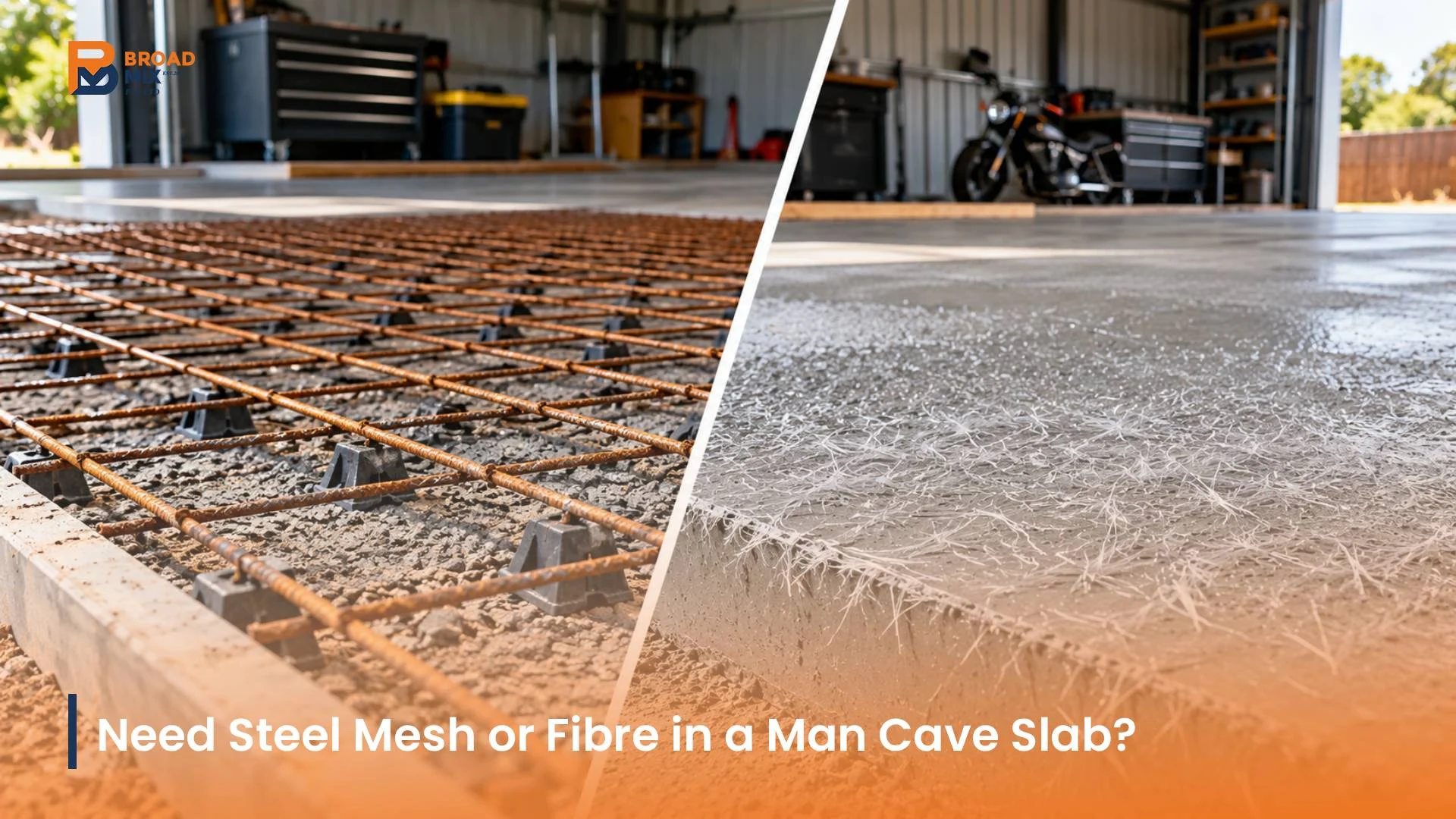
Yes, a man cave slab needs reinforcement, and for most shed-turned-living-space floors that means steel mesh. Mesh is the standard structural reinforcement for a habitable slab, holding the concrete together, keeping shrinkage cracks tight, and giving the slab the strength to carry furniture, a bar, a pool table, or a car hoist. Fibre, mixed through the concrete, is good at controlling early shrinkage cracking and adds toughness, but on its own it does not replace steel mesh for structural strength on a slab you plan to use and live in. The best answer for most man caves is steel mesh as the main reinforcement, with fibre as a useful addition rather than a substitute. The table below sums up how the two compare.
| Reinforcement | What it does | Role in a man cave slab |
| Steel mesh | Structural strength, holds cracks tight, carries load | The main reinforcement, standard choice |
| Fibre (in the mix) | Controls early shrinkage cracking, adds toughness | A helpful addition, not a mesh replacement |
| Mesh plus fibre | Structural strength and shrinkage control together | The strongest option for a quality floor |
What Steel Mesh Actually Does
To see why mesh is the default, it helps to know the job it does inside the slab. It is the backbone of the concrete.
Steel mesh is a welded grid of bars, commonly SL72 or SL82 for residential floors, laid through the slab and held up on bar chairs so it sits in the right position rather than on the ground. Concrete is strong in compression but weak in tension, and the mesh adds that missing tensile strength, so when the slab is loaded or the ground moves, the steel carries the pull that would otherwise crack the concrete apart. It also holds the two sides of any shrinkage crack tightly together, so cracks stay as fine hairlines instead of opening up. For a man cave that will carry real weight and be lived in, that structural reinforcement is what makes the floor dependable, which is why mesh is specified on habitable slabs.
What Fibre Does and Does Not Do
Fibre reinforcement gets a lot of interest because it sounds simpler than laying mesh, so it is worth being clear about what it genuinely offers. It is useful, but for a specific job.
Fibres, either fine synthetic strands or steel fibres, are mixed right through the concrete so they are distributed evenly across the whole slab. They are very good at controlling the early plastic shrinkage cracking that forms as the concrete dries, because there are millions of them holding the surface together as it sets. They also add toughness and impact resistance. What fibre does not do, at least not the common synthetic type at normal doses, is replace the structural strength of steel mesh. It does not sit in a planned position to carry tension across the slab the way a mesh grid does, so on a loaded, habitable floor it is an enhancement rather than a stand-alone solution. Fibre controls cracking, mesh carries the structure.
Why Mesh Is the Right Call for a Man Cave
A man cave is not a plain shed floor, and that difference is exactly why it needs proper steel reinforcement. You are turning a slab into a room you use.
Think about what a man cave slab carries. There may be a bar, a full-size pool table weighing several hundred kilograms, heavy tool cabinets, gym equipment, a car on a hoist, or a wood heater, all concentrated loads on the floor. The slab also becomes part of a living space where cracking, movement, or an uneven floor is a real problem rather than a cosmetic one. Steel mesh gives the slab the strength to carry those point loads and the resistance to hold together over years of use. On reactive clay soils common across parts of Central Victoria, where the ground swells and shrinks with moisture, that reinforcement matters even more. Pairing the mesh with the right concrete strength in MPa for the loads is what makes the floor fit for purpose.
When Fibre Is Worth Adding
None of this means fibre is a waste on a man cave slab, and in fact the strongest floors often use both. Fibre earns its place alongside mesh, not instead of it.
Adding fibre to a mesh-reinforced slab gives you shrinkage control through the full depth of the concrete plus the structural strength of the steel, which is a genuinely good combination for a quality floor. The fibre tackles the early surface cracking while the mesh handles the loads and long-term movement. Fibre can also be useful in areas where getting mesh positioned perfectly is difficult, as a supplement that reduces surface cracking. The key point is the pairing. Use fibre to improve a properly mesh-reinforced slab, not to avoid laying mesh in the first place. If you want fibre in your mix, it is simple to add when you order your pre-mix concrete, so mention it along with the strength and the volume you need.
Getting the Rest of the Slab Right
Reinforcement is only one part of a man cave slab that performs, and the same fundamentals that prevent cracking apply here too. The steel works best in a well-built slab.
The slab needs the correct thickness for the loads, usually at least 100mm and more where heavy equipment or a vehicle is involved, over a properly compacted base of crushed rock. It needs a vapour barrier underneath, since a man cave is a habitable space and you do not want ground moisture rising through the floor into carpet, flooring, or stored gear. The mesh must be held up on bar chairs at the right height to actually do its job, not thrown on the ground. And the slab needs curing, kept damp for the first week so it gains strength. Matching the right concrete to the project and getting the base, barrier, and reinforcement right together give you a floor built to live on. Our owner-builder concrete guide covers these steps for anyone managing their own pour.
Frequently Asked Questions
Do I need steel mesh or fibre in a man cave slab?
Both have a place, but steel mesh is the main reinforcement a man cave slab needs, because it carries the structural loads and holds cracks tight. Fibre controls early shrinkage cracking and is a good addition, but it does not replace mesh on a habitable, loaded floor.
Can fibre replace steel mesh in a slab?
For a loaded, habitable slab like a man cave, no. Common synthetic fibre controls shrinkage cracking but does not provide the structural tensile strength or the planned load path that a steel mesh grid does. Use fibre to enhance a mesh-reinforced slab, not to replace the mesh.
What mesh do I need for a man cave slab?
Residential floors commonly use SL72 or SL82 mesh, positioned on bar chairs within the slab, but the right size depends on the loads and the soil. For heavy equipment, a vehicle, or reactive soils, have the reinforcement and slab thickness specified for your situation.