
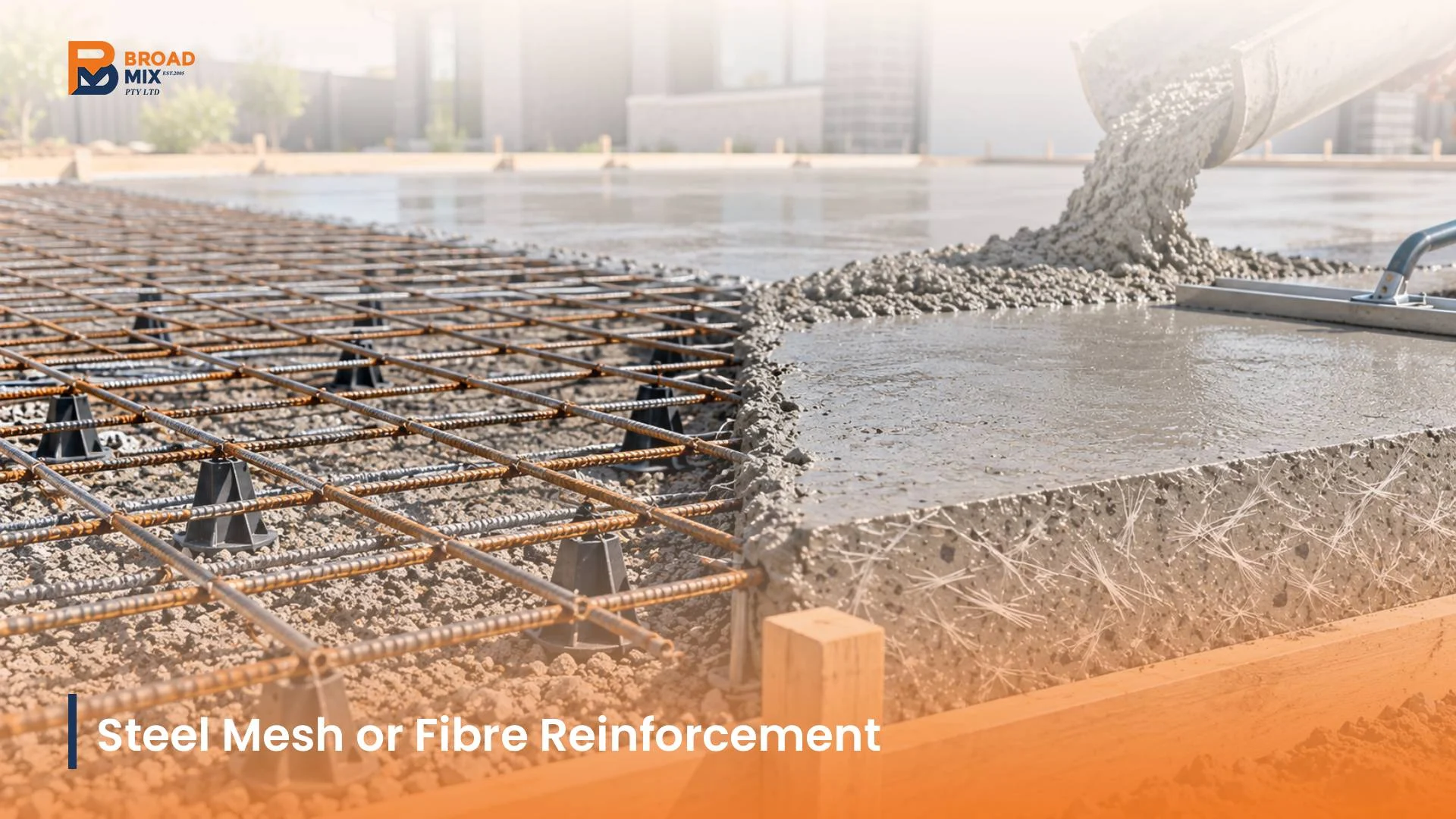
Neither steel mesh nor fibre is better for every slab, because they do different jobs, and the right choice depends on the loads, the structure, and the soil. Steel mesh is a positioned grid that gives a slab structural, load-carrying strength, so it is the better choice for driveways, house slabs, shed and garage floors, and anything that carries real weight or sits on reactive ground. Fibre is mixed through the concrete and is best at controlling shrinkage cracking and adding toughness, so it suits lighter, non-structural flatwork and works well as an addition to mesh. For most residential slabs that carry load, mesh is the main reinforcement, with fibre an optional extra. The table below shows where each one wins.
| Factor | Steel mesh | Fibre |
| Structural strength | Strong, carries load and tension | Limited, not a structural substitute |
| Crack control | Holds cracks tight once formed | Excellent at early shrinkage control |
| Position in slab | Placed on chairs where needed | Distributed evenly throughout |
| Labour | More, laid and supported by hand | Less, added at the mixer |
| Best for | Loaded and structural slabs | Light flatwork and as a mesh add-on |
How Steel Mesh Works
To choose well, it helps to know what each reinforcement actually does, starting with mesh. Mesh is about structure.
Steel mesh is a welded grid of bars, commonly SL72 or SL82 for residential work, laid inside the slab and held up on bar chairs so it sits at the correct height rather than on the ground. Concrete is strong under compression but weak under tension, and the mesh supplies that missing tensile strength, carrying the pulling forces that come from loads and ground movement. Because it is placed in a planned position, it works as a continuous structural layer across the whole slab, and it holds the sides of any crack tightly together so cracks stay fine. This is why mesh is the standard for slabs that carry weight or form part of a structure, and why getting the right concrete strength in MPa to work with it matters.
How Fibre Works
Fibre takes a completely different approach, and understanding it explains both its strengths and its limits. Fibre is about distribution.
Fibre reinforcement, either fine synthetic strands or steel fibres, is added to the concrete at the mixer so it is spread evenly through the entire slab. With millions of fibres holding the concrete together as it sets, it is very effective at controlling the early plastic shrinkage cracking that forms while the slab dries, and it adds impact resistance and toughness throughout. Because it is distributed rather than positioned, though, common synthetic fibre does not provide the concentrated tensile strength or the planned load path that a mesh grid does. It controls cracking everywhere a little, rather than carrying structure anywhere in particular. That makes it excellent for its job and limited for mesh’s job.
The Key Difference to Understand
If you take one thing away, make it this, because it settles most decisions. The two reinforcements are not competing at the same task.
Mesh is positioned structural reinforcement that carries load and resists movement. Fibre is distributed crack control that reduces shrinkage cracking. A slab that has to carry weight or resist a moving foundation needs the structural job done, which is mesh. A slab whose main risk is surface shrinkage cracking, and which carries little structural load, can often be served by fibre. Most of the confusion about which is better comes from treating them as two versions of the same thing, when really you are asking which job your slab needs done. Once you frame it that way, the slab type usually answers the question.
Which Is Better by Slab Type
Because the answer depends on the job, the clearest way to choose is by what you are pouring. Here is how it falls for common slabs.
Light, non-structural flatwork, such as a thin path, a small shed floor for light storage, or a garden slab, can often use fibre alone, since the main risk is shrinkage cracking rather than load. Driveways carry vehicles and are large, so they want steel mesh for strength, with control joints to manage shrinkage. Shed, garage, and man cave floors that carry equipment, storage, or a vehicle need mesh as the main reinforcement, and benefit from fibre added as well. House slabs are structural foundations and are always engineered with steel reinforcement and beams to suit the soil, never fibre alone. On reactive clay soils common across parts of Central Victoria, where the ground moves with the seasons, steel reinforcement matters even more. Matching the right concrete to the project includes getting this reinforcement choice right for the slab.
Can Fibre Ever Replace Mesh?
This is the question people really want answered, and the honest reply is sometimes, but with conditions. It is not a simple yes.
In some commercial and industrial slabs, engineered steel fibre or structural macro-synthetic fibre is specified at a dose designed to replace mesh, and in those cases it is a genuine structural alternative because an engineer has calculated the fibre type and quantity for the loads. For a standard residential slab, though, the common synthetic fibre added to a mix is not a structural replacement for mesh, and using it alone on a loaded or structural slab leaves the slab under-reinforced. So fibre can replace mesh only when it is specifically engineered to, not as a default assumption on a home project. If in doubt, treat mesh as the structural reinforcement and fibre as the shrinkage-control addition.
Using Both Together
For many quality slabs the best answer is not one or the other but both, and it is worth knowing why the combination works. They cover each other’s gaps.
Mesh handles the structural strength and long-term load, while fibre handles the early surface shrinkage cracking through the full depth of the slab, so together they give you a tougher, more crack-resistant floor than either alone. This pairing is common on quality residential and light commercial slabs where both performance and appearance matter. Adding fibre is simple, since it goes in when you order your pre-mix concrete, so you can specify mesh for the structure and fibre in the mix for crack control in the one job. Ordering enough for a single continuous pour, which our ready mix buyers guide helps you plan, also avoids the weak cold joints that no reinforcement fully makes up for. For anyone coordinating their own pour, our owner-builder concrete guide covers getting the reinforcement, base, and mix right together.
Frequently Asked Questions
Is steel mesh or fibre better for a concrete slab?
It depends on the slab. Steel mesh is better for structural and loaded slabs like driveways, house slabs, and shed floors because it carries load. Fibre is better for controlling shrinkage cracking in lighter, non-structural flatwork, and works well added to a mesh-reinforced slab.
Can fibre reinforcement replace steel mesh?
Only when it is specifically engineered to, as with structural steel or macro-synthetic fibre in some commercial slabs. The common synthetic fibre added to a residential mix controls shrinkage but is not a structural replacement for mesh on a loaded or structural slab.
Is fibre reinforcement any good?
Yes, for its job. Fibre is excellent at controlling early shrinkage cracking and adding toughness through the whole slab. It is just not a substitute for the positioned structural strength that steel mesh provides on slabs that carry load.