
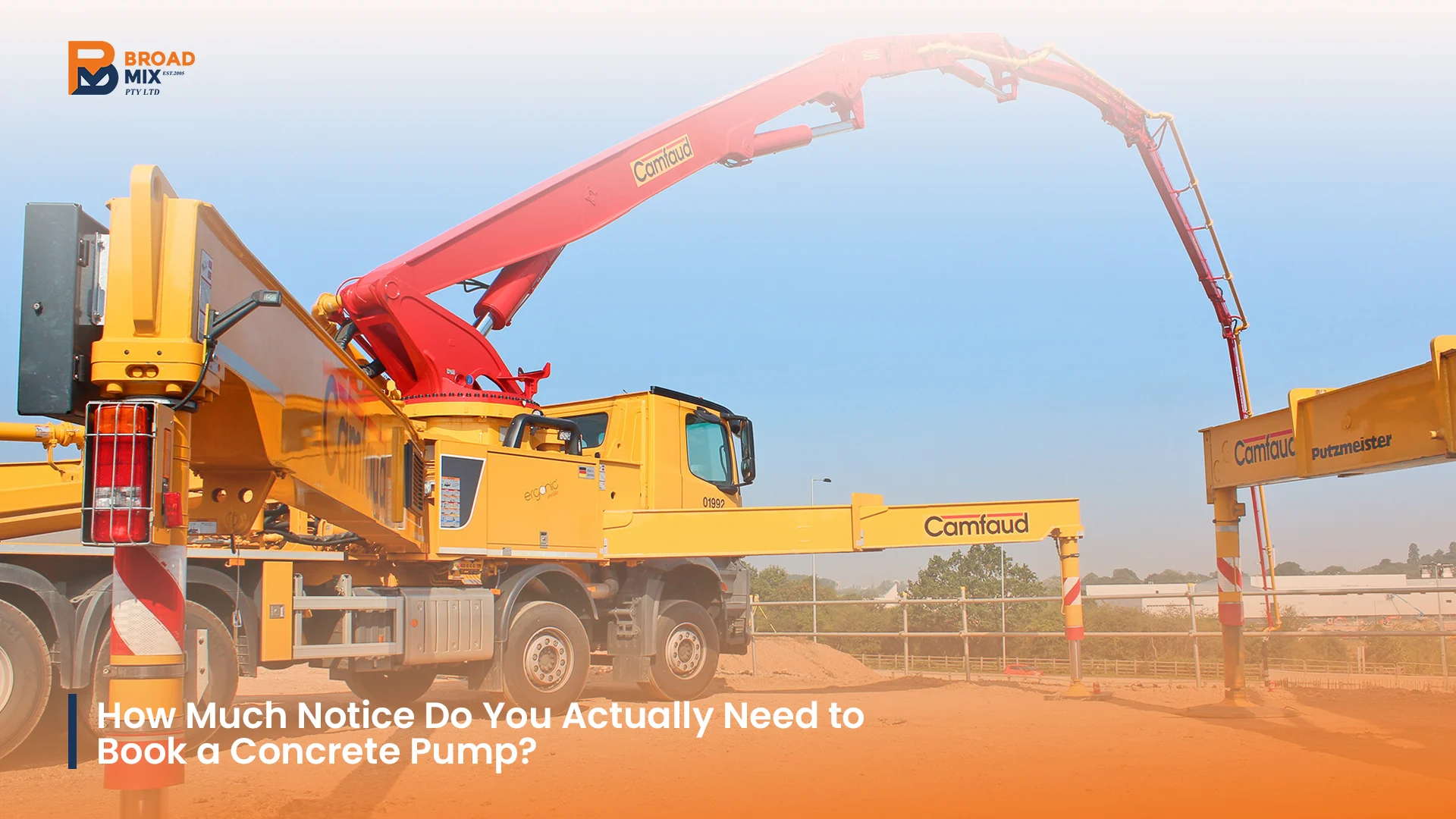
As a general guide, allow about a week of notice to book a concrete pump, though a small line pump for a straightforward residential pour can often be arranged in just a few days. Larger pours needing a boom pump, jobs in busy building periods, and anything with a fixed pour date you cannot move all deserve more lead time, so a week or two is safer. The more notice you give, the better the chance of getting the pump you need on the day you want, and the more time there is to coordinate it with the concrete delivery. Short-notice bookings are sometimes possible when a pump is free, but they are never guaranteed. The table below gives a realistic guide by job type.
| Job | Suggested notice | Why |
| Small line pump pour | A few days | Lower demand, simpler to slot in |
| Standard residential slab | About a week | Coordinates the pump with the concrete |
| Boom pump or large pour | One to two weeks | Fewer units, higher demand |
| Busy period or fixed date | Two weeks or more | Demand peaks, no flexibility to move |
Why Giving More Notice Helps
Before looking at specific timeframes, it helps to understand why lead time matters at all, because it is not just about availability. Good notice makes the whole pour run better.
A pump booking is really two bookings in one, the pump and the concrete, and both have to line up on the same day and time. The more notice you give, the more easily we can match a suitable pump to your site and coordinate it with the delivery, rather than squeezing both into whatever slot is left. More notice also leaves room to get the details right, from sizing the pump for your access to batching a pump-grade mix, and to adjust if the weather or your site preparation shifts the date. Booking early is not about rushing you, it is about giving the pour the best chance of going smoothly. A tight, last-minute booking leaves no slack if anything changes.
A Few Days for a Small Line Pump
At the shorter end, a small line pump for a simple residential job is the easiest to arrange at short notice, so these can often be booked within a few days. Demand for them is steadier and the coordination is simpler.
If you are pouring a backyard slab, a path, a shed floor, or a small pour that needs a line pump to reach it, a few days is often enough, especially midweek and outside the busiest building months. That said, a few days is a guide, not a promise, and the earlier you call the better your choice of day and time. If your pour date is flexible, mentioning that when you book helps us fit you in sooner, since we can place you on a day a pump is already free.
About a Week for a Standard Slab
For a typical residential slab, around a week of notice is the sweet spot, enough to lock in the pump and coordinate it with the concrete without needing to look too far ahead. This covers most home jobs.
A week gives time to size the pump to your access, schedule it with the pre-mix concrete delivery, and have everything confirmed before you finalise your formwork and crew. It also leaves a buffer if the weather looks doubtful, since you can talk to us about shifting the date rather than cancelling at the last minute. If you are working out your volume and timing, our concrete calculator helps you firm up the numbers so the booking is accurate. A week is comfortable for both sides and is a good default to aim for on a standard slab.
One to Two Weeks for a Boom or Large Pour
At the larger end, a boom pump or a big continuous pour needs more notice, because there are fewer of these units and they are in higher demand. Two weeks is a sensible target for these.
A house slab or any large pour that needs a boom pump is a bigger commitment of equipment and time, so booking one to two weeks ahead gives the best chance of securing the right size boom for your day. These pours also involve more trucks and tighter timing, which takes more planning to coordinate, so the extra notice is well spent. If your build has a fixed slab date set by your builder or a stage inspection, treat that as a reason to book at the earlier end rather than the later, since you have no room to move the date if a pump is not free. Our owner-builder concrete guide covers planning a large pour around these timelines.
Busy Periods Need Extra Lead Time
On top of the job type, the time of year affects how much notice you need, because demand for pumps rises and falls through the year. In the busy stretches, book further ahead.
Building activity tends to peak in the warmer, drier months and in the lead-up to end-of-year deadlines, and when pours are busy, pumps get booked out further in advance. During these periods, adding a week to whatever your job would normally need is wise, so a standard slab that would take a week of notice is better booked two weeks out. Weather plays a part too, since a run of good pour days after wet weather sees everyone trying to pour at once. If you can be flexible on the exact day, you will find it easier to get a pump in a busy spell, and ordering from a local supplier who knows the local demand helps you plan the timing.
Can You Book a Pump at Short Notice?
Sometimes the pour cannot wait, so it is fair to ask whether a pump can be arranged quickly, and the honest answer is sometimes. It depends on what is free.
Short-notice and even same-week bookings do happen when a suitable pump is available and the concrete can be supplied to match, particularly for smaller line pump jobs. What we cannot do is guarantee it, because a pump that is already booked for the day you need simply is not available, however urgent the job. If you are on a tight timeframe, call as early as you can and be flexible on the day and time, as that flexibility is often what makes a short-notice booking possible. The safest approach is always to book ahead, but if plans change, it is still worth asking rather than assuming it cannot be done.
Frequently Asked Questions
How much notice do you need to book a concrete pump?
As a guide, about a week for a standard residential slab, a few days for a small line pump, and one to two weeks for a boom pump or large pour. Busy building periods call for extra notice, so book earlier when demand is high.
Can I book a concrete pump at short notice?
Sometimes, if a suitable pump is free and the concrete can be supplied to match, especially for small line pump jobs. It cannot be guaranteed, though, so call as early as possible and be flexible on the day and time to improve your chances.
Why does a boom pump need more notice than a line pump?
There are fewer boom pumps and they are in higher demand, and the large pours they serve take more coordination with multiple trucks. That combination means booking one to two weeks ahead gives the best chance of securing the right boom for your date.