
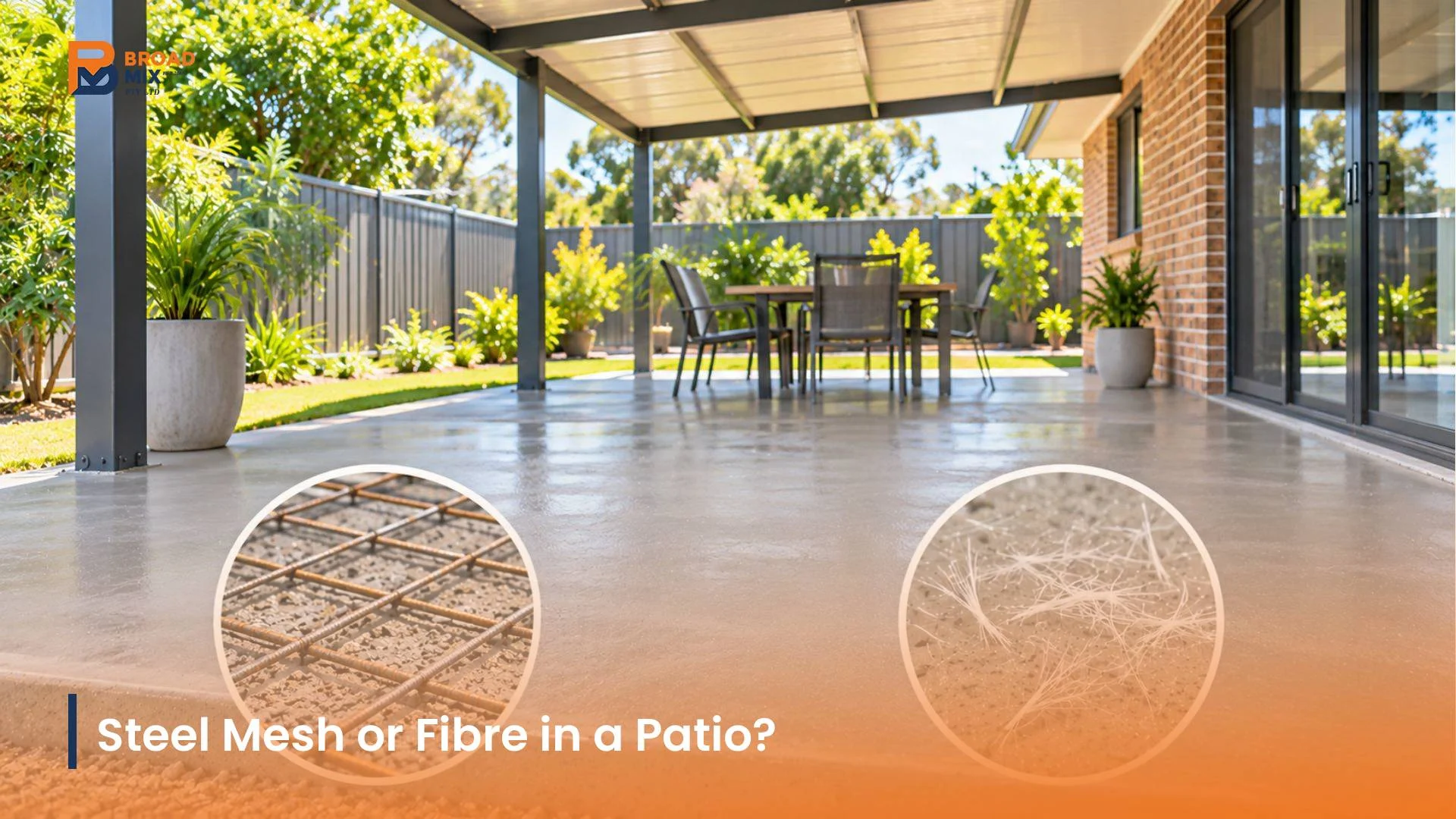
A patio needs reinforcement of some kind, but because a patio carries foot traffic and furniture rather than vehicles, it is lighter duty than a driveway or a carport, and this is where fibre genuinely competes with steel mesh. For a well-prepared patio on stable ground, a quality fibre mix is often enough, controlling the shrinkage cracking that is the main risk on a non-vehicle slab. Steel mesh is still the safer, stronger choice, and it is worth using on larger patios, on reactive soils that move, or where you want the lowest risk of cracking, and it is the better option if the patio might ever take a vehicle. So the honest answer is that a patio can go either way, with fibre acceptable on a light, simple slab and mesh the safer pick when conditions are less certain. The sections below help you decide.
A Patio Is a Light-Duty Slab
To choose well, start with what a patio actually carries, because it is a much lighter load than the slabs where mesh is essential. That changes the calculation.
A patio holds people, outdoor furniture, a barbecue, and maybe a pot plant or two, all light, distributed loads that concrete handles comfortably. There are no concentrated vehicle loads bending the slab, which is exactly the force that makes mesh non-negotiable on a driveway, carport, or machinery slab. Because the structural demand is low, the main thing a patio slab has to resist is not load but shrinkage cracking as the concrete dries and moves with temperature. That shifts the question from load strength, which is mesh’s job, toward crack control, which is fibre’s strength. So a patio is the one common residential slab where fibre alone is a realistic option rather than just an add-on.
Why Fibre Can Be Enough on a Patio
Given that crack control is the main job, it makes sense that fibre earns a bigger role on a patio than on a loaded slab. It is well suited to the task.
Fibre, usually fine synthetic strands, is mixed right through the concrete so it is spread evenly across the whole slab, and it is very effective at controlling the early shrinkage cracking that forms as a patio cures. With the load demand low, that crack control is most of what the slab needs, so on a modest patio, poured at a good thickness on a well-prepared, stable base, a quality fibre mix can give a sound, tidy result without mesh. It also saves the labour of laying and supporting steel. For a simple, light patio on good ground, fibre is a legitimate choice, not a shortcut. Getting the right concrete for the project, with fibre in the mix, is straightforward to arrange.
When Mesh Is Still the Safer Choice
That said, fibre being acceptable does not make it always the best option, and there are clear cases where mesh is worth it on a patio. These come down to risk.
Mesh is the safer choice on a larger patio, where more total shrinkage builds up across the slab, and on reactive clay soils common across parts of Central Victoria, where the ground swells and shrinks with the seasons and can move the slab. It is also the better pick if the patio adjoins a driveway or might ever take the weight of a vehicle, even occasionally, and any time you simply want the lowest possible risk of cracking. In those situations the positioned structural reinforcement of a mesh grid, holding any crack tightly together and tying the slab into one piece, is worth the modest extra cost. If your patio is big, on moving ground, or you want peace of mind, use mesh. Pairing it with the right concrete strength completes a durable slab.
The Strongest Option Is Both
As with any slab, the best result on a patio often comes from using mesh and fibre together, and on a patio you are paying a little more for noticeably better crack control. They complement each other.
Mesh handles any structural movement and holds cracks tight, while fibre controls the early surface shrinkage cracking through the full depth of the slab, so together they give the cleanest, most crack-resistant finish, which matters on a patio where appearance counts. This is worth considering on a patio you want to look good for years, especially a decorative one. Adding fibre is simple, since it goes in when you order your pre-mix concrete, so you can specify mesh and fibre together in the one job. For a decorative patio, the same choice applies whether you finish it plain, coloured, or as exposed aggregate.
The Rest of the Patio Slab
Whichever reinforcement you choose, the usual slab fundamentals decide how well a patio resists cracking, and they matter just as much as mesh or fibre. Good practice holds the whole thing together.
A patio is typically poured at 75 to 100mm in a 20 to 25 MPa mix, over a properly compacted base of crushed rock, with 100mm the safer default where furniture or heavier use is expected. It needs control joints at the right spacing so shrinkage cracks run along planned lines, a slight fall so rainwater runs off rather than pooling, and curing by keeping it damp for the first week so it gains strength before shrinkage can stress it. If you use mesh, it has to be held up on bar chairs at the right height to do its job, not left on the ground. Working out the volume is easy with our concrete calculator, and our owner-builder concrete guide covers getting the base, joints, and curing right for a slab like this.
Frequently Asked Questions
Do I need steel mesh or fibre in a patio?
A patio carries foot traffic rather than vehicles, so it is light duty. Fibre can be enough on a well-prepared patio on stable ground, since the main risk is shrinkage cracking. Steel mesh is the safer choice on larger patios, reactive soils, or if a vehicle might ever use it.
Can I use fibre instead of mesh in a patio?
Yes, often. On a modest patio poured at a good thickness on a stable, well-prepared base, a quality fibre mix controls shrinkage cracking well and can be used without mesh. Mesh remains the safer option on bigger slabs, moving ground, or where you want the least risk.
What thickness and mix does a patio slab need?
A patio is commonly 75 to 100mm thick in a 20 to 25 MPa mix over a compacted base, with 100mm the safer choice for heavier use. Control joints, a slight fall for drainage, and proper curing all help it resist cracking as much as the reinforcement does.
Should I use both mesh and fibre in a patio?
On a patio you want to keep looking good, yes. Mesh handles any structural movement while fibre controls early surface shrinkage cracking, giving the cleanest, most crack-resistant finish. Fibre is simple to add to the mix when you order the concrete.