
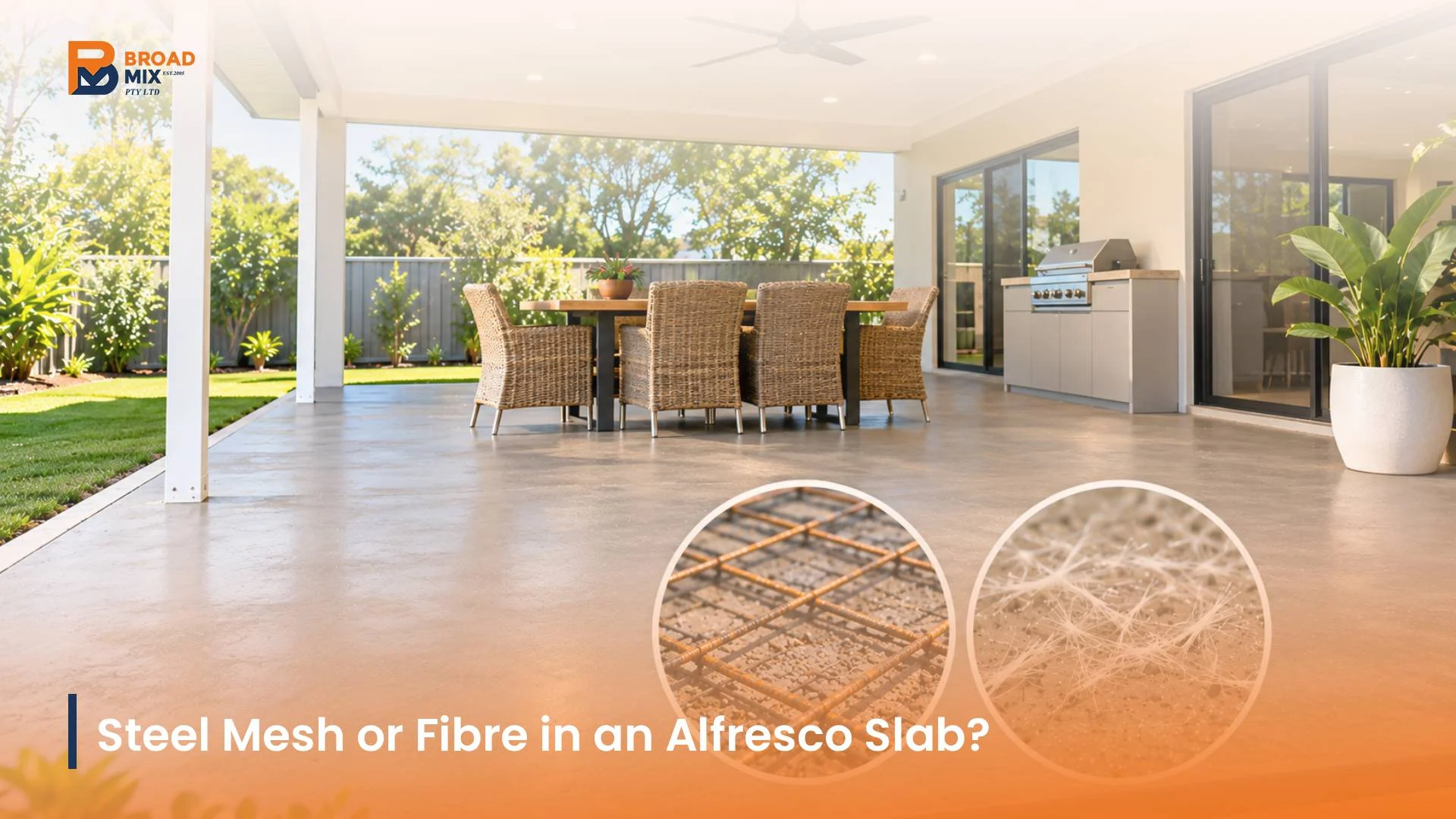
For an alfresco slab, steel mesh is the standard and safer choice, more so than for a simple open patio, because an alfresco is usually part of the house build, is often tiled, and may carry heavier features like an outdoor kitchen or spa. Mesh gives the slab the structural strength for those loads and holds any shrinkage cracks tight, which matters a great deal when a tiled finish is going over the top. Fibre, mixed through the concrete, is good at controlling early shrinkage cracking and is a worthwhile addition, but on its own it is not the equal of mesh for a slab that is integrated into the home and finished with tiles. So the straightforward answer is steel mesh for an alfresco slab, with fibre a useful extra rather than a substitute. The sections below explain why an alfresco leans more firmly toward mesh.
| Reinforcement | What it does | Role in an alfresco slab |
|---|---|---|
| Steel mesh | Structural strength, holds cracks tight | The standard, recommended choice |
| Fibre, in the mix | Controls shrinkage cracking | A helpful addition, not a replacement |
| Mesh plus fibre | Strength plus shrinkage control | The best option, especially under tiles |
Why an Alfresco Leans Toward Mesh
An alfresco is often confused with a patio, but a few differences push it more firmly toward mesh, and it helps to see them. It is usually more than a slab in the yard.
An alfresco is typically part of the house, built under the main roofline, often poured with or tied to the house slab and set to match the indoor floor level. Because it is part of the home, it is usually covered by the building design, which specifies steel reinforcement as a matter of course, so mesh is the expected standard rather than an optional upgrade. It is also a living space you furnish and use like a room, not an occasional-use garden slab, so it has to perform and look good for the long term. All of that tilts an alfresco toward the positioned structural reinforcement of mesh, where a plain open patio can more often get by on fibre. Matching the right concrete to the project ties the reinforcement to how the alfresco is built and used.
Tiling Changes the Equation
The single biggest reason an alfresco favours mesh is that it is so often tiled, and a tiled finish is unforgiving of slab movement. This is worth understanding before you decide.
When a slab is tiled, any crack or movement in the concrete can telegraph up through the tiles, cracking them or the grout lines above, which is an expensive and visible failure. Steel mesh holds the two sides of any shrinkage crack tightly together and ties the slab into one stable piece, keeping movement to a minimum so the tiles stay sound. Fibre controls surface shrinkage well, but it does not provide that same structural restraint against the slab moving as a whole. So if your alfresco is going to be tiled, which most are, mesh is the reinforcement that protects the finish. It is much cheaper to lay mesh than to replace a cracked tiled floor.
Heavier Features Add Real Loads
Beyond tiling, an alfresco often carries more than furniture, and those features bring concentrated loads that a plain patio never sees. They strengthen the case for mesh.
Many alfresco areas include an outdoor kitchen with a masonry or stone bench, a built-in barbecue, a pizza oven, or a spa, and these are heavy, concentrated loads sitting on specific parts of the slab. A spa full of water, in particular, is a serious point load. Steel mesh, and sometimes extra reinforcement under the heaviest features, gives the slab the strength to carry them without cracking, which fibre alone is not designed to do. Even if you are not building these in now, an alfresco often gains them later, so reinforcing for the possibility is sensible. Where a spa or masonry kitchen is planned, the slab under it is worth having designed for the load, much like any slab taking real weight.
What Fibre Adds Here
None of this makes fibre pointless on an alfresco, and in fact the best slabs use both. Fibre has a clear role alongside the mesh.
Fibre, usually fine synthetic strands mixed through the concrete, is very effective at controlling the early shrinkage cracking that forms as the slab cures, doing it through the full depth of the slab. On an alfresco that will be tiled, that extra surface crack control works with the mesh to give the most stable base for the tiles. The mesh handles the structure and the loads while the fibre keeps shrinkage cracking to a minimum, and together they give a tougher, more crack-resistant slab than either alone. Adding fibre is simple, since it goes in when you order your pre-mix concrete, so you can specify mesh and fibre in the one job. For a decorative alfresco left exposed rather than tiled, the same reinforcement applies whether you finish it plain, coloured, or as exposed aggregate.
The Rest of the Alfresco Slab
Reinforcement is one part of an alfresco slab that performs, and the usual fundamentals matter here too, with a couple of alfresco-specific points. The mesh works best in a well-built slab.
An alfresco slab is commonly 100mm thick in a 20 to 25 MPa mix, stepping up to 32 MPa where heavier features or a spa are involved, over a properly compacted base of crushed rock. Choosing the right concrete strength for the use is part of it. Because an alfresco is often partly enclosed and tiled, a vapour barrier under the slab is worth including to keep ground moisture from rising through into the tiles or flooring. It also needs a slight fall so any rain blown in runs off rather than pooling, control joints where it is not tiled, and curing by keeping it damp for the first week. The mesh must be held up on bar chairs at the right height to do its job. Our owner-builder concrete guide covers getting these details right.
Frequently Asked Questions
Do I need steel mesh or fibre in an alfresco slab?
Steel mesh is the standard, recommended choice for an alfresco slab, because it is usually part of the house build, often tiled, and may carry heavier features. Mesh gives the structural strength and holds cracks tight. Fibre controls shrinkage and is a good addition, but not a replacement.
Can I use fibre instead of mesh in an alfresco?
It is not the best choice, especially if the alfresco will be tiled or carry an outdoor kitchen or spa. Fibre controls surface shrinkage cracking but does not give the structural restraint mesh does, and slab movement can crack tiles above. Mesh is the safer option here.
Does a tiled alfresco slab need mesh?
Yes, mesh is strongly recommended under tiles. Any movement or cracking in the slab can telegraph up through the tiles and grout, and mesh holds the slab together to keep that movement to a minimum. It is far cheaper than replacing a cracked tiled floor.
What thickness and mix does an alfresco slab need?
An alfresco slab is commonly 100mm thick in a 20 to 25 MPa mix, stepping up to 32 MPa where a spa or masonry kitchen adds weight, over a compacted base with steel mesh. A vapour barrier, a slight fall, and proper curing all help it perform, especially when tiled.