
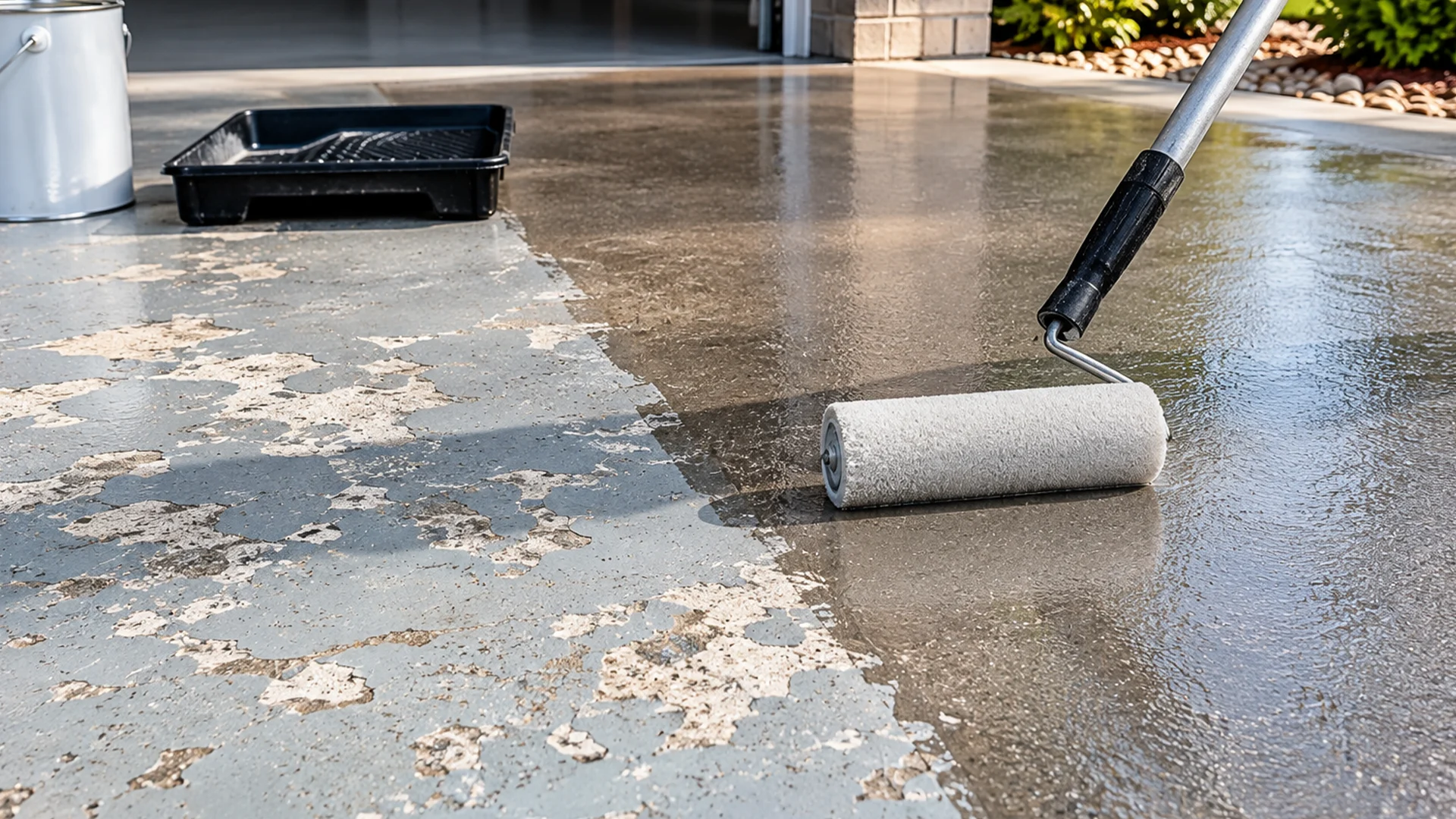
The short answer is that it depends on the type of sealer. A penetrating sealer will not work over paint, because it needs to soak into bare concrete to do its job, and paint blocks it. A topical, film-forming sealer can sometimes go over paint, but only if the paint is fully cured, well bonded, and chemically compatible with the sealer. In most cases, if the goal is a sealed, hard-wearing finish, you are better off removing the paint and sealing the bare concrete, or repainting with a proper masonry or floor coating instead. The table below sums up the difference.
| Sealer type | How it works | Over paint? |
| Penetrating (silane, siloxane, densifier) | Soaks into the pores and seals from within | No, paint blocks absorption |
| Topical film-forming (acrylic, polyurethane, epoxy) | Forms a coating on the surface | Sometimes, if paint is sound and compatible |
Why Penetrating Sealers Will Not Work Over Paint
Penetrating sealers, such as silanes, siloxanes, and lithium densifiers, protect concrete by reacting inside the pore structure. They are absorbed into the surface, where they either repel water or harden the concrete from within. Because they rely on soaking in, they need bare, open concrete to be effective.
Paint is a barrier coating. It sits on top of the slab and fills or covers the very pores a penetrating sealer needs to enter. Apply a penetrating sealer over paint and it will simply sit on the painted surface, bead up, and eventually wipe or wear away without ever bonding. You will have spent money and gained no protection at all. If you want the benefits of a penetrating sealer, the paint has to come off first.
When a Topical Sealer Can Go Over Paint
Film-forming sealers, such as acrylics, polyurethanes, and epoxies, are a different story, because they work by forming a coating on top of the surface rather than soaking in. In principle, a topical sealer can be applied over paint, but there are strict conditions that all have to be met for it to last.
The paint must be fully cured, not just dry to the touch. It must be firmly bonded, with no flaking, bubbling, or chalky patches, since the sealer is only ever as sound as the layer beneath it. The paint and the sealer must be chemically compatible, because some solvent-based sealers will lift or wrinkle certain paints. The surface also needs to be clean, dry, and lightly abraded so the new coat has something to grip. Miss any one of these and the sealer is likely to peel.
The Risks of Sealing Over Paint
Even when a topical sealer will physically stick to paint, sealing over a painted surface stacks up risk, and it pays to understand what can go wrong before you start.
The biggest problem is adhesion. You are now relying on two bonds instead of one, the sealer to the paint and the paint to the concrete. If the paint lets go, the sealer goes with it, and you get peeling in sheets. Trapped moisture is the other common failure. Concrete needs to breathe, and a film-forming sealer over paint can trap water vapour rising through the slab, which pushes both layers off from underneath as blisters. Solvent-based sealers can also soften or wrinkle incompatible paints on contact. And on a painted floor, adding a glossy sealer can make an already slick surface more slippery, which is worth thinking about the same way you would with any smooth finish, as we cover in our note on whether exposed aggregate is slippery.
How to Test Before You Commit
If you have decided a topical sealer over paint is your best option, never coat the whole area straight away. A small test panel will tell you in a day or two what a full job would take a week to reveal.
Choose an out-of-the-way patch, clean it, lightly scuff the paint, and apply the sealer exactly as you plan to on the full area. Give it a few days to cure, then check it. Look for wrinkling or softening of the paint, poor adhesion when you scratch it with a coin, hazing or a milky look, and any lifting at the edges. Press some tape firmly onto the cured test patch and pull it off. If paint or sealer comes away, the system is not sound and you should not proceed. If the panel is clean, hard, and well stuck after several days, you can move ahead with more confidence.
The Better Approach for a Lasting Finish
For most homeowners, the cleaner solution is to stop trying to seal over paint and deal with the paint itself. It takes more work up front, but it avoids the peeling and blistering that so often follow a sealer laid over an old coating.
If you want a true sealed concrete finish, strip or grind the paint back to bare concrete, then apply the right sealer for the surface. Our guide to why sealing your concrete is essential explains what a good sealer actually does for durability and appearance, and you can see the options on our concrete sealers page. If you simply want colour rather than a sealed look, a purpose-made masonry or floor paint applied over sound, prepared concrete will outlast a sealer stretched over an old coat.
It is also worth remembering that the best finish starts with the concrete, not the coating. A well-placed slab in the right mix takes colour, sealer, or a decorative treatment far better than a poor one, which is why matching the right concrete to your project matters from the first pour. For new work, a decorative option like exposed aggregate is designed to be sealed rather than painted, and gives a hard-wearing finish without the paint problem in the first place.
Frequently Asked Questions
Can you put a penetrating sealer over painted concrete?
No. Penetrating sealers work by soaking into bare concrete, and paint blocks that absorption. The sealer will sit on the paint and wear away without protecting anything. The paint must be removed first.
Will concrete sealer stick to paint?
A topical film-forming sealer can stick to paint if the paint is fully cured, firmly bonded, clean, lightly abraded, and chemically compatible with the sealer. Always test a small patch first, since poor adhesion leads to peeling.
Should I seal or paint my concrete?
For a durable, low-maintenance finish, sealing bare concrete generally outperforms paint. If you want colour, use a proper masonry or floor coating on prepared concrete. Layering a sealer over old paint is the least reliable option.
How do I remove paint before sealing concrete?
Paint is usually removed by grinding, shot blasting, or a suitable chemical stripper, followed by a thorough clean. Once the slab is back to sound bare concrete, you can apply a penetrating or topical sealer as intended.