
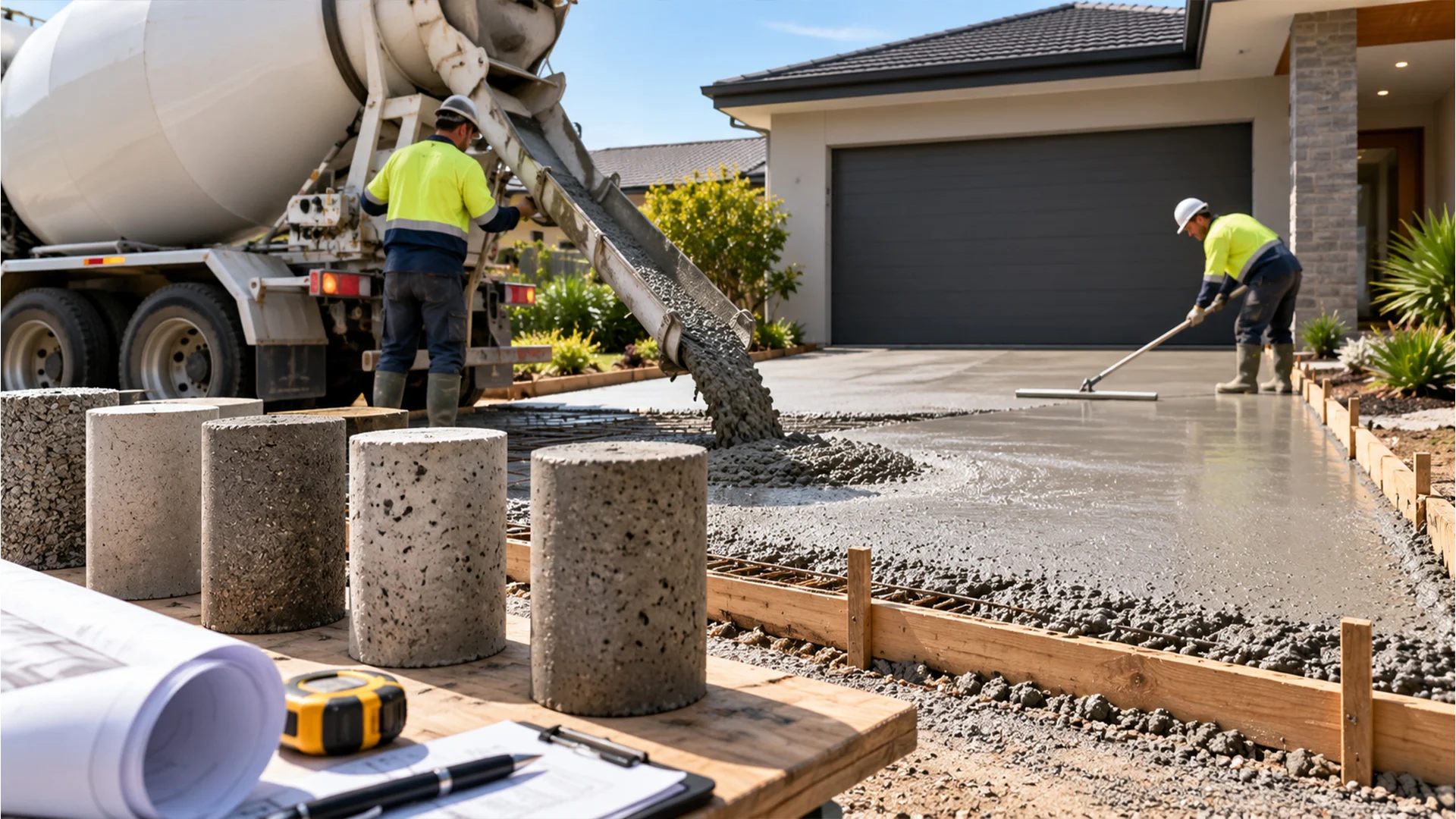
Most residential concrete driveways in Australia use 25 MPa concrete, stepping up to 32 MPa where heavier vehicles, caravans or commercial traffic are involved. That single figure answers the question for the large majority of homes. What it does not tell you is that MPa is only one of four things that decide whether a driveway lasts, and it is not the most important one. Slab thickness, the compacted base underneath and proper curing all do more damage when they are wrong than a strength grade one step too low. A 25 MPa slab at 125 millimetres on a well prepared base will outlast a 32 MPa slab at 80 millimetres on soft fill every time. Get the grade right, then spend your attention on the other three.
| Application | Typical grade | Typical thickness |
|---|---|---|
| Footpath or garden path | 20 MPa | 75 to 100 mm |
| Standard residential driveway, cars | 25 MPa | 100 mm |
| Driveway with caravan, boat or 4WD | 32 MPa | 125 mm |
| Shed or garage floor | 25 to 32 MPa | 100 to 125 mm |
| Driveway with regular truck access | 32 to 40 MPa | 150 mm or more |
| Commercial hardstand | 40 MPa | Engineer specified |
What MPa Actually Measures
Knowing what the number means makes the rest of the decision easier, and it is simpler than it sounds. MPa is a strength rating, not a quality rating.
MPa stands for megapascals, and it describes the compressive strength the concrete reaches after 28 days of curing. A 25 MPa mix will withstand 25 megapascals of pressure before it fails in compression. In Australia you will also see it written as an N-grade, so N25 and 25 MPa mean the same thing. Higher numbers are achieved mainly by increasing the cement content, which is why stronger mixes cost more per cubic metre. A higher grade is not automatically better for a driveway, because compressive strength is not what most driveways fail on. They fail on cracking from movement below, which is a base and thickness problem rather than a strength one.
25 MPa Is the Standard Residential Driveway
For a driveway carrying ordinary cars, 25 MPa is the accepted grade across Australia and it is what we supply for most residential jobs. It is a well proven specification.
At 100 millimetres thick over a properly compacted base, 25 MPa handles daily car traffic, the occasional delivery van and normal weather comfortably. AS 3727.1, the Australian guide to residential pavements, sits residential driveway concrete in this range. Going to 32 MPa when the base and thickness are already right buys you very little on a normal car driveway, so the extra cost is usually better spent on an extra 25 millimetres of slab or on better base preparation. If you are pouring a plain grey driveway, standard pre-mix concrete at 25 MPa is almost always the correct call, and our guide to choosing the right concrete for your project covers how this compares with other applications around the home.
When to Step Up to 32 MPa
There are clear cases where 25 MPa is not enough, and they are worth knowing because retrofitting strength is impossible. You either pour it right or you replace it.
Step up to 32 MPa if the driveway will carry a caravan, a boat trailer, a heavy 4WD or a work ute with loads, since concentrated wheel loads and jockey wheels are far harder on a slab than a family car. Do the same if trucks will use it, if you are pouring a steep driveway where traction and wear are higher, or if the driveway doubles as a hardstand or work area. Exposed and coastal sites benefit from the denser mix a higher grade gives, since durability improves alongside strength. Decorative finishes are another common reason, and exposed aggregate driveways are often poured at 32 MPa because the surface is worked harder during finishing and you want the extra margin.
Why Thickness Matters as Much as MPa
If you are choosing between a stronger mix and a thicker slab on the same budget, take the thickness. It does more for a driveway than the grade does.
Concrete fails in driveways almost entirely through bending and cracking rather than through being crushed, and resistance to bending comes largely from depth. Going from 100 to 125 millimetres increases a slab’s load-carrying capacity substantially, far more than moving from 25 to 32 MPa at the same depth. One hundred millimetres is the standard for a car driveway, 125 millimetres is the sensible upgrade for caravans, boats or heavy vehicles, and 150 millimetres suits regular truck access. Thickness also gives you room for correct reinforcement cover. This is why we would rather talk you into a deeper slab than a stronger one when the budget is fixed.
The Base Under the Slab Decides More Than the Grade
Most cracked driveways we get asked about were not poured too weak. They were poured on ground that moved. The base is the part nobody sees and the part that matters most.
Concrete needs uniform support across its whole area, and where the ground settles unevenly the slab has to bridge the gap and cracks doing it. That means the subgrade needs to be properly compacted, with a compacted crushed rock base of around 100 millimetres over it, graded to drain and free of soft spots, tree roots and organic material. Reactive clay soils, common across parts of Central Victoria, move seasonally with moisture and demand particular care. No strength grade compensates for a poorly prepared base, which is the single most useful thing in this guide.
Reinforcement, Jointing and Curing
These three finish the job, and each one is a common cause of failure on driveways that had the right mix in the truck. They cost little and they matter.
Reinforcement holds the slab together once it does crack, which all concrete eventually does somewhere. SL72 mesh is typical for a residential driveway, correctly positioned in the upper third of the slab on bar chairs rather than thrown in and walked on. Control joints give cracking a planned place to happen, cut to about a quarter of the slab depth and spaced at roughly 2.5 to 3 metres for a residential driveway. Curing is the one most often skipped, and keeping the slab damp through the first week rather than letting it dry out fast is what delivers the strength you paid for. Our explanation of how long concrete takes to dry and cure covers the timeline and why fast drying works against you.
What to Tell Us When You Order
Getting the right concrete delivered is a two minute conversation if you have the details ready. We would rather work through it before the pour than after.
Have your driveway dimensions and intended slab thickness, so we can calculate volume, and our concrete calculator will get you close before you call. Tell us what will use it, since a caravan or a work ute changes the recommendation. Mention the finish you want, because plain, exposed aggregate and coloured finishes each have implications for the mix. Note anything unusual about the site such as a steep grade, poor drainage or reactive clay. For a standard residential driveway we will usually recommend 25 MPa and talk through thickness with you. For anything structural or unusual we will tell you to get an engineer rather than guess, because that is the honest answer. Call us on +61 3 5784 1500 or send your details through our contact page.
Frequently Asked Questions
What MPa concrete do I need for a driveway?
25 MPa is the standard for a residential driveway carrying normal cars, poured at 100 millimetres over a compacted base. Move to 32 MPa if a caravan, boat, heavy 4WD or truck will use it, or if the driveway is steep or doubles as a work area.
Is 20 MPa strong enough for a driveway?
Generally no. 20 MPa suits footpaths, garden paths and light pedestrian areas rather than vehicle traffic. For anything a car drives on, 25 MPa is the sensible minimum and the small price difference is not worth the risk.
Is 32 MPa overkill for a normal driveway?
For a standard car driveway on a good base at the right thickness, largely yes. The extra cost usually delivers more if it goes into slab depth or base preparation instead. Where caravans, trailers or heavier vehicles are involved, 32 MPa earns its place.
How thick should a concrete driveway be?
One hundred millimetres is standard for cars, 125 millimetres for caravans, boats and heavy 4WDs, and 150 millimetres or more where trucks will use it. Thickness does more for a driveway than a higher strength grade at the same depth.