
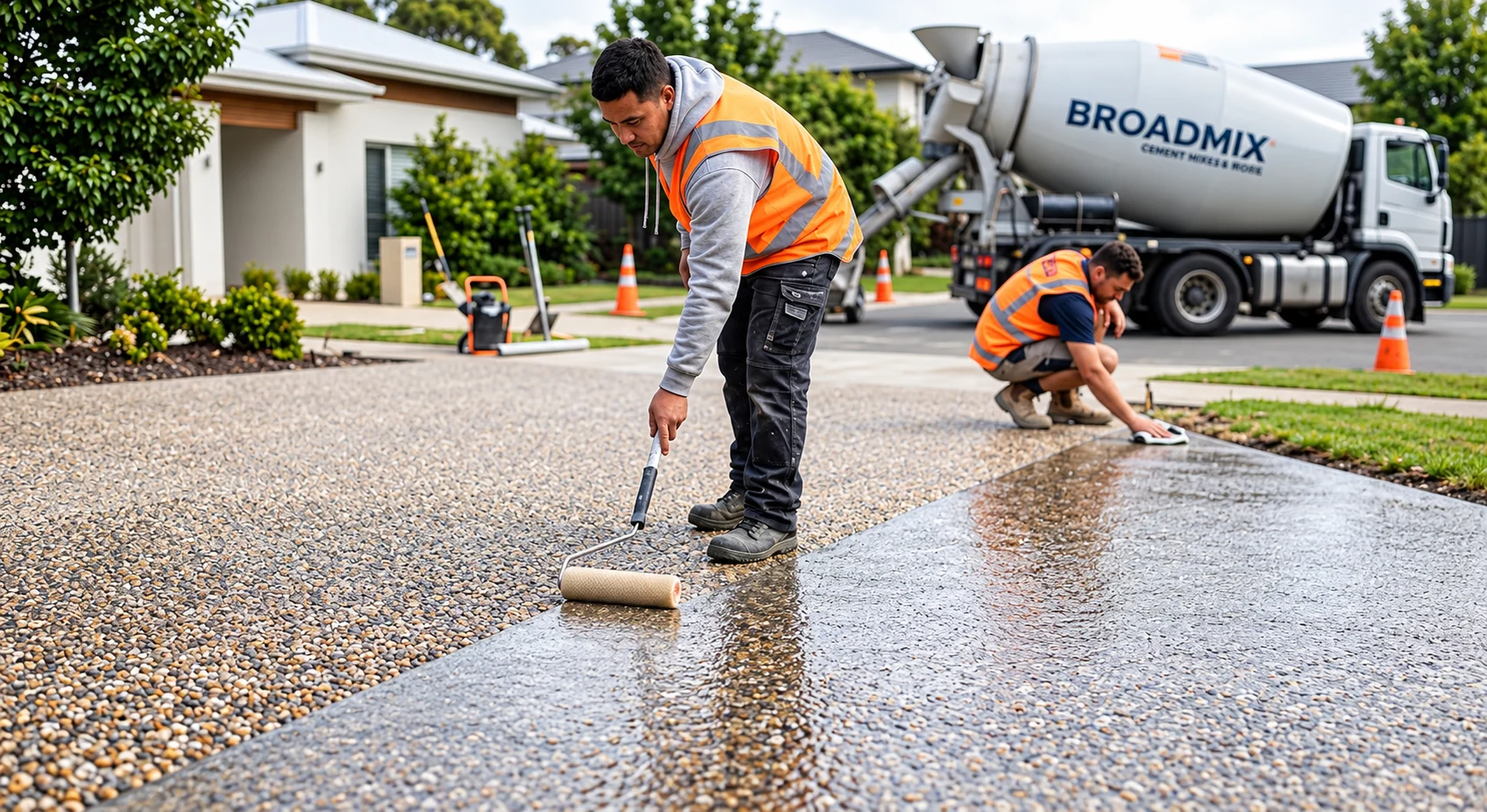
Yes, you should seal exposed aggregate concrete, because the textured surface is porous, and sealing protects it, enriches the stone colour and makes cleaning far easier. It is closer to necessary on exposed aggregate than on plain concrete, since all those gaps between stones hold dirt, absorb spills and give moss somewhere to take hold. An unsealed exposed aggregate driveway will not fall apart, but it will look tired sooner and clean up worse. There are two genuine catches worth knowing before you commit. Sealing is an ongoing obligation rather than a one-off, because a slab that gets sealed then neglected ends up looking worse than one never sealed at all. And some sealers reduce slip resistance, which matters on a sloped driveway. Both are manageable, but decide with them in view.
| Sealed | Unsealed | |
|---|---|---|
| Stone colour | Rich and defined | Flat and dusty looking |
| Cleaning | Hoses off easily | Dirt sits in the texture |
| Oil and stains | Sit on top, time to wipe | Absorb quickly |
| Moss and algae | Strongly resisted | Takes hold in shade |
| Surface ravel | Bound and stable | Stones can loosen over years |
| Ongoing cost | Reseal every 2 to 3 years | None |
| Slip resistance | Depends on product chosen | Naturally excellent |
What Sealing Actually Does
Understanding the mechanism makes the rest of the decision straightforward, and it is simpler than the product marketing suggests. A sealer fills or coats the pores.
Concrete is porous, and exposed aggregate doubly so because the washed surface leaves an open texture with gaps between every stone. A sealer either soaks into those pores or forms a thin film across them, so water, oil, dirt and organic matter sit on the surface instead of soaking in. That is the entire principle. Everything else follows from it. Stains become wipeable rather than permanent because they have not penetrated. The stones look richer because the sealer fills surface irregularities and light scatters less, much as a wet stone looks deeper in colour than a dry one. And the surface holds together better because the sealer binds the exposed cement paste that anchors each stone.
The Case for Sealing
Four things make sealing worth the money on exposed aggregate specifically, rather than on concrete generally. The texture drives all of them.
Appearance is the most immediate, and the difference is not subtle. A sealed exposed aggregate slab shows the stone colour properly, which is the entire reason you paid for a decorative finish rather than a broom finish. Cleaning is the practical one, because a sealed surface hoses off while an unsealed one holds grime in every gap and needs scrubbing. Stain protection matters more here than on smooth concrete, since oil, leaf tannins and rust from garden furniture absorb readily into an open surface. And surface durability matters over the long term, because the cement paste holding the stones weathers slowly and a sealed surface loses stones far more slowly than an unsealed one. See the benefits of exposed aggregate for what you are protecting.
The Honest Case Against
There are real arguments on the other side and they deserve stating plainly, because a page selling sealers that pretends otherwise is not worth reading. Three points are legitimate.
Cost is the obvious one, and it is not a single cost but a recurring one every two to three years for the life of the driveway. Slip resistance is the serious one, since exposed aggregate has excellent natural grip and some sealers, particularly high-gloss solvent-based products, reduce it noticeably on a surface people walk on in the wet. And there is a real risk of a poor result, because sealer applied badly to a textured surface pools in the gaps, dries unevenly, and on film-forming products can later peel or cloud if moisture gets underneath. None of these are reasons not to seal. They are reasons to choose the product carefully and either apply it properly or have someone do it.
Once You Seal, You Are Committed
This is the point most worth understanding before you start, and almost nothing written about sealing mentions it. The decision is not really whether to seal once.
A sealed slab that is maintained looks excellent. A slab that has never been sealed weathers evenly and looks acceptable in a plain sort of way. A slab that was sealed once and then left for eight years looks worse than either, because film-forming sealers wear unevenly, going first in the wheel tracks and at the entry while staying intact in sheltered corners, leaving a patchy surface with visible boundaries between worn and unworn areas. Stripping and starting again is the only proper fix and it is more work than resealing would have been. So the honest question is not should you seal, but will you reseal every two to three years for as long as you own the place. If the answer is genuinely no, a penetrating sealer, which wears more gracefully, is a better choice than a film-forming one.
When to Seal
Timing is where most sealing jobs go wrong, and the rule is simple. Wait 28 days.
Most sealers need the concrete to have completed its initial moisture loss, which takes the full curing period. Seal before that and you trap moisture under the coating, where it appears as a cloudy white bloom within months and can only be fixed by stripping and redoing the job. Some water-based products permit earlier application, so check the datasheet rather than assuming. The surface also needs to be clean and completely dry when you apply, which on a textured surface means several dry days rather than one, since water sits in the gaps between stones long after the high points look dry. Our guide on how long concrete takes to cure covers the full timeline from pour to sealing.
Which Sealer for Exposed Aggregate
The main choice is between a sealer that soaks in and one that sits on top, and it changes both the look and the long-term commitment. Neither is wrong.
A penetrating sealer, sometimes called an impregnating sealer, soaks into the surface without forming a film. It gives good stain and water resistance, keeps the natural matte look, barely affects slip resistance, and wears evenly rather than patchily, which makes it the forgiving choice. What it does not do is enhance the stone colour much. A film-forming acrylic sealer sits on the surface and delivers the wet-look enrichment most people associate with exposed aggregate, showing the stones at their best, but it needs recoating more often and can affect grip. Solvent-based versions enhance more strongly than water-based. Look through our concrete sealers range or talk to us about which suits your slab, aspect and how much maintenance you want to take on.
Slip Resistance Deserves a Thought
On a driveway or a pool surround this is a safety question rather than a preference, and it is worth raising before you buy rather than after you slip. Exposed aggregate starts with an advantage here.
The raised stone profile gives exposed aggregate genuinely excellent natural grip, and a glossy film-forming sealer can partly smooth that advantage away, particularly when wet. If your driveway slopes, sits in shade, faces south into winter damp, or leads to a pool where people walk barefoot and wet, either choose a penetrating sealer or ask for an anti-slip additive to be mixed into a film-forming one. These additives are fine-grained and largely invisible in a textured surface. It is a small decision at purchase and a difficult one to reverse afterwards.
How Often to Reseal
Every two to three years is the general rule, with the slab itself giving you a better signal than the calendar does.
Driveways and high-traffic areas sit at the shorter end, while sheltered paths and patios stretch longer. The simplest test is to splash water on the surface. If it beads, the sealer is working. If it soaks straight in and darkens the concrete, it is due. Fading, a chalky appearance or stains that suddenly start sticking all point the same way. Clean the slab thoroughly and let it dry completely before recoating, since sealing over trapped dirt or moisture locks the problem in. Where a slab has heavy cement haze or stubborn efflorescence, acid washing before sealing will give a better result, though it is not needed on a routine reseal.
Frequently Asked Questions
Is it necessary to seal exposed aggregate concrete?
Not structurally, but it is strongly recommended. An unsealed slab will not fail, though it will hold dirt in the texture, absorb stains readily, look flatter in colour and lose surface stones faster over the years. Sealing is closer to necessary on exposed aggregate than on plain concrete.
How long after pouring can you seal exposed aggregate?
Wait 28 days for the concrete to cure and complete its initial moisture loss. Sealing earlier traps moisture and produces a cloudy bloom under the coating that can only be fixed by stripping and redoing it. Some water-based sealers allow earlier application, so check the product datasheet.
How often should exposed aggregate be resealed?
Every two to three years for most driveways, longer for sheltered areas. Test by splashing water on it. Beading means the sealer is still working, while water soaking in and darkening the surface means it is due.
Does sealing make exposed aggregate slippery?
It can, particularly with high-gloss solvent-based products on a wet surface. Exposed aggregate has excellent natural grip to begin with, so choose a penetrating sealer or ask for an anti-slip additive if the driveway slopes, sits in shade, or leads to a pool.
What happens if you never seal exposed aggregate?
It will not fail, but it will hold dirt in the texture and need more scrubbing, absorb oil and organic stains, look dull rather than rich, grow moss in shaded spots, and slowly lose surface stones as the cement paste weathers. It weathers evenly though, which is more than can be said for a slab sealed once and then neglected.