
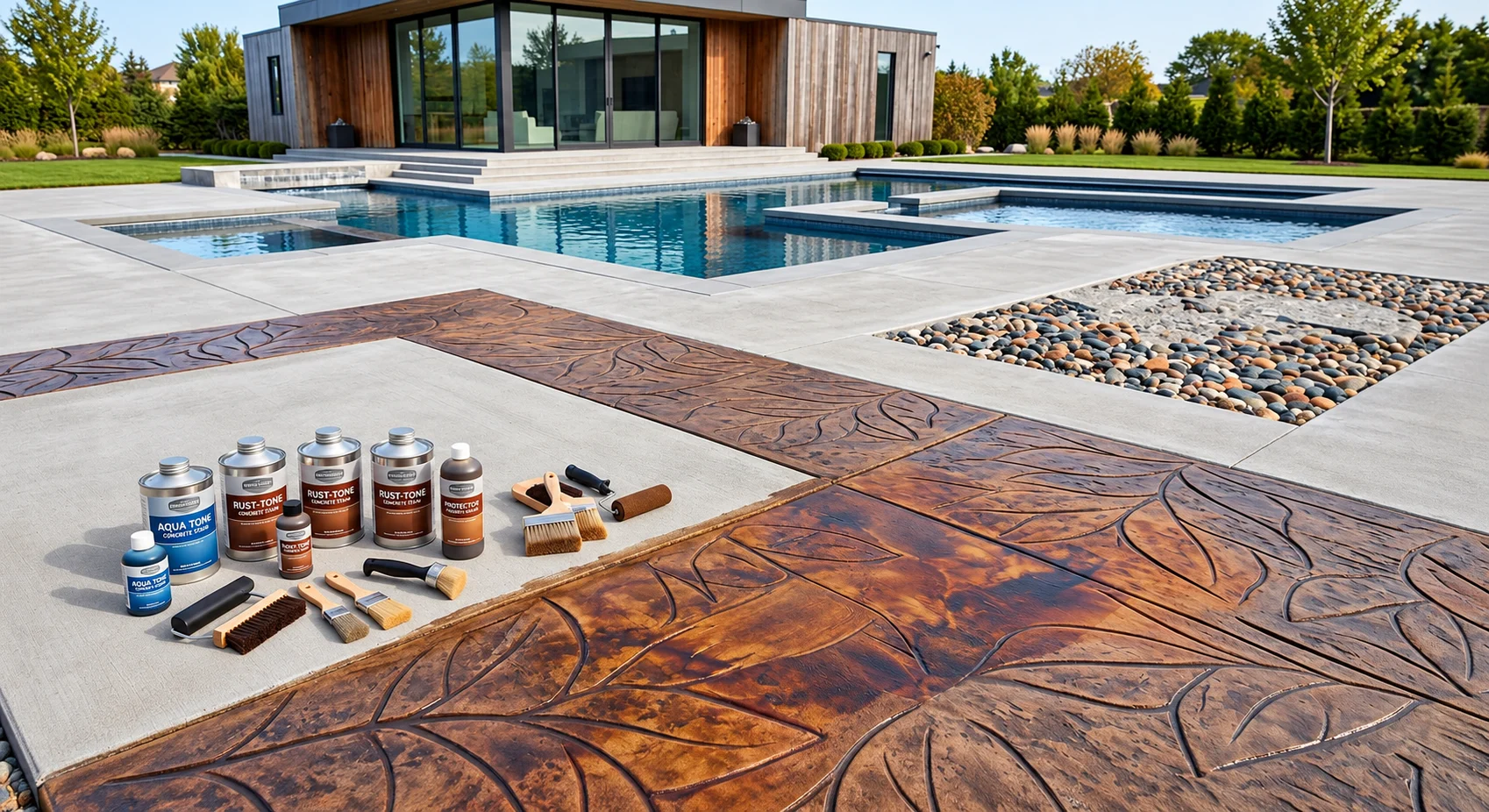
Coloured concrete is better for driveways and new pours because the pigment runs through the full slab, while stained concrete is the better choice for existing concrete. That fork answers the question for most people before any comparison of finishes is needed. Coloured concrete is decided at the batching plant and can only be done when you are pouring something new. Staining is applied to concrete that has already cured, which makes it the only option if you have a grey slab you want to change. They also look different in a way that matters, since integral colour gives a uniform solid tone while acid staining gives a mottled, translucent, stone-like finish that no two slabs share. Neither is simply better. They answer different questions.
| Coloured concrete | Stained concrete | |
|---|---|---|
| How colour is added | Oxide pigment mixed at the plant | Applied to cured concrete |
| Colour depth | Full slab depth | Around 1 to 3 mm |
| Works on existing slabs | No, new pours only | Yes, its main advantage |
| Appearance | Uniform, solid, predictable | Mottled, variegated, translucent |
| Colour range | Wide, consistent batch to batch | Acid stain limited to earth tones |
| Chips and wear | Colour continues underneath | Grey shows through |
| Predictability | High, dosed to a recipe | Low, reacts with each slab |
| Best for | Driveways, paths, new slabs | Existing slabs, interiors, patios |
| Sealing | Recommended | Essential |
They Are Not Really Competing Options
Most comparisons treat these as two ways of doing the same job, which is misleading and sends people down the wrong path. The deciding factor is usually your slab, not your taste.
If you are pouring new concrete, both are technically available to you, and integral colour is the stronger choice for anything carrying vehicles. If you already have a slab, integral colour is simply not an option, because the only way to get pigment through the depth of concrete is to put it in before it sets. At that point staining is not competing with anything, it is the answer. So before weighing up finishes, establish which situation you are in. It resolves the question for a large share of people asking it, and it is the reason head-to-head comparisons of these two so often feel unsatisfying.
What Coloured Concrete Is
Coloured concrete, properly called integral colour, has the pigment in the mix rather than on the surface. That single fact drives every advantage it has.
Iron oxide pigment is dosed at the batching plant, either as a powder or a liquid, and mixed through the whole load to a set recipe for the volume. What arrives is ordinary concrete at the strength you ordered, carrying colour all the way through. Because the dosing happens by batch rather than by hand on site, the colour is even from the first barrow to the last, and it is repeatable if you order the same mix again. The palette is broad, covering creams, sandstones, terracottas, reds, browns, charcoals and custom greys. Our post on coloured ready mix concrete covers how it is made and ordered.
What Stained Concrete Is
Staining covers two quite different products that behave differently, and most content discussing stained concrete does not distinguish between them. It is worth knowing which you are considering.
Acid stain, also called reactive stain, uses metallic salts in an acidic solution that react chemically with the free lime in cured concrete, depositing insoluble coloured compounds in the surface pores. The result is genuinely bonded rather than sitting on top, and it produces the translucent, mottled, marbled look that acid staining is known for. The palette is limited to earthy tones, mainly tans, browns, terracottas, soft blue-greens and blacks, and the result is not fully predictable because it depends on the chemistry of your particular slab. Water-based or acrylic stains are different, using fine pigment particles that penetrate the pores without reacting. They offer a much wider colour range and a more uniform result, but they sit shallower and depend more heavily on a maintained sealer.
Depth Is the Decisive Difference
If you remember one thing from this comparison, make it this, because it determines how each finish ages under traffic. There is a simple test that makes it obvious.
Chip a piece off coloured concrete and the exposed surface underneath is the same colour, because the pigment goes all the way through. Chip a piece off stained concrete and you see grey, because the colour is only in the top millimetre or two. On an interior floor or a low-traffic patio that difference may never show. On a driveway, where tyres abrade the surface, the edge takes knocks and a trench may one day be cut through it, that difference is the whole argument. Integral colour has depth in reserve and surface colour does not, which is why the same wear that barely registers on a coloured slab shows clearly on a stained one.
The Look Is Genuinely Different
Setting durability aside, these two produce visually distinct results, and some people specifically want what staining does. This is a real aesthetic choice rather than a compromise.
Integral colour gives a solid, even, consistent tone across the whole slab. It reads as deliberate and modern, and it is what you want if you are matching a colour scheme or after a clean contemporary finish. Acid staining gives a variegated, translucent finish with tonal variation across the surface, closer to natural stone or leather than to paint, and every slab comes out unique because it depends on the slab’s own chemistry. If you want that organic mottled character, integral colour cannot reproduce it. If you want predictable uniformity, acid staining cannot deliver it reliably. Neither limitation is a fault.
Which Wins for a Driveway
For a driveway, coloured concrete is the clearer choice, and the reasons are practical rather than aesthetic. Traffic is what separates them.
A driveway takes constant tyre abrasion, point loads, the occasional dragged object and edge knocks, and it may be trenched for services at some point. Integral colour absorbs all of that without revealing grey, while a stained surface wears through in the wheel tracks first and shows it. Integral colour is also more predictable, which matters when you are committing a large visible area to one decision. And it involves no separate application step, since the colour arrives in the truck rather than requiring a contractor back on site afterwards. Our page on how long coloured concrete lasts explains why integral pigment effectively does not fade, and concrete driveway types sets out the finishes it can be combined with.
When Staining Is the Better Choice
There are clear situations where staining wins outright, and it is worth being straightforward about them rather than steering everyone toward a new pour.
Existing concrete is the main one. If you have a sound grey slab and want to transform it, staining does that for a fraction of the cost and disruption of removing and repouring, and there is no realistic alternative. Interior floors are the second, since acid stained floors are popular precisely for the mottled depth they produce, and an interior floor sees no tyre wear or weather. Sheltered patios, courtyards and alfresco areas sit in similar territory. Staining also suits anyone wanting a specific variegated look that integral colour cannot produce, and it is more accessible to a capable DIYer than getting a coloured pour right. If your slab is sound and you like the mottled aesthetic, stain it and do not feel you have settled.
Cost, Maintenance and Repairs
The running costs are closer than the headline prices suggest, and repairs favour integral colour on both counts.
Integral colour adds a modest premium per cubic metre to a pour you were doing anyway, so the incremental cost is small relative to the job. Staining is a separate labour operation with its own materials, surface preparation and sealing, which makes it cheaper than repouring but not cheap in isolation. Both need sealing, though staining depends on it more heavily since the colour sits shallow and an unsealed stained slab degrades visibly. Repairs are difficult for both, but a patch in coloured concrete at least carries pigment through its own depth, whereas a patch in a stained slab has to be restained to match a finish that was never uniform to begin with. Our protecting coloured concrete guide and our concrete sealers range cover the maintenance side.
Deciding
Two questions settle it in almost every case, and the first one does most of the work.
Are you pouring new concrete or working with an existing slab? Existing means staining. New means you have a choice. Then, is the surface going to carry vehicles? If yes, choose integral colour, since depth matters more than anything else once tyres are involved. If no, and you want a mottled organic look, staining is a legitimate and often better answer. We batch coloured pre-mix concrete to a set dose across the full pour, so call +61 3 5784 1500 or use our contact page and we will talk through colour and finish together.
Frequently Asked Questions
Is coloured concrete better than stained concrete?
For driveways and new pours, yes, because the pigment runs through the full slab so wear does not reveal grey underneath. For existing concrete, staining is better simply because integral colour is not possible on a slab that has already set.
Can you stain existing concrete?
Yes, and this is staining’s main advantage. A sound existing slab can be cleaned, stained and sealed for far less cost and disruption than removing and repouring it. Integral colour cannot be added to concrete after it has cured.
Does stained concrete fade?
Acid stain is chemically bonded and does not fade as such, but it only penetrates 1 to 3 millimetres, so traffic wear can abrade through it and expose grey. Water-based stains sit shallower again and depend more on a maintained sealer. Integral colour does not have this problem.