
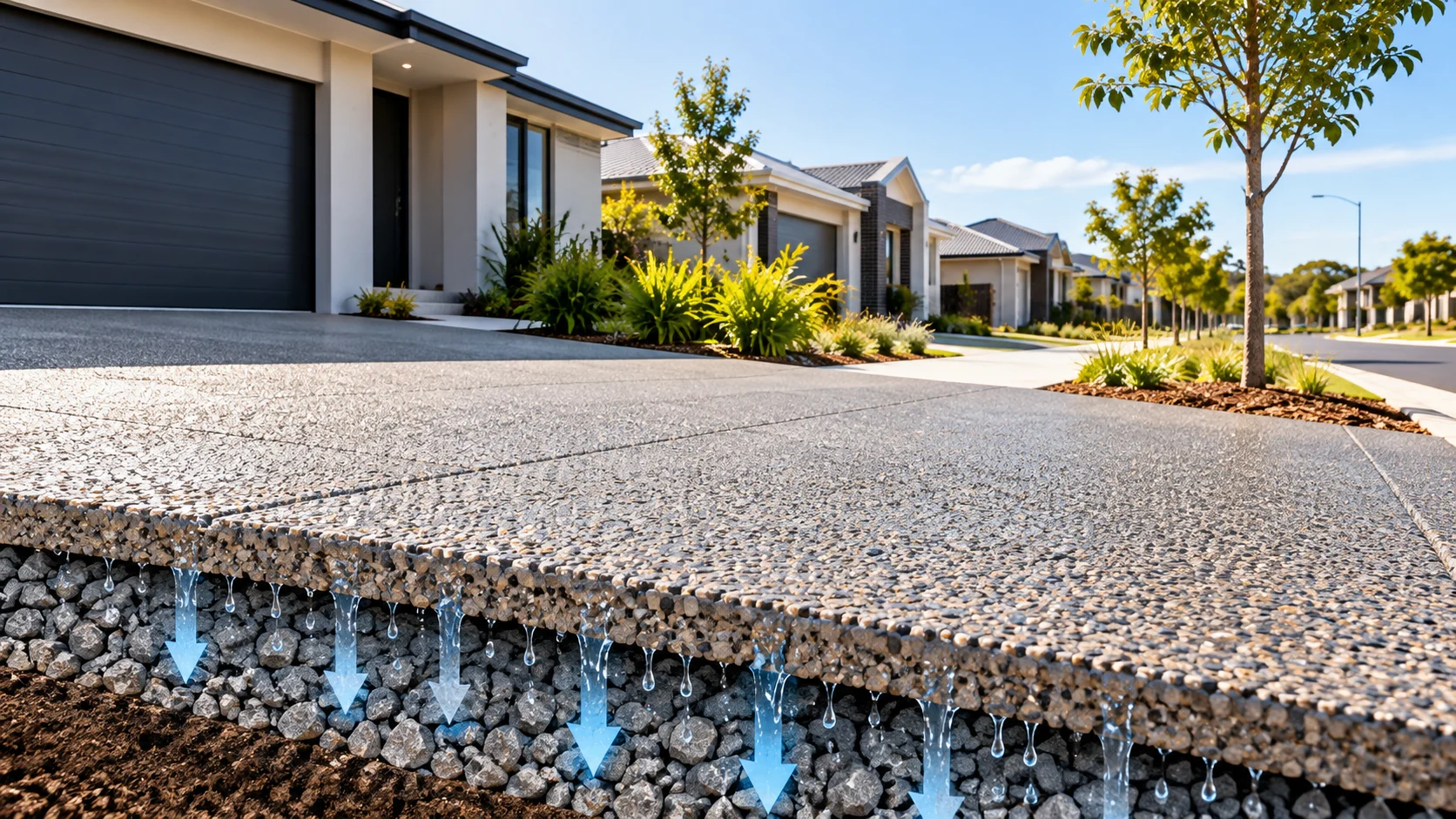
Your planning permit has arrived, and somewhere among the conditions is a line about stormwater. It might ask for a minimum permeable site area, a stormwater management plan, or proof that the development meets best practice targets. If you have been considering permeable concrete for the driveway or paths, the obvious question is whether it will satisfy that condition.
The short answer: permeable concrete can help meet stormwater permit conditions in Victoria, but it does not do so automatically. Councils generally accept it as part of a stormwater solution when it is properly designed, supported by product specifications, and backed by a maintenance plan. Whether it fully satisfies your particular condition depends on the wording of the permit and on the council assessing it.
Which planning rules are involved?
Most stormwater conditions on residential and subdivision permits in Victoria trace back to a handful of planning provisions.
| Provision | Applies to | What it asks for |
| Clause 55.03-4 (Standard B9) | Two or more dwellings, units, townhouses | At least 20% of the site not covered by impervious surfaces, plus stormwater management |
| Clause 53.18 | Subdivisions and many urban developments | Stormwater managed on site to meet best practice quality and flow objectives |
| Council local policy | Varies by municipality | Extra requirements, such as on-site detention or specific WSUD measures |
Under Clause 53.18, the best practice targets for stormwater quality are an 80% reduction in suspended solids, a 45% reduction in phosphorus and nitrogen, and a 70% reduction in litter, all compared with an untreated site. Permeable pavements contribute to these targets because water filters through the surface and stone base rather than running straight into drains.
Does it count as a permeable surface?
This is where councils differ, and it catches many applicants out.
Some councils accept a correctly designed permeable concrete surface as pervious area towards the 20% requirement. Others count it as partly pervious, or they only accept it when an engineer’s design shows it will keep infiltrating over time. A few councils prefer garden beds and lawn for the minimum permeable area, and treat permeable paving as an extra stormwater measure rather than a replacement for them.
Before you lock in a design, check two things:
- How your council treats permeable paving in its site coverage and permeability calculations.
- The exact wording of your permit condition. “Not covered by impervious surfaces” is assessed differently from “a stormwater management plan to the satisfaction of the responsible authority”.
A short phone call or email to the council’s planning or engineering team usually settles this quickly.
What do councils want to see?
When permeable concrete forms part of your stormwater response, councils typically ask for some or all of the following:
- Product specifications showing the mix’s void content and infiltration rate.
- A pavement design detailing the concrete thickness, sub-base depth, geotextile and any underdrain.
- Soil information, particularly for clay sites, where water soaks away slowly.
- A stormwater assessment. Smaller developments often use Melbourne Water’s STORM calculator. Larger subdivisions usually need MUSIC modelling by an engineer.
- A maintenance plan explaining how the surface will be kept clear of sediment so it continues to drain.
The pavement design is where many applications go wrong. A permeable surface only performs as well as the stone layer beneath it. Our article on the sub-base a permeable concrete driveway needs explains the layers and depths that councils and engineers expect to see.
Why maintenance matters to council
Councils think long term. A permeable surface that clogs with silt after five years becomes an impervious one, and the stormwater benefit is lost. That is why many permit conditions or approved plans include ongoing maintenance requirements.
A typical maintenance plan covers:
- Regular sweeping to remove leaves and grit
- Periodic vacuum sweeping or pressure washing to clear surface pores
- Keeping soil, mulch and sand stockpiles away from the surface
- No film-forming sealers, which close the pores
For owners corporations and new estates, these tasks are often written into handover documents so future owners understand their obligations.
Growth areas face more scrutiny
New suburbs along the Hume corridor are some of the fastest-growing areas in Victoria. That growth puts real pressure on local drainage networks and waterways. Developments in places such as Mickleham, Beveridge and Donnybrook are therefore likely to face detailed stormwater conditions, particularly on multi-lot subdivisions.
For developers working at that scale, permeable surfaces are often used on footpaths, parking bays and driveways across a whole estate. We cover how that works in practice in our article on permeable concrete for new housing estates.
Permeable concrete or no fines concrete?
You may see both names on plans and permit documents. In practice they describe the same type of product: a concrete mix without fine sand, which leaves open voids for water to pass through. “Pervious concrete” is another common name for it.
If your engineer or council specifies one of these terms, the requirement is the same: a mix with enough void content and infiltration rate to meet the design. Our no fines concrete mix is supplied for exactly this purpose.
Frequently asked questions
Will permeable concrete alone satisfy my stormwater condition?
Sometimes, but not always. On many sites it works alongside other measures, such as rainwater tanks, garden beds or raingardens. Check the permit wording and your council’s approach.
Do councils accept permeable concrete towards the 20% permeable site area?
Some do in full, some only partly, and some require engineering evidence. Ask your council before finalising your site plan.
What documents does Broadmix provide?
Broadmix can provide product specifications for its permeable mix to support your planning or engineering documentation.
Do I need an engineer?
For subdivisions and larger developments, yes. For a single driveway, it depends on the permit condition, but an engineer’s pavement design makes approval more straightforward.
Can I seal permeable concrete?
Do not use film-forming sealers, because they block the pores and remove the stormwater benefit that the permit relies on.