
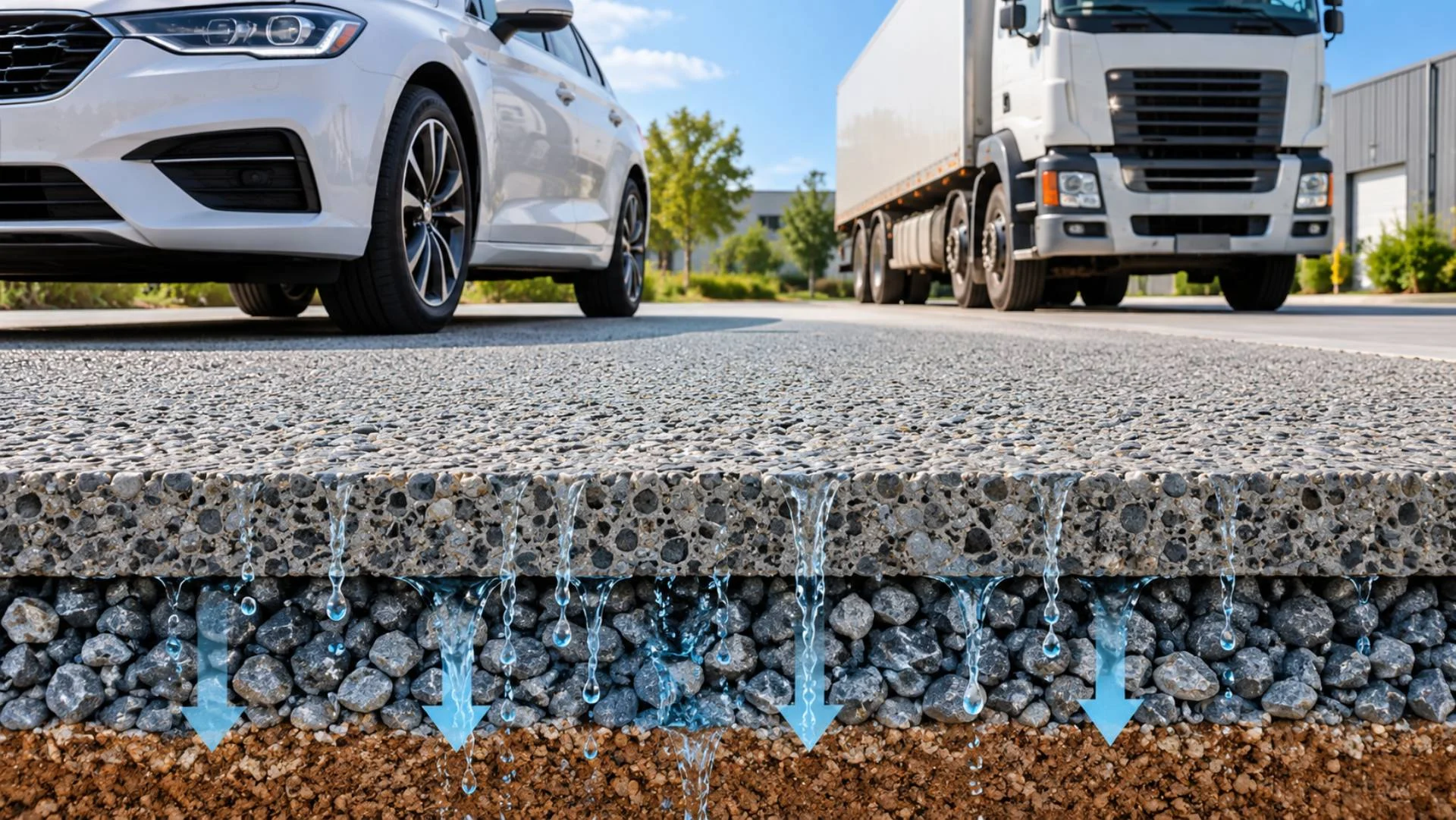
A standard residential driveway is usually poured with 25 MPa premix. A typical permeable mix sits lower, often somewhere between 10 and 20 MPa. The gap comes from the open voids that let water drain through. Those same voids mean there is less solid material to carry weight.
That lower number does not make permeable concrete weak. It handles everyday cars, SUVs and utes comfortably when it is built to the right thickness on a well-prepared base. Where it reaches its limits is with heavy trucks, frequent truck traffic, and tight turning areas.
Strength versus standard concrete
| Property | Standard driveway premix | Typical permeable mix |
| Compressive strength | Around 25 MPa | Around 10 to 20 MPa |
| Air voids | Very low | 15 to 25% |
| Flexural strength | Higher | Lower |
| Surface wear under turning tyres | Very good | Moderate |
Compressive strength is the figure most people quote, but flexural strength also matters for driveways. It measures how well a slab resists bending under a wheel load. Permeable concrete is lower on both measures, which is why its slab is usually poured thicker than a standard driveway. If you want to understand the numbers better, our explainer on what concrete MPa ratings mean covers how strength grades are measured.
Which vehicles suit a permeable surface?
| Vehicle | Suitability | Typical slab thickness |
| Cars and small SUVs | Excellent | 125 mm |
| Large SUVs, utes and vans | Very good | 125 to 150 mm |
| Caravans, boats and trailers | Good, with care | 150 mm or more |
| Light commercial vehicles | Possible, with an engineered design | 150 to 200 mm |
| Heavy trucks and frequent truck traffic | Not recommended | Use standard concrete |
These thicknesses are typical guides for residential work. An engineer should confirm the design wherever heavier or commercial vehicles are involved.
What limits its load capacity?
Thickness is only one part of how well a permeable driveway carries weight. Four other factors make a real difference.
The base underneath. A permeable slab relies heavily on the stone layer below it for support. A well-compacted, open-graded base spreads the load and keeps the slab stable. Our article on the stone base beneath the slab explains the depths and materials involved.
Turning tyres. The biggest wear on permeable concrete comes from wheels twisting in place, not from straight-line driving. Tight turns, three-point turns and parking manoeuvres can gradually loosen surface stones, a problem known as ravelling. Keep turning areas generous, or use dense concrete in those spots.
Point loads. Caravan jockey wheels, trailer stands and car jacks put a lot of weight on a small area. Place a timber pad or steel plate underneath to spread the load.
Curing. Permeable concrete only reaches its design strength if it is covered and kept moist while it cures. A slab that dries out too fast in hot or windy weather will be weaker at the surface.
What about trucks?
The occasional light delivery truck or small tipper on a properly designed driveway is usually fine. Regular heavy trucks are a different matter. That includes concrete agitators, loaded tippers, horse floats with heavy stock, and farm machinery.
For properties with regular truck access, the most practical approach is a hybrid layout. Use a dense standard mix for the truck route and turning bay, and permeable concrete for the car parking and pedestrian areas. Our dense premix for truck turning areas suits the heavy-duty zones, while the permeable sections keep runoff down elsewhere.
This hybrid setup is common on larger rural blocks, such as those around Seymour and Shepparton. There, the same driveway may serve a family car and a stock trailer or feed delivery.
Protect it during construction
New permeable driveways are often damaged before anyone moves in. Heavy construction traffic and building sediment are the two main risks. To protect the surface:
- Keep concrete trucks, tippers and machinery off the finished surface. Pour the driveway late in the build if possible.
- Do not drive on it until it has cured. Allow at least seven days for light vehicles, and longer in cold weather.
- Cover it while soil, sand or render is being worked nearby, so sediment cannot clog the pores.
Frequently asked questions
Can I park a caravan on permeable concrete?
Yes. Use a slab of at least 150 mm on a well-built base, and put a pad under the jockey wheel and stabiliser legs.
Will a garbage truck damage a permeable driveway?
Bin trucks usually stay on the street. If one needs to drive onto your property regularly, use standard concrete for that section.
Is permeable concrete strong enough for a commercial car park?
For cars and light vehicles, yes, with an engineered design. Delivery bays and truck routes should be dense concrete.
Can I make permeable concrete stronger?
Thickness, base quality and careful curing make the biggest difference. Some mixes also include additives that improve strength. Ask about our no fines mix options for your project.