
Every autumn across Central Victoria, leaves pile up on driveways, paths and car parks. On plain concrete they are only untidy. On permeable concrete they matter more, because leaves, dust and fine soil gradually settle into the open pores that let water drain through.
Permeable concrete does not need much maintenance, but it does need a different kind. Plain concrete is cleaned mainly for appearance. Permeable concrete is cleaned to keep its pores open. Regular sweeping, a deeper clean once or twice a year, and avoiding a few common mistakes will keep it draining for 20 years or more.
Why permeable surfaces clog
Water drains through permeable concrete via small connected voids between the stones. Anything finer than those voids can work its way in and get stuck. The usual culprits are:
- Fine soil washed from garden beds or bare ground
- Sand and dust from nearby building or landscaping work
- Leaf litter breaking down into fine organic matter
- Mulch and lawn clippings blown or tracked onto the surface
- Moss and algae in shaded, damp areas
Clogging happens slowly, starting at the surface. That is good news. Most of it can be removed before it causes drainage problems.
A simple maintenance schedule
| Task | How often | Purpose |
| Sweep or blow off leaves and debris | Monthly, and after storms | Stops material breaking down into the pores |
| Bucket drainage test | Every 6 months | Checks the surface is still draining |
| Pressure wash or vacuum sweep | Once or twice a year | Lifts trapped fines out of the pores |
| Check edges and nearby garden beds | Twice a year | Finds sources of soil runoff |
| Treat moss in shaded areas | As needed | Keeps pores clear and the surface safe underfoot |
Busy surfaces, such as estate footpaths and visitor parking, may need cleaning more often. Driveways surrounded by large trees will also need more frequent sweeping in autumn. Our article on maintenance for estate paths and parking bays covers how developers build this into handover plans.
The bucket test
A quick way to check drainage is to tip a bucket of water onto the surface.
- Water disappears almost immediately: the surface is draining well.
- Water spreads and sits for a while before soaking in: the pores are partly clogged and due for a clean.
- Water pools or runs off: the surface needs a deep clean, or there may be a problem with the base below.
Test a few spots, especially low points, shaded areas and the edges beside garden beds. Those areas usually clog first.
How to clean it properly
Sweeping. A stiff outdoor broom or leaf blower removes loose material before it settles in. This is the most important habit.
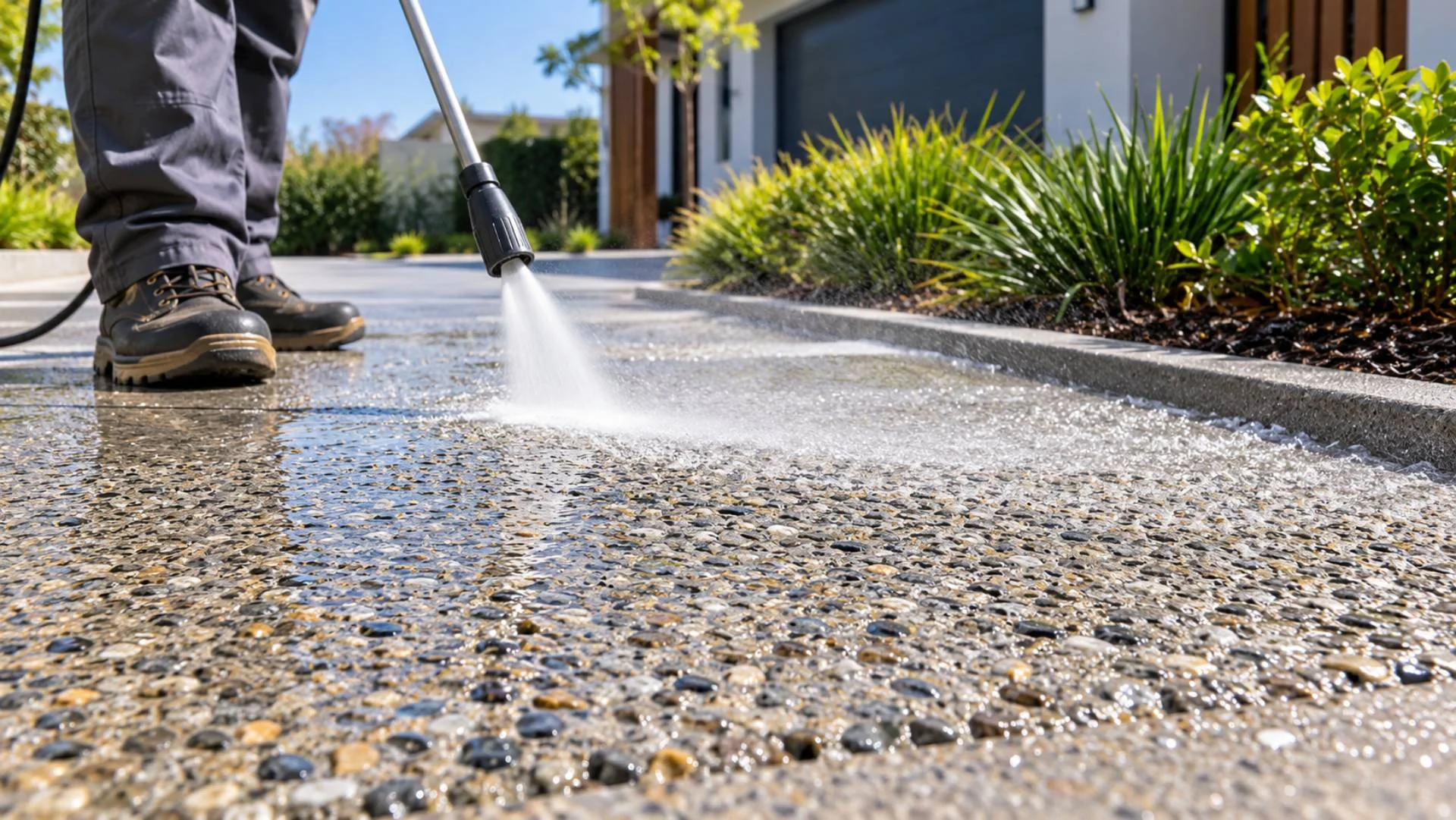
Pressure washing. Hold the nozzle at an angle rather than straight down, so dirt is lifted out of the pores instead of being pushed deeper. Use a fan tip at a sensible distance, because a concentrated jet held too close can loosen surface stones.
Vacuum sweeping. For large areas such as car parks and estate paths, a vacuum sweeper truck is the most effective option. It pulls fine material out of the pores rather than washing it around.
Moss and algae. Use a treatment that does not leave an oily or sticky film behind. Then sweep the dead growth away once it has dried.
Mistakes that cause lasting damage
Some common habits from plain concrete maintenance are harmful on permeable surfaces:
- Applying a film-forming sealer. Glossy or acrylic sealers block the pores entirely. If you are unsure what can go on your surface, ask before you buy from our concrete sealer range.
- Stockpiling soil, sand or mulch on it. Even one delivery left on the driveway can clog a section.
- Patching with standard mortar. Repairs should use a permeable mix, otherwise the patch becomes a solid plug.
- Washing soil down from garden beds. Edge garden beds with a border so soil cannot wash onto the surface.
- Heavy turning on a new surface. Twisting tyres can loosen surface stones. We explain how to prevent this in avoiding surface wear from turning tyres.
Can a clogged surface be restored?
In most cases, yes. A surface that has slowed down can usually be restored with a thorough pressure wash or vacuum sweep. Badly neglected areas may need several passes, or a specialist cleaning contractor.
If water still pools after a deep clean, the problem may be below the surface. Common causes are a compacted base or soil that has migrated into the stone layer. In that case, an engineer or experienced contractor should inspect it before any repair.
Why it matters for permits
On many properties, permeable concrete is part of how the site meets its permeability or stormwater conditions. If the surface clogs, it stops doing the job it was approved for. Councils and building surveyors increasingly ask for a maintenance plan for exactly this reason. Our article on council maintenance expectations for stormwater approval explains this in more detail.
Frequently asked questions
Is permeable concrete more work than plain concrete?
Not much more. It needs regular sweeping and one or two deeper cleans each year. Plain concrete needs periodic resealing, which permeable concrete does not.
Can I use a pressure washer on permeable concrete?
Yes. Use a fan tip, hold it at an angle, and keep a sensible distance so you do not loosen the surface stones.
Should permeable concrete be sealed?
Not with a film-forming sealer. Some penetrating products may be suitable, but check with your supplier first.
How long does permeable concrete last with good maintenance?
A well-built, well-maintained permeable surface can last 20 years or more.