
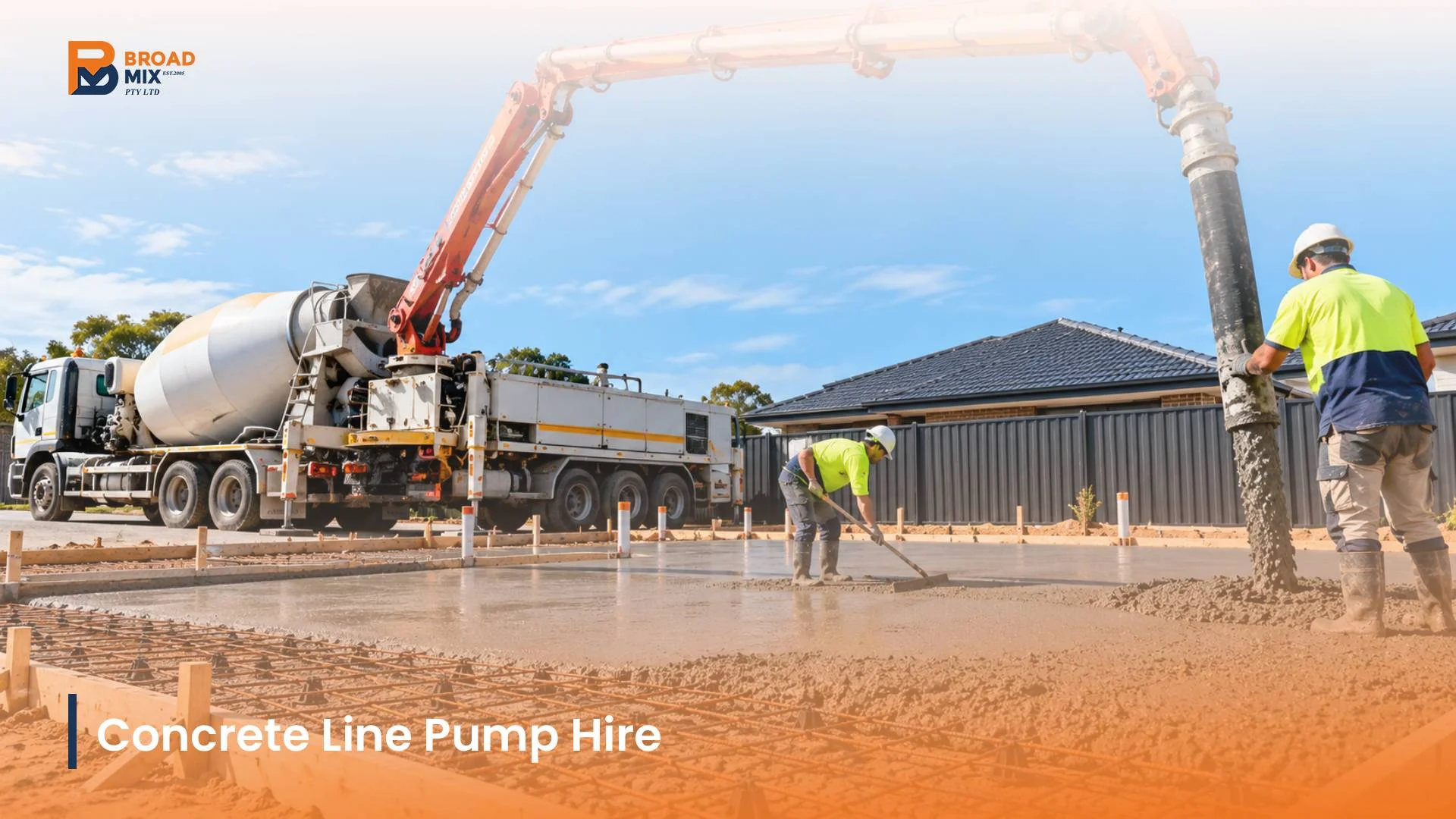
Yes, we offer concrete line pump hire for jobs where a truck cannot reach the pour. A line pump moves concrete through a series of hoses from the truck to where you need it, so it can get concrete around the side of a house, into a backyard, over a fence, or into a tight or restricted spot that the truck’s chute cannot reach. It is the practical answer for a huge number of residential pours across Central Victoria, where backyard slabs, narrow blocks, and difficult access are common. We can arrange the line pump along with your concrete supply, so the mix and the pump are coordinated for the same pour. The table below shows how a line pump compares with the larger boom pump.
| Line pump | Boom pump | |
| How it works | Pumps concrete through ground-level hoses | Pumps via a truck-mounted boom arm |
| Best for | Tight access, backyards, smaller residential pours | Large pours, or high and long reach |
| Reach | Along the ground, around obstacles | Up and over, from a fixed position |
| Typical use | Most home slabs and paths | Big commercial and multi-storey jobs |
What a Concrete Line Pump Is
Before deciding whether you need one, it helps to know what a line pump actually does. It is simpler than it sounds.
A concrete line pump is a pump, often trailer-mounted, that takes concrete from the delivery truck and pushes it through a line of flexible and steel hoses to the pour. The hoses run along the ground and can be laid around corners, down the side of a house, through a gateway, or over a fence, so the concrete arrives exactly where it is needed rather than only where the truck can park. Because the hoses are moved by hand, a line pump is well suited to the tight, awkward access that residential sites so often have. It turns a pour that would otherwise mean endless wheelbarrow runs into a quick, controlled job.
When You Need a Line Pump
The main reason to hire a line pump is access, so the question is really how easily a truck can get concrete to your pour. A few common situations point straight to a pump.
If your pour is in the backyard and the only way in is a narrow side path or a gate, a truck cannot reach it and a line pump is the answer. The same applies when the slab is behind the house, down a slope, across a soft lawn the truck must not drive on, or separated from the driveway by a fence or garden. Pouring a shed or man cave slab at the rear of a block, a path around the house, or a pool surround often needs a pump for the same reason. As a rule, if the truck cannot get its chute within a couple of metres of the pour, a line pump is usually the easiest and cleanest way to place the concrete. Our owner-builder concrete guide covers planning placement when access is tight.
Line Pump Versus Boom Pump
There are two main types of concrete pump, and knowing the difference helps you understand what suits a home job. Most residential pours use a line pump.
A line pump pushes concrete along the ground through hoses, which is ideal for getting around obstacles at ground level and into backyards and tight spaces, and it is the workhorse for residential slabs, paths, and small to medium pours. A boom pump uses a large truck-mounted articulated arm to place concrete up high or a long way off from a fixed position, which suits big commercial pours, multi-storey work, or jobs where the concrete has to go over a house rather than around it. For the typical home slab, driveway section, or backyard pour, a line pump is the right tool, and it is the one most Central Victoria residential jobs call for.
What Line Pump Hire Costs
Cost is a common question, so here is a realistic guide, keeping in mind every job is quoted on its own. Pumping adds to the pour but often saves far more in time and labour.
As a general guide across the industry, a line pump runs in the order of $650 to $900 for up to around four hours, plus a per-cubic-metre pump fee of roughly $4 to $6. There is also usually a small adder for pump-grade concrete, since the mix needs a slightly higher slump to flow through the hoses, in the range of $10 to $15 per cubic metre. Those figures are a guide only, and the exact cost depends on the pump, the distance, and the job. Weighed against a day of wheelbarrowing concrete across a block, a pump is often well worth it, and we can give you a combined price for the concrete and the pump when you enquire. For the concrete side, our honest guide to concrete cost per cubic metre sets out the supply pricing.
How to Arrange It With Your Pour
Booking a line pump is straightforward when you plan it in with the concrete, and giving us a few details up front makes delivery day smooth. The pump and the mix need to suit each other.
Let us know your volume, the strength you need, and that the site needs a pump, along with a quick description of the access and how far the concrete has to travel from where the truck can park. We will supply pre-mix concrete batched to a pump-friendly slump and arrange the line pump for the same pour, so everything arrives coordinated. If you are still working out how much concrete the job needs, our concrete calculator will help. Because we supply locally, getting both the concrete and the pump organised for a Central Victoria pour is simple, so get in touch with your project details and we will sort out the right setup.
Frequently Asked Questions
Do you offer concrete line pump hire?
Yes. We arrange concrete line pump hire alongside your concrete supply for sites a truck cannot reach, such as backyards, narrow blocks, and restricted-access jobs across Central Victoria. The pump and the mix are coordinated for the same pour.
What is a concrete line pump used for?
A line pump moves concrete through hoses from the truck to the pour, so it can reach backyards, areas behind the house, sloping sites, and spots blocked by fences or gardens. It is the common choice for residential slabs, paths, and pool surrounds with tight access.
How much does line pump hire cost?
As a guide, a line pump is around $650 to $900 for up to about four hours, plus roughly $4 to $6 per cubic metre, and a small pump-grade mix adder of about $10 to $15 per cubic metre. Every job is quoted individually based on access and distance.