
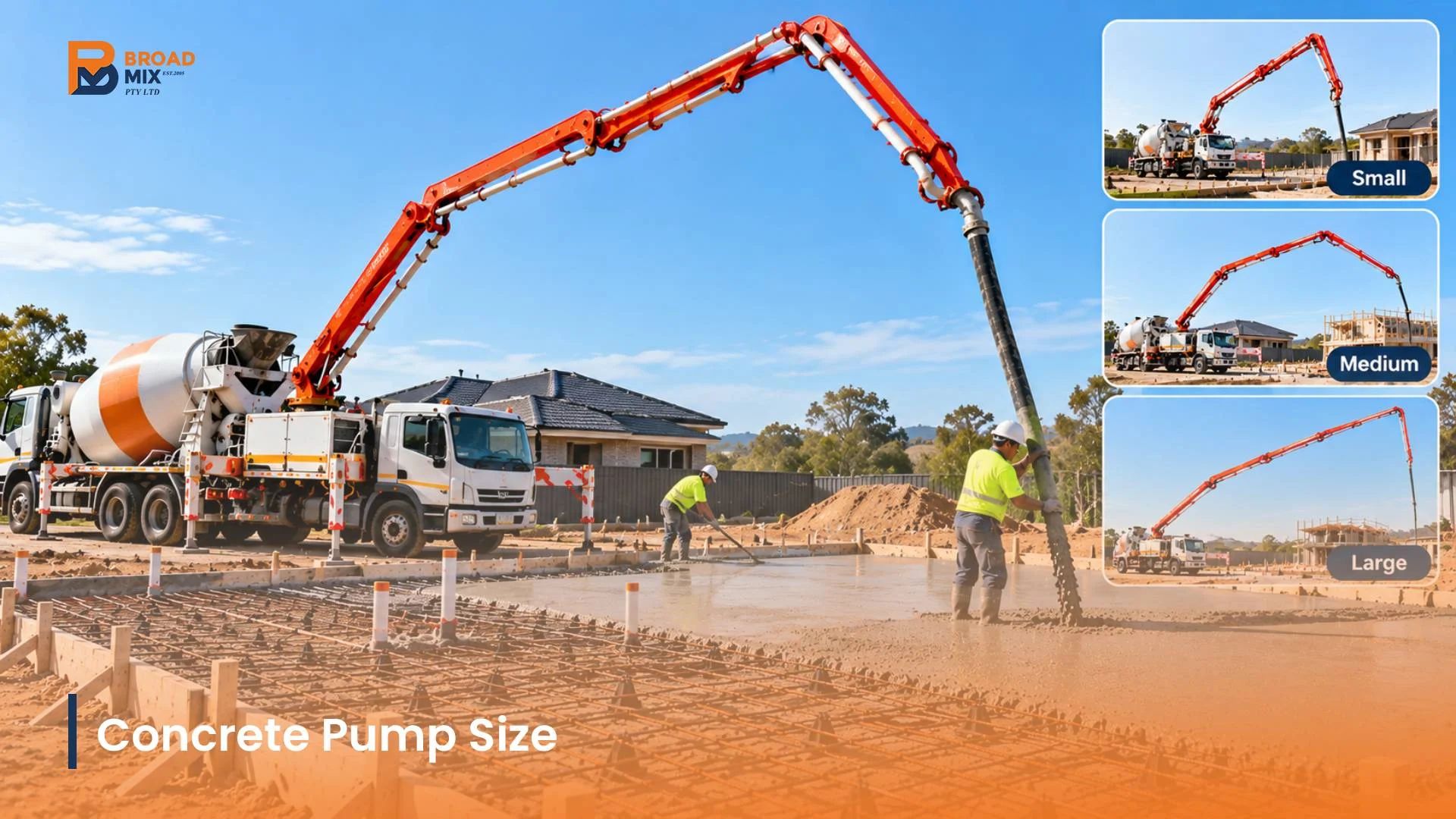
For most full house slabs, you need a boom pump rather than a line pump, because a house slab is a large, high-volume pour that has to be placed quickly and reach right across the slab. A truck-mounted boom pump of around 28 to 32 metres handles a typical single-storey house slab, placing concrete fast and reaching over the formwork from a fixed position. A line pump suits smaller slabs, additions, or sites where access is too tight for a boom, but it is slower and better for lower volumes. The right size is not decided by the slab alone, but by three things together: how much concrete, how far and high it has to reach, and how a pump can access the site. The table below is the starting point.
| Pump type | Typical reach | Best for |
| Line pump | Along the ground, via hoses | Small slabs, additions, tight access, lower volume |
| Boom pump, 24m | Mid reach | Smaller house slabs with reasonable access |
| Boom pump, 28 to 32m | Long and high reach | Standard single-storey house slabs |
| Boom pump, 36m plus | Maximum reach | Large or multi-storey slabs, long setbacks |
Why a House Slab Usually Needs a Boom
To see why the boom is the default for a house slab, it helps to think about what the pour demands. A house slab is simply a lot of concrete placed at once.
A full house slab commonly needs 20 to 50 cubic metres or more, and it all has to go in as one continuous pour so the slab sets as a single structure without cold joints. That means placing concrete fast, keeping up with multiple trucks arriving one after another, and reaching every corner of a wide slab from where the pump can stand. A boom pump is built for exactly this, using its articulated arm to place concrete quickly and precisely across the whole slab without moving hoses by hand. A line pump can physically pump the concrete, but moving its hoses around a large slab is slow, and on a big continuous pour that slowness risks the concrete stiffening before placement is finished. For volume and speed, the boom wins on a house slab.
When a Line Pump Is Enough
That said, not every slab that gets called a house slab is a big pour, so there are real cases where a line pump is the right size. Access often decides it.
A small slab, an extension, a granny flat, or a garage slab is a lower-volume pour, and a line pump can handle it comfortably, especially where the pour is in a tight or restricted spot a boom cannot set up near. If the site is hemmed in by the existing house, fences, trees, or overhead wires, a boom may not have the clearance to extend its arm safely, and a line pump running hoses along the ground becomes the practical choice despite being slower. So the line pump is the answer when the volume is modest or the access rules out a boom, which is common on infill and rear-of-block builds. Matching the right concrete to the job and the pump to the access go hand in hand.
The Three Things That Decide Pump Size
Rather than picking a pump off the slab size alone, the real selection comes down to three factors together, and getting all three right is what sizes the pump correctly. Miss one and the wrong pump turns up.
The first is volume, or how many cubic metres the slab needs, since a bigger pour wants a faster, higher-capacity pump to place it within the concrete’s workable time. The second is reach, meaning how far horizontally and how high the concrete has to travel from where the pump can stand to the far side of the slab, which sets the boom length, so a long setback or a slab behind the house needs more reach. The third is access, or whether a boom pump can physically get onto the site and extend its arm clear of wires, trees, and buildings, because the biggest boom is no use if it cannot set up. A good supplier weighs all three, not just the slab area, to size the pump.
How Boom Length Is Chosen
Since reach is often the deciding factor, it is worth understanding how the boom length is matched to a site. The arm has to clear the obstacles and still reach the slab.
Boom pumps are described by their vertical reach in metres, commonly 24, 28, 32, or 36 metres and up, and the right one depends on where the pump can park relative to the slab and what is in the way. A pump that can set up close to an open, flat slab needs less reach, while one that must stand out on the street or behind a setback, or clear a single-storey roofline to reach a slab beyond, needs a longer boom. The arm has to reach not just the near edge but the far corners of the slab from a safe standing position. This is why the same size slab can need different booms on different blocks, and why describing your site accurately matters more than quoting a slab area.
Let the Supplier Size It With the Concrete
Because sizing a pump depends on volume, reach, and access together, the simplest and safest approach is to have it sized as part of ordering the concrete. One plan covers the whole pour.
When you order pre-mix concrete for a house slab, give us the slab size and volume, the strength your engineer has specified, and a clear picture of the access, including where a pump could stand, the distance to the slab, and any wires, trees, or buildings in the way. Our concrete calculator helps you pin down the volume, and from there we can match the right pump to the job and coordinate it with the delivery so the whole pour runs to one plan. Because we supply locally, sizing and arranging the pump for a Central Victoria house slab is handled together, and ordering from a local supplier keeps it coordinated. Our owner-builder concrete guide covers planning a slab pour from the ground up.
Frequently Asked Questions
What size pump do I need for a house slab?
Most full house slabs need a boom pump, commonly around 28 to 32 metres, because of the large volume and the reach required across the slab. A line pump suits smaller slabs, extensions, or tight-access sites where a boom cannot set up.
Can you use a line pump for a house slab?
You can for a smaller slab, an extension, or a site too restricted for a boom, since a line pump reaches tight spots via hoses. But on a full house slab the line pump is slow for the volume, which risks the concrete stiffening, so a boom pump is usually better.
What size boom pump for a single-storey house slab?
A single-storey house slab is commonly served by a 28 to 32 metre boom pump, but the exact length depends on where the pump can stand and how far and high it has to reach. A long setback or obstacles may call for a longer boom.