
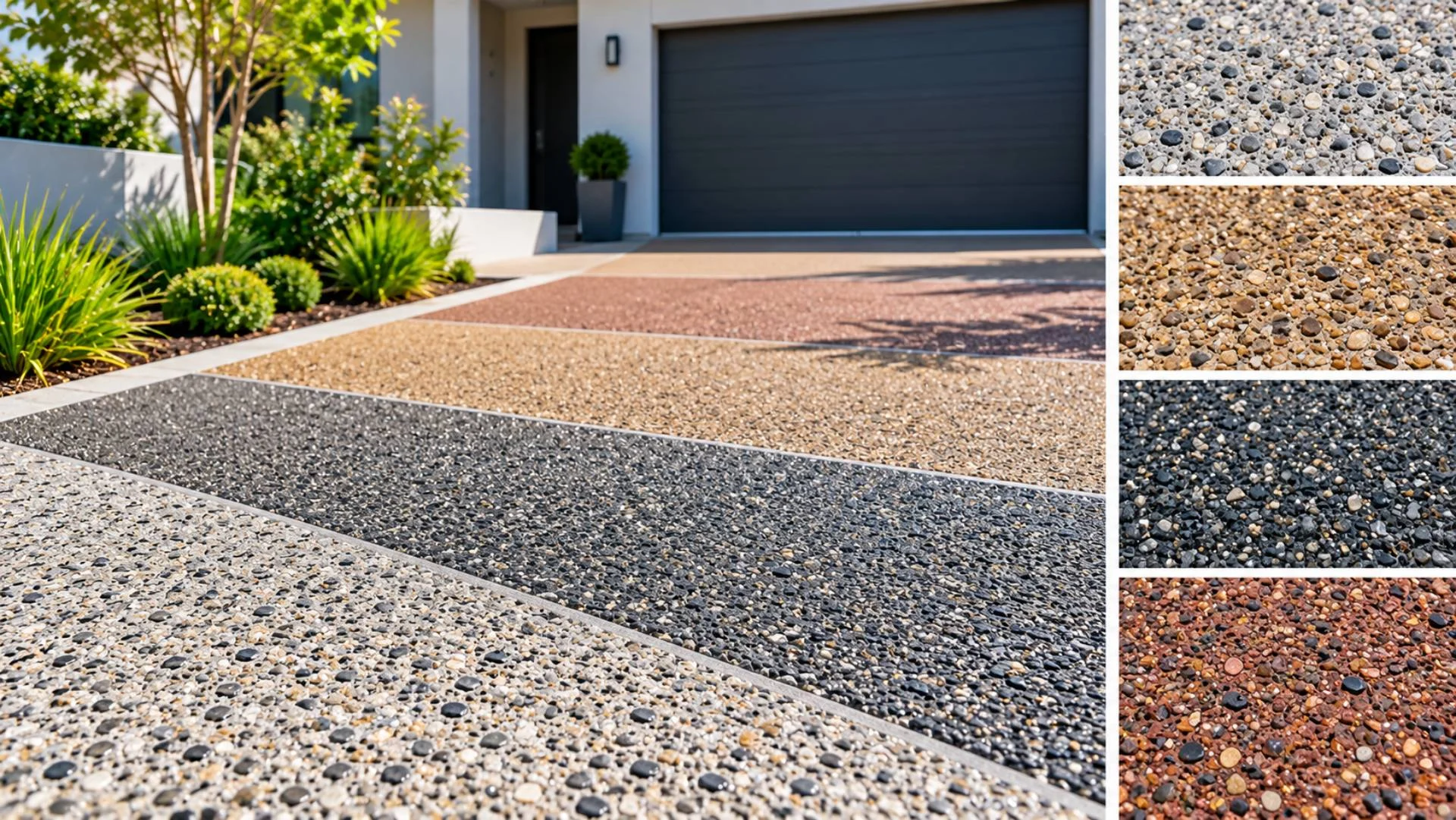
Look closely at a permeable surface and you will notice its colour comes from two places at once. There are the stones themselves, and there is the thin coat of cement paste that binds them together. Because permeable concrete has so little paste and so much exposed stone, its colour behaves quite differently from a standard coloured driveway.
Permeable concrete comes in natural grey as standard. It can also be tinted with oxide pigments in shades such as charcoal, sandstone, brown and terracotta. The final look depends heavily on the stone used in the mix. Expect a speckled, natural finish rather than the flat, even colour of a dense coloured slab.
Where the colour comes from
| Colour source | What it contributes | How much it shows |
| Aggregate (stone) | The base tone and speckle | Strongly, because the stones are visible at the surface |
| Cement paste | A coating over the stones | Moderately, as a thin layer |
| Oxide pigment | Tints the paste | Muted, because there is less paste to colour |
The aggregate matters more in permeable concrete than in almost any other mix. Two batches tinted with the same pigment can look quite different if they use different stone.
Common colour options
Natural grey. This is the standard finish, made with grey cement and local stone. It blends well with most homes and landscapes, and it hides dust and silt better than lighter colours.
Charcoal. A darker tint for modern homes and black or dark grey facades. It looks sharp, but it absorbs more heat in summer.
Sandstone and buff. Warm, light tones that suit country properties, bushland settings and natural stone features. They show dirt and silt more readily, so plan for regular sweeping.
Brown and earthy tones. Good for blending a driveway into gardens and rural surroundings.
Terracotta and red. A bolder choice that works with brick homes and Mediterranean-style landscapes. These tints soften over time in strong sun.
Available colours vary by supplier and mix, so ask to see a sample before ordering.
Why it looks different from coloured concrete
A standard coloured driveway is dense, with a smooth layer of paste on top. Pigment in that paste produces a strong, even colour.
Permeable concrete has far less paste, and most of the surface you see is stone. The same pigment therefore produces a softer, more speckled result. Many people prefer this natural look, but it helps to expect it. If a bold, uniform colour is your priority, our integrally coloured concrete range gives a stronger result on a dense slab.
Will the colour fade?
Pigment added to the mix runs through the whole slab rather than sitting only on the surface. As it weathers, the colour softens evenly instead of wearing off in patches.
Some gradual softening is normal, particularly with red and charcoal tones in full sun. Two practical points:
- Avoid coloured topical sealers. They block the pores, so they are not a good way to restore colour on permeable concrete.
- Keep it clean. Silt, moss and leaf stains dull colour faster than sunlight does, especially on light shades. A simple routine for keeping light-coloured surfaces clean keeps the tone looking fresh.
Can you get an exposed aggregate look?
Not in the traditional sense. Exposed aggregate is made by washing paste off a dense slab to reveal the stones. Permeable concrete has no paste layer to wash away. Its open, stony surface does give a naturally textured look, and choosing a decorative stone can bring out more character.
If you love the look of selected stones in a pebbled surface, compare the stone colour options for exposed aggregate. Some homeowners use exposed aggregate for the front path and entry, and permeable concrete for the driveway or side areas.
Choosing the right shade
- Think about heat. Dark colours get hotter underfoot in summer, which matters around pools and entertaining areas. Lighter tones stay cooler. For more on wet-area surfaces, see our article on pool surround surface choices.
- Match your home. Pick up a tone from your roof, render, bricks or stonework rather than choosing a colour in isolation.
- Allow for dust and leaves. Mid-tones such as natural grey and brown are the most forgiving. Very light colours show every mark.
- See a sample. Colour charts on screen are misleading. A physical sample, viewed outdoors in daylight, shows how the stone and tint will really look.
Frequently asked questions
What colour is permeable concrete normally?
Natural grey, made with grey cement and the stone used in the mix.
Can permeable concrete be coloured?
Yes. Oxide pigments added at the batching plant tint the paste, giving a softer, speckled colour compared with dense coloured concrete.
Does coloured permeable concrete cost more?
Yes. Pigment is an extra cost, charged according to the colour and the volume ordered.
Can I paint or stain permeable concrete later?
Avoid paints and film-forming coatings, because they block the pores. Ask your supplier before applying any product.