
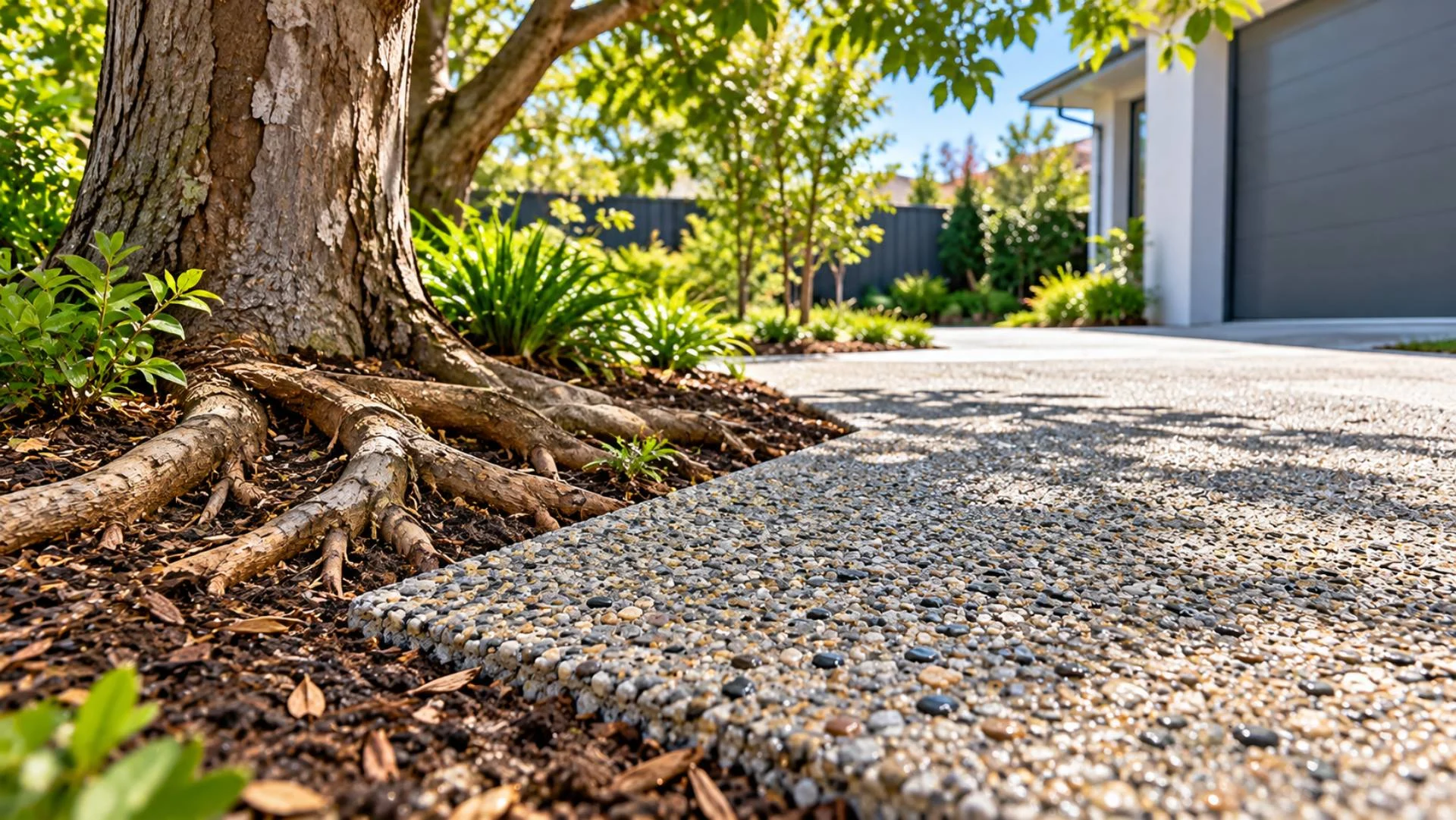
A tree’s roots need three things from the ground around them: water, air and room to grow. A standard concrete slab cuts off the first two and often damages the third during excavation. That is why trees beside new driveways and paths so often decline in the years after construction.
Permeable concrete is one of the better ways to pave near trees, because it lets rain and air reach the soil beneath. It is widely used for footpaths, car parks and tree surrounds for this reason. The surface itself is only half the story, though. How the base is built, and how close you dig to the trunk, decide whether the tree stays healthy.
Why it suits trees better than solid paving
| Need | Standard concrete | Permeable concrete |
| Water reaching the roots | Sheds rain away from roots | Lets rain soak down to the soil |
| Air in the soil | Seals the surface | Open pores allow air exchange |
| Soil compaction | Usually heavily compacted base | Lighter compaction is possible |
| Runoff around the trunk | Concentrates water at edges | Spreads infiltration evenly |
Trees under solid paving often send roots up towards the surface in search of moisture and air. That can lift slabs over time. When water and air reach the soil evenly, roots have less reason to push upwards.
Know the root zones first
The Australian Standard for protecting trees on development sites (AS 4970) defines two zones around a tree.
Tree Protection Zone (TPZ). The main area of roots and soil the tree needs to stay healthy. Its radius is roughly 12 times the trunk diameter, measured 1.4 m above the ground, with a minimum of 2 m and a maximum of 15 m.
Structural Root Zone (SRZ). A smaller area close to the trunk, containing the large roots that hold the tree upright. Work in this zone should be avoided.
As a general guide, encroaching on up to 10% of the TPZ is treated as minor. Larger encroachments usually need an arborist’s assessment. A tree with a 40 cm trunk diameter, for example, has a TPZ radius of about 4.8 m.
Check whether the tree is protected under your local planning scheme before any work starts. Many councils protect significant trees through overlays or local laws, and removing or damaging roots may need a permit.
Building the base without cutting roots
Excavation causes most of the damage near trees. Digging out soil for a deep stone base can sever roots and compact the ground the tree depends on. Within the root zone, the usual approach is to build up rather than dig down.
- Minimal excavation. Remove only grass and loose surface material, keeping the natural soil level where possible.
- Above-grade construction. Raise the surface slightly so the base sits on top of the existing ground rather than cutting into it.
- Cellular confinement. A geocell mat, which is a honeycomb grid filled with clean stone, spreads vehicle loads without heavy compaction of the soil beneath.
- No heavy rolling. Avoid compacting machinery inside the root zone.
- Hand digging near roots. Where any digging is needed, expose roots by hand so an arborist can decide which can be kept.
These methods change the standard base design. Our article on base construction options explains the conventional layers that a tree-friendly design adapts.
Managing leaves and litter
The downside of paving near trees is what falls from them. Leaves, flowers, seed pods and bark all land on the surface, and as they break down they can clog the pores. Deciduous trees drop most of their leaves in a few weeks of autumn, while many eucalypts shed bark and leaves all year.
Plan for this from the start:
- Sweep or blow leaves off often, particularly through autumn, before they break down.
- Clean the surface once or twice a year to clear fine organic matter.
- Choose a mid-tone colour, which hides leaf stains better than a light one.
Our autumn sweeping routine covers the timing in detail. To understand how quickly debris affects drainage, see our article on leaf litter and clogging risk.
Street trees and shared spaces
Permeable surrounds are increasingly used for street trees, car park planting and footpaths in new subdivisions. They let water reach the roots while giving people a firm, level surface to walk on.
For developers, permeable tree surrounds often form part of a wider stormwater and landscaping plan. We cover how that fits into estate design in our article on paths and tree surrounds in new estates.
When to call an arborist
Bring in a qualified arborist before paving if:
- The paving falls within the Tree Protection Zone of a large or significant tree
- The tree is protected by a planning overlay or local law
- Roots have already lifted existing paving or kerbs
- You are unsure where the major roots run
An arborist report costs far less than replacing a damaged tree or a lifted driveway.
Frequently asked questions
Will permeable concrete stop roots lifting my driveway?
It reduces the risk because roots get water and air without pushing upwards. It cannot prevent lifting entirely, especially with vigorous species planted close to the paving.
How close to a tree can I pave?
Avoid the Structural Root Zone altogether. Within the wider Tree Protection Zone, keep encroachment small and use low-impact construction, with an arborist’s advice for larger trees.
Can permeable concrete go right up to the trunk?
Leave a gap of soil or mulch around the trunk so it can widen as the tree grows, and so water reaches the base of the tree.