
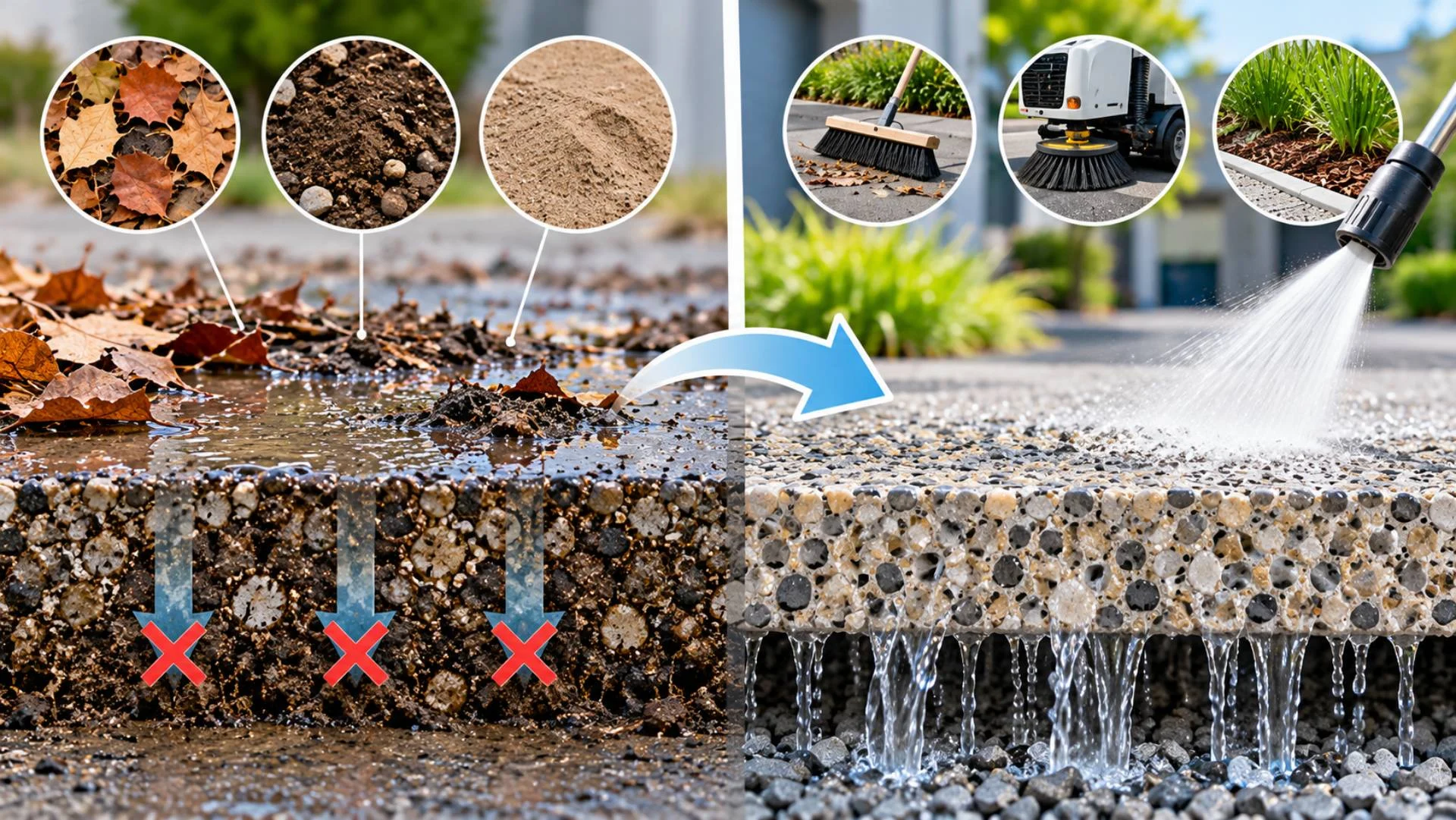
Research on pervious pavements around the world tells a consistent story. Clogging is real, but it is slower, shallower and more preventable than most people expect.
Most of the fine material that blocks a permeable surface gets trapped in the top few centimetres, rather than travelling deep into the slab. A brand new surface also drains far faster than rain usually falls. That gives it a large safety margin before any loss of drainage becomes noticeable.
So yes, permeable concrete does clog over time. How quickly depends almost entirely on how much sediment reaches it, and on whether the site was designed to keep that sediment away.
How much drainage can it lose?
New permeable concrete can absorb water at rates far above the intensity of even heavy rain. So a surface can lose a good share of its original drainage capacity and still keep up with most storms.
The problem only becomes visible once clogging passes a tipping point. At that stage water starts to pond or run off instead of soaking in. A well-designed and maintained surface may never reach that point. A neglected surface surrounded by bare soil can reach it within a few years.
What decides how fast it clogs?
| Factor | Higher clogging risk | Lower clogging risk |
| Surrounding ground | Bare soil or garden beds that drain onto the surface | Lawn, edging or a gravel buffer strip |
| Trees | Large deciduous trees overhead | Open, sunny position |
| Construction activity | Pouring early in a build | Pouring after landscaping is finished |
| Traffic | Vehicles tracking in mud and grit | Light, clean traffic |
| Maintenance | No regular sweeping | Regular sweeping and annual cleaning |
The biggest factor by far is run-on. This is water flowing onto the permeable surface from nearby areas and carrying soil with it. A permeable surface that only receives the rain falling directly on it clogs much more slowly than one taking muddy runoff from a garden bed or unsealed area.
Clogging below the surface
Surface clogging is the common kind, and it is fixable. The more serious problem is clogging deeper in the system. That happens when soil moves up from the ground into the stone base, or when the base was built with material containing fines.
This kind of clogging cannot be cleaned out from above. Prevention comes down to how the base is built, particularly the geotextile that keeps soil out of the base and the use of clean, open-graded stone.
Design choices that prevent it
A small amount of planning at the design stage does more than years of cleaning. The most effective measures are:
- Stop run-on. Grade nearby garden beds and lawns away from the permeable surface, or install edging so soil cannot wash across it.
- Add a buffer. A narrow strip of gravel or grass between soil areas and the concrete catches sediment before it arrives.
- Pour last. Schedule the permeable surface after building and landscaping work is finished. On large developments, this means staging permeable pours on new estates so finished areas are not exposed to construction dust.
- Choose the right location. Under large deciduous trees, expect more frequent cleaning, or consider dense concrete for that section.
- Use the right mix. A properly designed pervious no fines concrete has well-connected voids, which resist clogging better than a poorly proportioned mix.
Signs your surface is starting to clog
Watch for these early warning signs:
- Puddles forming after rain where none used to appear
- Water running along the surface instead of soaking in
- A dark film of silt, or moss, building up in low spots
- Clogging first appearing near edges or garden beds
Caught early, surface clogging is usually reversed with a thorough clean. Our step-by-step cleaning schedule explains how to restore drainage and keep it there.
Why clogging matters beyond puddles
On many properties, a permeable surface is part of how the site meets its required permeable area or stormwater conditions. A clogged surface no longer does that job. This is one reason building surveyors and councils pay attention to design and upkeep. Our article on site permeability rules for new homes explains how these requirements work.
Frequently asked questions
How long before permeable concrete clogs?
It depends on the site. A well-designed, regularly swept surface can drain effectively for 20 years or more. A neglected surface surrounded by bare soil can clog within a few years.
Can clogged permeable concrete be fixed?
Surface clogging can usually be reversed with pressure washing or vacuum sweeping. Clogging deep in the base generally means part of the system needs to be rebuilt.
Does rain wash the pores clean?
No. Rain tends to carry fine material deeper into the surface rather than flushing it out. Regular cleaning is still needed.
Do leaves clog permeable concrete?
Whole leaves sit on top and are easy to sweep away. The problem starts when they break down into fine organic matter, so remove them promptly, especially in autumn.