
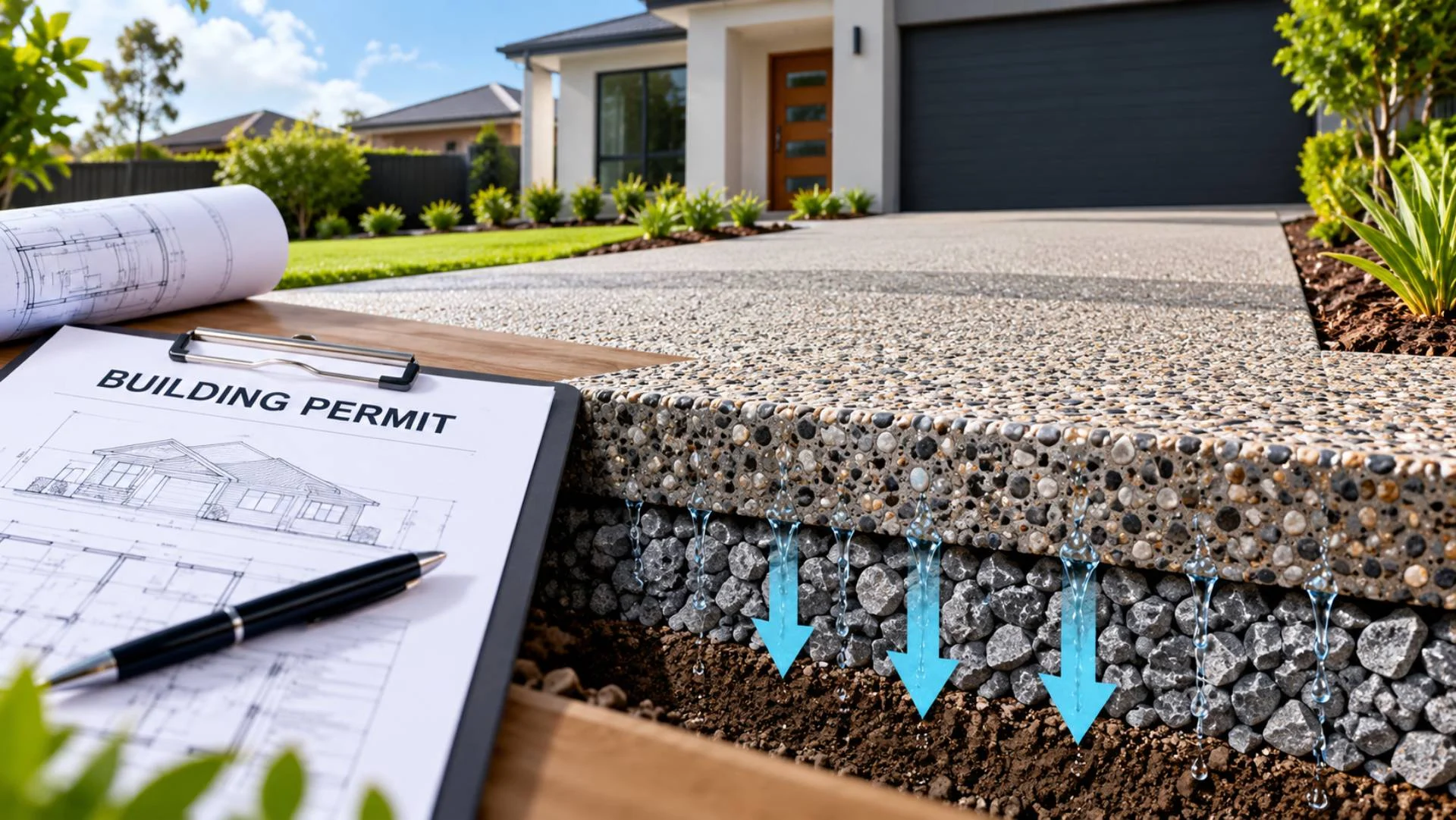
Many owner builders and homeowners assume their building permit will force them to use permeable concrete. In most cases, it will not. No Victorian building rule names permeable concrete as a required material.
What a permit can require is a minimum amount of permeable ground on your lot, or a way of managing stormwater. Permeable concrete is one way to meet that requirement, but it is rarely the only way.
The difference matters because it affects your driveway design, your budget and how smoothly your approval goes.
Building permit or planning permit?
These two approvals are often confused, and they check different things.
| Approval | Issued by | What it covers |
| Building permit | A registered building surveyor | Structure, safety, siting rules and drainage to a legal point of discharge |
| Planning permit | Your local council | Land use, design, site layout and stormwater management conditions |
Not every project needs a planning permit. A single house on a standard lot often needs only a building permit. Multi-unit developments, subdivisions and sites with planning overlays usually need both.
Where the 20% rule comes in
For most new houses in Victoria, the siting rules checked at building permit stage include a permeability requirement. At least 20% of the lot must be left free of impervious surfaces such as roofs, sealed driveways and paving. Planning schemes apply a similar 20% standard to multi-unit developments.
The rule does not say the 20% must be permeable concrete. It simply requires that part of the lot can still absorb rainwater. On a typical block, that area is usually made up of:
- Lawn and garden beds
- Mulched or planted areas
- Gravel paths and loose stone
- Permeable paving, where the surveyor accepts it
If your house, alfresco and driveway already cover more than 80% of the lot, you will need to make up the difference somewhere. That is often when permeable concrete becomes the practical answer.
Will a permeable driveway count?
It depends on who assesses it. Some building surveyors and councils accept a correctly built permeable concrete surface as permeable area. Others accept it only with supporting documents, such as product specifications and a pavement design. A few still treat any concrete as impervious.
Ask your building surveyor before finalising your site plan. Getting their view early can save a costly redesign later.
A permeable surface also only counts if it genuinely drains. That depends on the stone layers beneath it. Our article on permeable driveway base layers and depths explains what a surveyor or engineer will expect to see.
Other reasons it may be specified
Even when the building regulations do not require it, permeable concrete can still end up on your plans because of:
- Planning permit conditions. Councils may require on-site stormwater management, particularly for units and subdivisions. Our article on how councils assess permeable surfaces for stormwater covers what they look for.
- Estate design guidelines. Some new estates set rules for driveway materials through covenants or design guidelines, which you agree to when buying the land.
- Drainage limits on your lot. On blocks where stormwater cannot easily reach a council drain, reducing runoff can help with the legal point of discharge.
- Your own choice. Many homeowners choose a permeable driveway to stop water pooling or running towards the house.
If you are building in a growth area such as Wallan or Kilmore, check your estate’s design guidelines as well as your permit conditions. The two can differ.
Is it the right choice anyway?
Even when permeable concrete is optional, it can still be worth considering. It reduces puddles and runoff, eases pressure on drains, and can free up more of your lot for paving while staying within the permeability limit.
The trade-offs are a higher installed cost, lower strength than standard concrete, and the need for occasional cleaning to keep the pores open. Our side-by-side look at permeable and standard driveways compares cost, strength and maintenance in detail.
Frequently asked questions
Does the building code require permeable concrete?
No. Victorian regulations require a minimum permeable site area for most new houses, but they do not specify permeable concrete as the material.
What happens if my lot is under 20% permeable?
You will need to redesign, for example by reducing paved areas, adding garden beds, or using a permeable surface the building surveyor accepts. A variation may sometimes be possible through the council’s report and consent process.
Do rainwater tanks count towards permeable area?
No. Tanks help manage stormwater, but the ground they sit on does not count as permeable area.
Can I add a permeable driveway after the house is finished?
Yes. Just remember that site coverage and permeability rules may still apply if the work needs a permit.