
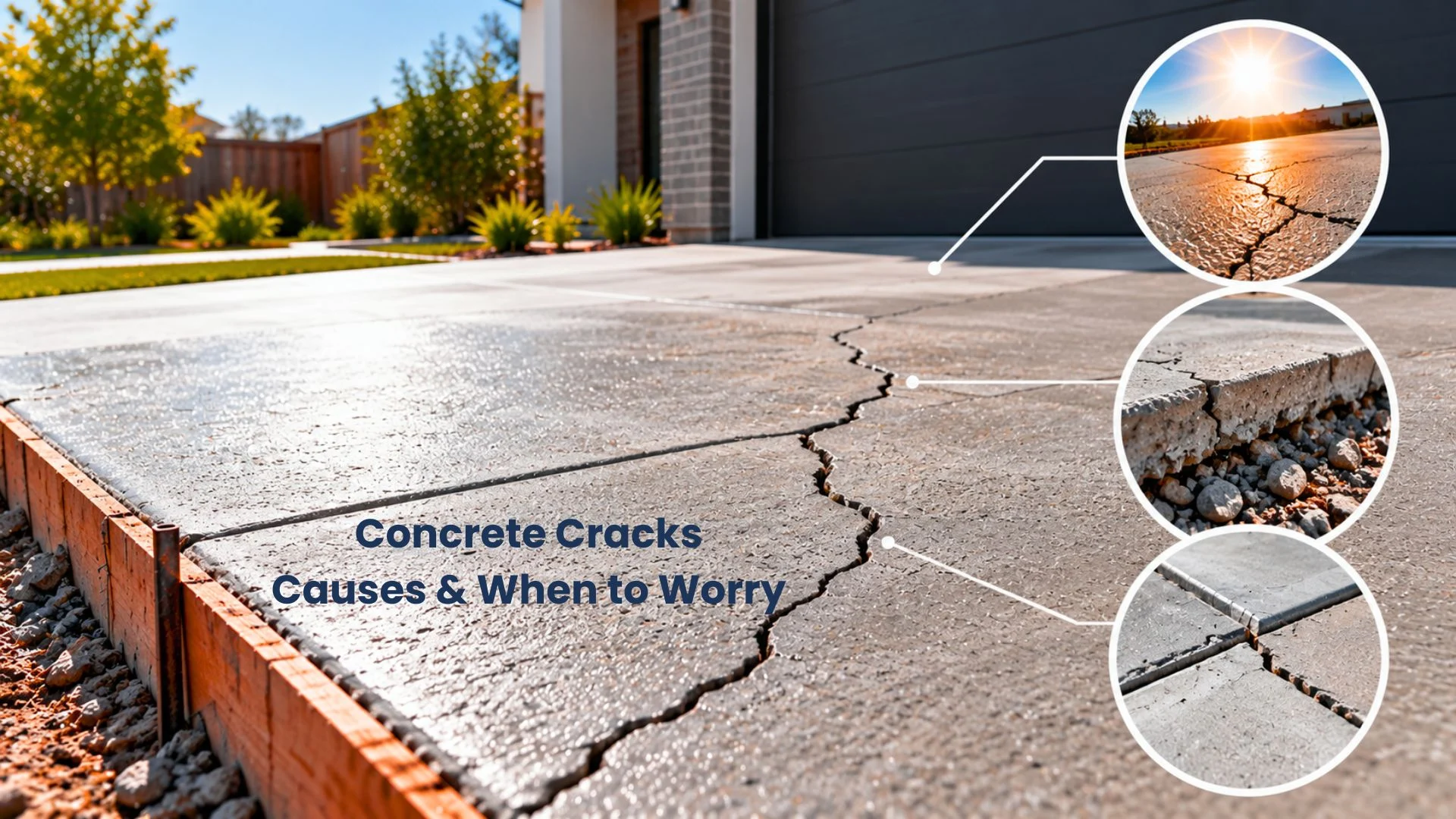
When a crack appeared tells you almost as much as what it looks like. Cracks that showed up within hours of the pour have a very different cause from ones that appeared a few weeks later, or that open and close with the seasons. Working out the timing, the pattern and the width is the quickest way to know whether you are looking at a cosmetic blemish or something that needs attention.
Most cracks in new concrete come from shrinkage as the concrete dries. They are usually fine, cosmetic and not a sign of failure. Concrete loses water and shrinks as it cures, and if that movement is not controlled by joints, curing and reinforcement, the slab relieves the stress by cracking. Wider cracks, cracks where one side sits higher than the other, or cracks that keep growing point to a deeper cause, such as a poorly compacted base or soil movement.
Identify your crack
| When it appeared | What it looks like | Likely cause | Usually serious? |
|---|---|---|---|
| Within hours of pouring | Short, parallel or random surface cracks | Plastic shrinkage from fast surface drying | No, mostly cosmetic |
| First few days | Fine spider-web pattern over the surface | Crazing from overworking or rapid drying | No, cosmetic |
| Weeks to months later | Straight cracks across the slab | Drying shrinkage, joints too far apart or cut late | Usually not |
| Weeks to months later | Diagonal cracks from inside corners | Stress concentrating at re-entrant corners | Usually not |
| Any time | Wide cracks, one side higher | Base settlement or ground movement | Yes, get advice |
| Opening and closing seasonally | Cracks that change width | Reactive clay movement | Monitor and get advice |
| Soon after first vehicle use | Cracks in wheel paths or at edges | Loaded too early, or too thin | Often yes |
The common causes explained
Plastic shrinkage cracks
These form while the concrete is still soft, usually within the first few hours. Hot sun, wind and low humidity draw water from the surface faster than it can be replaced from below, and the surface pulls itself apart. The cracks are often short, roughly parallel, and can look alarming, but they are generally shallow.
Prevention comes down to protecting the surface on hot or windy days. Covering, misting and evaporation retarders all help. Micro fibres in the mix also reduce this type of cracking. Read more about micro fibres for hot-weather pours.
Crazing
Crazing is a network of very fine surface cracks, a bit like a dried riverbed. It usually comes from overworking the surface while finishing, finishing while bleed water is still present, or the surface drying too quickly. It affects appearance, not strength.
Drying shrinkage cracks
This is the most common type in slabs. Concrete keeps shrinking for weeks and months as it dries. Control joints are cut or formed to give that shrinkage a planned place to crack. If joints are too far apart, too shallow, or cut too late, the slab cracks somewhere else instead, usually in a fairly straight line across it.
Adding water on site to make concrete easier to place increases this shrinkage significantly. Ordering the right workability and the right mix matters. Our guide to what strength grade your slab should be explains how the mix affects performance.
Corner cracks
Inside corners, around pits, and where a slab changes shape all concentrate stress. Diagonal cracks running from these points are common. Extra reinforcement bars and well-placed joints at these locations reduce the risk.
Settlement and ground movement
These are the cracks to take seriously. If the base was not properly compacted, or soft spots were left under the slab, parts of the slab can sink and crack under their own weight or under loads. On reactive clay, which is common across Central Victoria, the soil swells in wet months and shrinks in dry months. That bends the slab from beneath.
Signs include cracks wider than a few millimetres, one side of the crack sitting higher than the other, and cracks that grow or change with the seasons.
Loading too early
Concrete gains strength gradually. Driving on a new slab before it has cured, especially with heavy vehicles, can crack it in the wheel paths or along unsupported edges. Check how long to keep vehicles off new concrete before using your driveway.
When should you worry?
As a general guide:
- Hairline cracks, under about 1 mm wide, with both sides level: usually cosmetic. Monitor them.
- Cracks around 1 to 2 mm wide: worth sealing, then monitoring.
- Cracks wider than about 2 mm, or with one side higher: get advice from your builder or an engineer.
- Cracks that grow over time: mark the ends with a pencil and date them, then check again in a few weeks. Growth means the cause is still active.
On house slabs and other structural slabs, report any significant cracking to your builder promptly. New homes have warranty and defect periods, and early documentation helps.
Does reinforcement prevent cracking?
No. Reinforcement controls cracks rather than preventing them. Steel mesh keeps cracks tight and holds the slab together. Fibres reduce early shrinkage cracking. A slab can be correctly reinforced and still show fine shrinkage cracks. Learn more about how reinforcement controls cracking in our slab reinforcement guide.
Is it the concrete or the installation?
People often ask whether the concrete itself was faulty. In most cases, cracking comes from conditions on site rather than the mix: weather, curing, joint spacing, base preparation, added water, or early loading.
That said, if you have concerns, keep your delivery dockets, note whether water was added on site, and contact your supplier and installer. The docket records the mix that was delivered, which helps rule causes in or out.
How to fix cracks in new concrete
- Hairline cracks: often best left alone. A penetrating sealer can help keep water and dirt out. Ask about options for sealing hairline cracks.
- Small, stable cracks: clean them out and fill with a flexible concrete crack sealant that can move with the slab.
- Wider structural cracks: need professional assessment. Repairs may involve epoxy injection, stitching, or replacing a section.
- Decorative surfaces: repairs are harder to hide on textured finishes. See our tips on repairing cracks in exposed aggregate.
Fix the cause before fixing the crack. Sealing a crack caused by base settlement will not stop it reopening.
Frequently asked questions
Is it normal for new concrete to crack?
Fine shrinkage cracks are common and usually cosmetic. Wide, uneven or growing cracks are not normal and should be checked.
How soon can concrete crack after pouring?
Plastic shrinkage cracks can appear within hours. Drying shrinkage cracks may take weeks or months to show.
Can cracks in new concrete be prevented?
They can be greatly reduced with good base preparation, correct joint spacing, proper curing, the right mix, and protection from hot or windy weather.
Should I seal cracks in my new driveway?
Sealing small cracks keeps water and debris out. Monitor them first to make sure they are stable.