
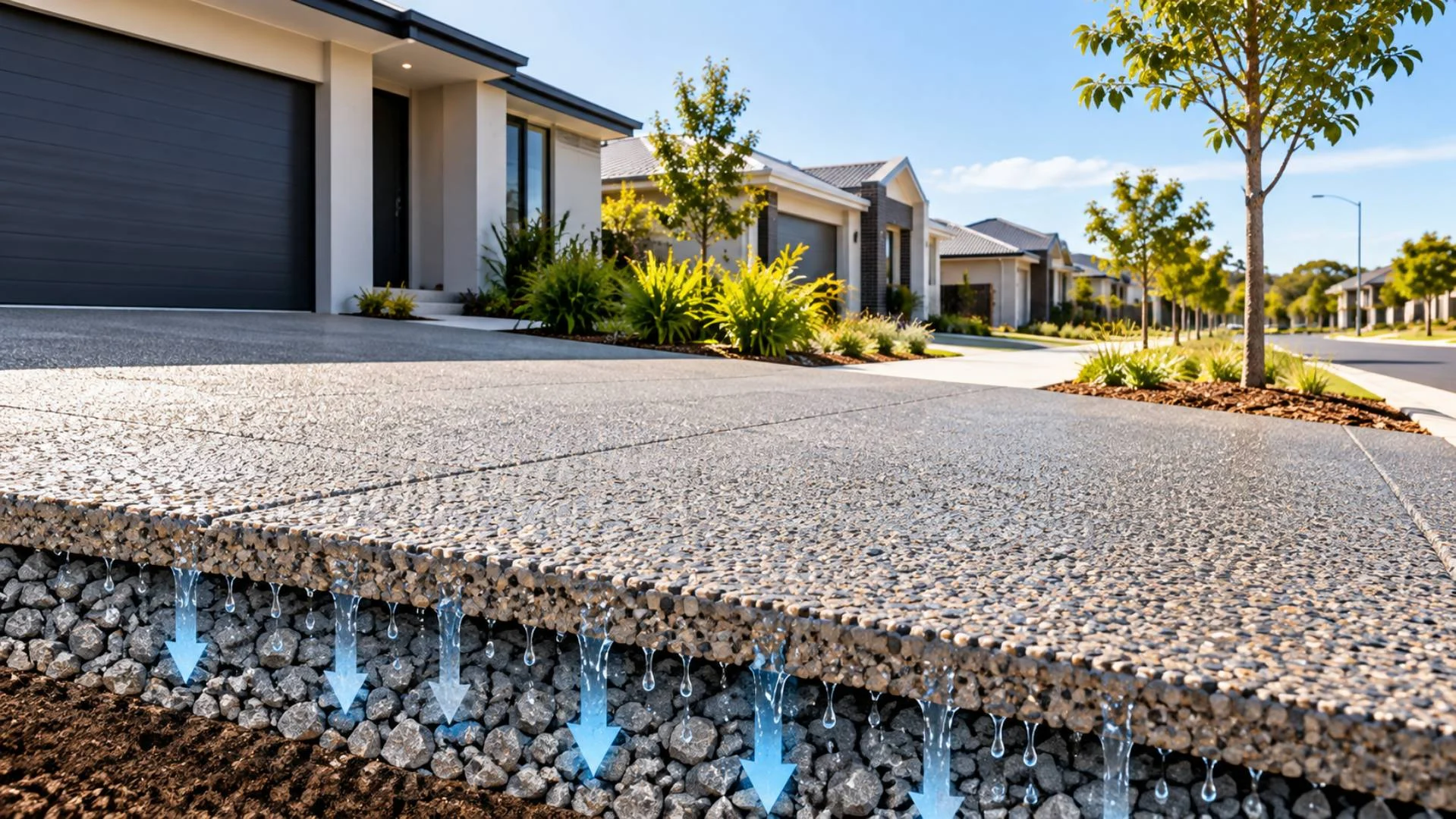
Yes. Broadmix supplies permeable concrete for new housing estates across Central Victoria, including footpaths, shared paths, driveways, car parks and open-space areas. Permeable concrete lets rainwater pass through the surface into a stone base below, instead of running off into drains. That makes it a practical tool for meeting stormwater requirements on new subdivisions.
This guide covers where permeable concrete suits an estate, how it supports stormwater compliance, the design basics, and what information we need to quote your project. It is written for developers, civil contractors, builders and estate project managers working in growth areas such as Wallan, Beveridge, Kilmore and Donnybrook.
Why are estates choosing permeable surfaces?
New estates replace paddocks with roofs, roads and driveways. Those hard surfaces send rainwater straight into the drainage network, which increases flows, flooding risk and pollution in local waterways.
Victorian planning rules respond to this. Under Clause 53.18 of the Victoria Planning Provisions, new urban developments are expected to manage stormwater on site using water sensitive urban design (WSUD) principles. Permeable paving is one of the recognised ways to reduce runoff and help meet those targets. It works alongside measures such as raingardens, swales and wetlands.
For a developer, that can mean:
- Less reliance on larger pipes and detention basins
- Help meeting council stormwater conditions on permits
- Paths and car parks that do not pond after rain
- A visible sustainability feature for buyers
Where does it work best in an estate?
Permeable concrete has a lower compressive strength than standard premix because of its open void structure. It performs best where loads are light to moderate.
| Estate area | Suitability | Notes |
| Footpaths and shared paths | Excellent | Removes puddles and reduces runoff along streets |
| Residential driveways | Very good | Suits cars and light vehicles |
| Visitor and community car parks | Good | Best for light vehicle parking bays |
| Park and playground surrounds | Excellent | Dries quickly after rain |
| Tree surrounds | Excellent | Lets water and air reach roots |
| Main roads and bus routes | Not recommended | Heavy, frequent loads suit dense concrete |
Many projects use both. Dense premix concrete goes on roads, crossovers and heavy traffic areas, and permeable concrete goes on paths and parking bays. For a detailed comparison of the two, see our guide to permeable vs plain concrete.
How is a permeable pavement built?
The concrete is only one layer of a system. A typical permeable pavement includes:
- Prepared subgrade, levelled and checked for how well the soil drains.
- Open-graded aggregate base, which stores water while it soaks into the ground.
- Permeable concrete surface layer, usually thicker than a standard path or driveway slab to make up for its lower strength.
- Underdrains where needed, on clay or low-infiltration soils so stored water can leave the base at a controlled rate.
The thickness of each layer depends on soil type, expected traffic and stormwater targets. The pavement should be designed by the project’s civil engineer. Please send us the specification with your enquiry so we can match the mix to it.
What should you plan for on site?
Permeable concrete behaves differently from standard premix during placement. A few points help a pour go smoothly:
- Placement time is shorter. The mix has very little paste and dries out quickly, so crews need to place, compact and cover it promptly.
- Curing matters. The surface should be covered with plastic straight after compaction to stop it drying too fast, particularly in warm weather.
- Keep sediment away. Exposed soil and building dust can clog the surface pores. Protect finished areas while houses are still under construction, or schedule permeable pours late in the build.
- Avoid film-forming sealers. These close the surface pores and stop drainage.
Ongoing care is simple. Regular sweeping, plus periodic vacuum sweeping or pressure washing, keeps the surface draining as intended. This can be built into the estate’s maintenance plan or handover documents.
Can supply be staged across a project?
Housing estates are usually built in stages, and concrete supply should follow the same timeline. Broadmix works with contractors to plan deliveries around each stage, from early civil works through to driveways as homes are completed.
Being a local supplier helps here. Shorter travel times from our plant mean fresher concrete arriving on site. That matters for a mix that needs to be placed quickly. We explain more in why local beats large when choosing a concrete supplier in Central Victoria.
What do we need to quote your estate?
To give you an accurate price and supply plan, please include:
- The estate name and location
- Areas to be paved with permeable concrete (paths, driveways, car parks)
- Approximate volumes in m³, or areas and slab thickness
- The engineer’s pavement specification, if available
- Expected traffic type for each area
- Project stages and estimated pour dates
- Site access details for agitator trucks
- Any council or WSUD requirements attached to your permit
If you are early in planning and only have estimated areas, our concrete calculator can help you estimate volumes.
Frequently asked questions
Is permeable concrete accepted by Victorian councils?
Permeable surfaces are generally viewed positively under WSUD frameworks, and they can contribute to stormwater management targets. Always confirm specific requirements with the relevant council.
Can permeable concrete be used for residential driveways in an estate?
Yes. It suits cars and light vehicles well, provided the base is designed for the site’s soil and traffic.
Does permeable concrete work on clay soils?
Yes, with the right design. On clay or slow-draining soils, an underdrain is usually added so water can leave the base at a controlled rate.
Is permeable concrete more expensive than standard concrete?
The installed cost is usually higher because of the deeper base. However, it can reduce spending on drainage infrastructure elsewhere in the estate.
Can it be coloured or finished with exposed aggregate?
It can be supplied in a natural finish or tinted. However, it cannot take an exposed aggregate finish, because that technique needs dense concrete.