
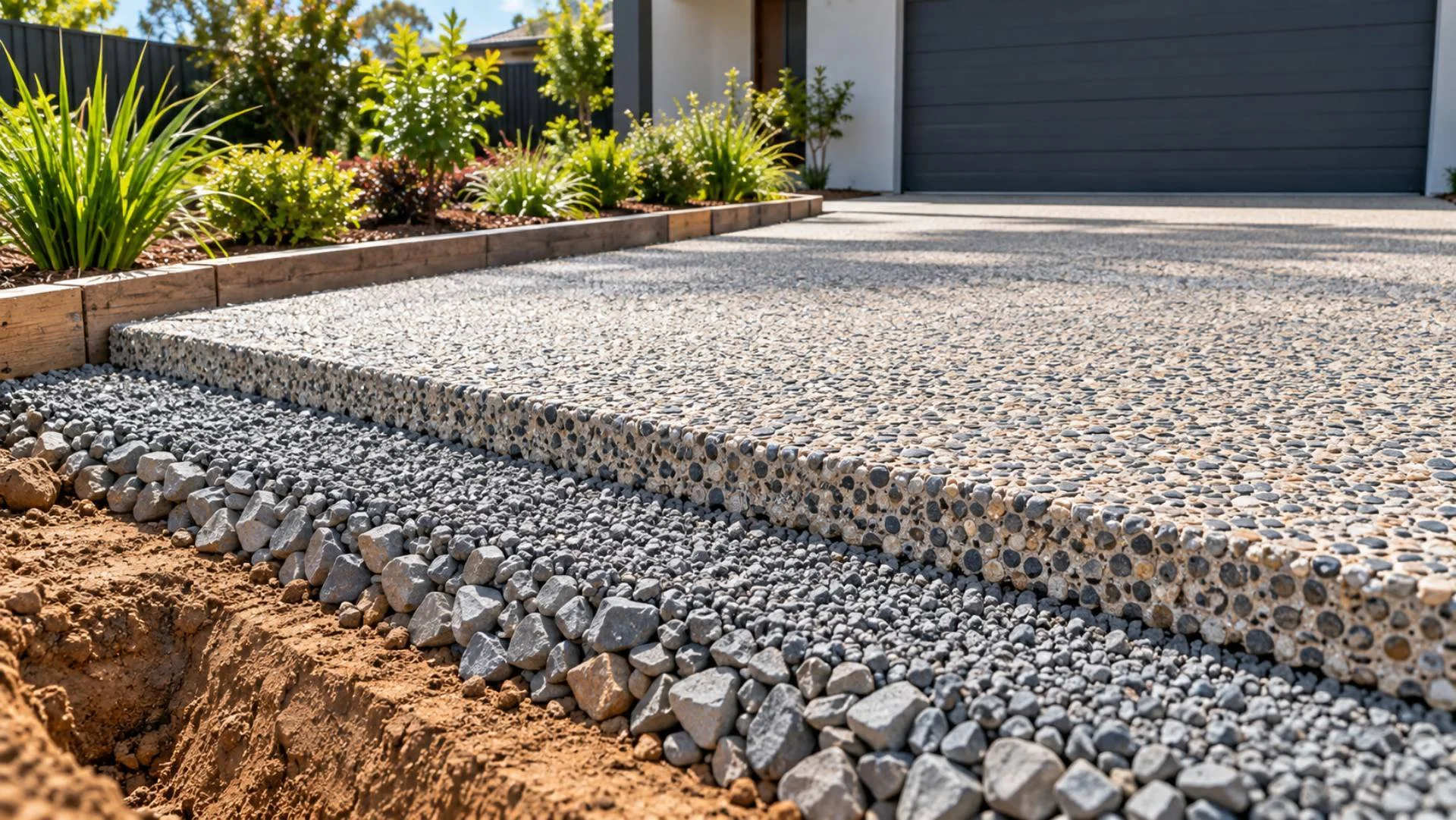
A permeable concrete driveway is really a stone water tank with a concrete lid. The concrete lets rain through, but the sub-base underneath does most of the work: it holds that water and releases it into the ground.
In most cases, a permeable driveway needs a clean, open-graded crushed rock base with no fine particles. This base is typically 150 to 300 mm deep and laid over a geotextile fabric on a prepared subgrade. On clay soils, a slotted underdrain is usually added so water can leave the base at a controlled rate.
If the base is wrong, even the best permeable mix will pond, crack or clog. The sections below explain what each layer does and how deep it should be. They also cover how Central Victorian soil conditions change the design.
Why does the base matter so much?
With a standard driveway, the base mainly supports the slab. With a permeable driveway, the base has three jobs:
- Support: it carries the weight of vehicles.
- Storage: it holds rainwater in the gaps between the stones.
- Release: it lets that water soak into the soil or drain away slowly.
Open-graded stone typically has around 30 to 40% empty space between the particles. A 300 mm deep base at 35% voids can temporarily hold about 105 litres of water per square metre. That is more than enough for most heavy downpours in our region.
The layers, from the ground up
| Layer | Typical material | Typical depth | Purpose |
| Subgrade | Natural soil, levelled | n/a | Accepts the water and supports the system |
| Geotextile | Non-woven filter fabric | n/a | Stops soil mixing into the stone |
| Base course | Clean 20 to 40 mm crushed rock, no fines | 150 to 300 mm | Stores water and carries loads |
| Choker layer (optional) | Clean 7 to 14 mm aggregate | 25 to 50 mm | Gives a flat, stable surface to pour onto |
| Surface | Permeable concrete | 125 to 150 mm | Lets water in and takes vehicle traffic |
These depths are typical for residential driveways only. Your final design should suit your soil, slope and vehicle loads.
Subgrade
Clear organic topsoil and level the natural ground. Compact it enough to support vehicles, but take care not to over-compact. Heavily rolled soil absorbs water far more slowly, which defeats the purpose of the system.
Geotextile fabric
A non-woven geotextile goes between the soil and the stone. Without it, fine soil slowly works up into the base, fills the voids and reduces how much water the base can store.
Base course
This is the reservoir. The stone must be clean, crushed and single-sized or open-graded, so it has plenty of space between particles. It is laid in layers and lightly compacted, which locks the stones together without crushing them.
Choker layer
A thin layer of smaller clean aggregate fills the surface gaps of the coarse base. This gives the concrete a firm, even surface to sit on. Many installers use one, although it is not always essential.
Can you use Class 2 crushed rock?
No, and this is the most common mistake on Victorian sites.
Class 2 and Class 3 crushed rock (often called FCR) are the standard bases for plain concrete driveways. They work well there because the fine particles pack tightly into a dense, solid layer. But that same density blocks water. If you pour permeable concrete over a Class 2 base, the water drains through the concrete and then sits on top of the base, with nowhere to go.
For a permeable driveway, the base must be free of fines. When you order, ask your quarry or landscape supplier for “clean” or “no fines” aggregate.
What changes on clay soils?
Large parts of Central Victoria have reactive clay soils, which absorb water slowly. That does not rule out a permeable driveway, but it does change the design:
- Add an underdrain. A slotted pipe in the base carries excess water to a legal point of discharge, such as a stormwater pit.
- Deepen the base if more storage is needed while water slowly soaks away.
- Protect your house footings. Soaking reactive clay right beside a slab can cause ground movement. Near the house, a lined section or an underdrain that takes water away from the footings is a sensible precaution.
If you are unsure about your soil, a site classification report from your build, or a quick check by an engineer, will tell you what you are working with.
Mistakes that stop a driveway draining
- Using Class 2 or Class 3 crushed rock as the base
- Leaving out the geotextile on fine or silty soils
- Over-compacting the subgrade
- Pouring while soil or sand is stockpiled nearby, so sediment washes onto the surface
- Sealing the surface with a film-forming sealer
- Building in a steep fall, which sends water to the low end instead of spreading it across the base
A correctly built base also keeps your driveway strong over time. If you are still deciding between surfaces, our comparison of permeable vs plain concrete covers strength, cost and maintenance side by side.
Getting the concrete right on top
Once the base is ready, the concrete needs to be placed and compacted quickly, then covered to cure. Permeable mixes contain very little paste, so they dry out faster than standard premix. A short travel time from the plant to your site makes a real difference.
To work out how much concrete to order for the surface layer, use our concrete calculator with your planned slab depth. Allow a little extra, because permeable concrete compacts as it is placed.
Frequently asked questions
How deep should the base be under a permeable driveway?
For most homes, 150 to 300 mm of clean, open-graded crushed rock. Clay soils or large driveways may need more.
Do I need geotextile fabric under a permeable driveway?
On most soils, yes. It stops soil moving up into the stone base and reducing its storage capacity.
Can permeable concrete go straight onto the soil?
It is not recommended. Without a stone base there is nowhere for water to be stored, and the slab has less support.
Does a permeable driveway need a slope?
Only a minimal fall is needed, because water drains down through the surface rather than across it.
Does the base need maintenance?
No. Keep the surface swept and pressure wash it occasionally, so water can keep reaching the base.