
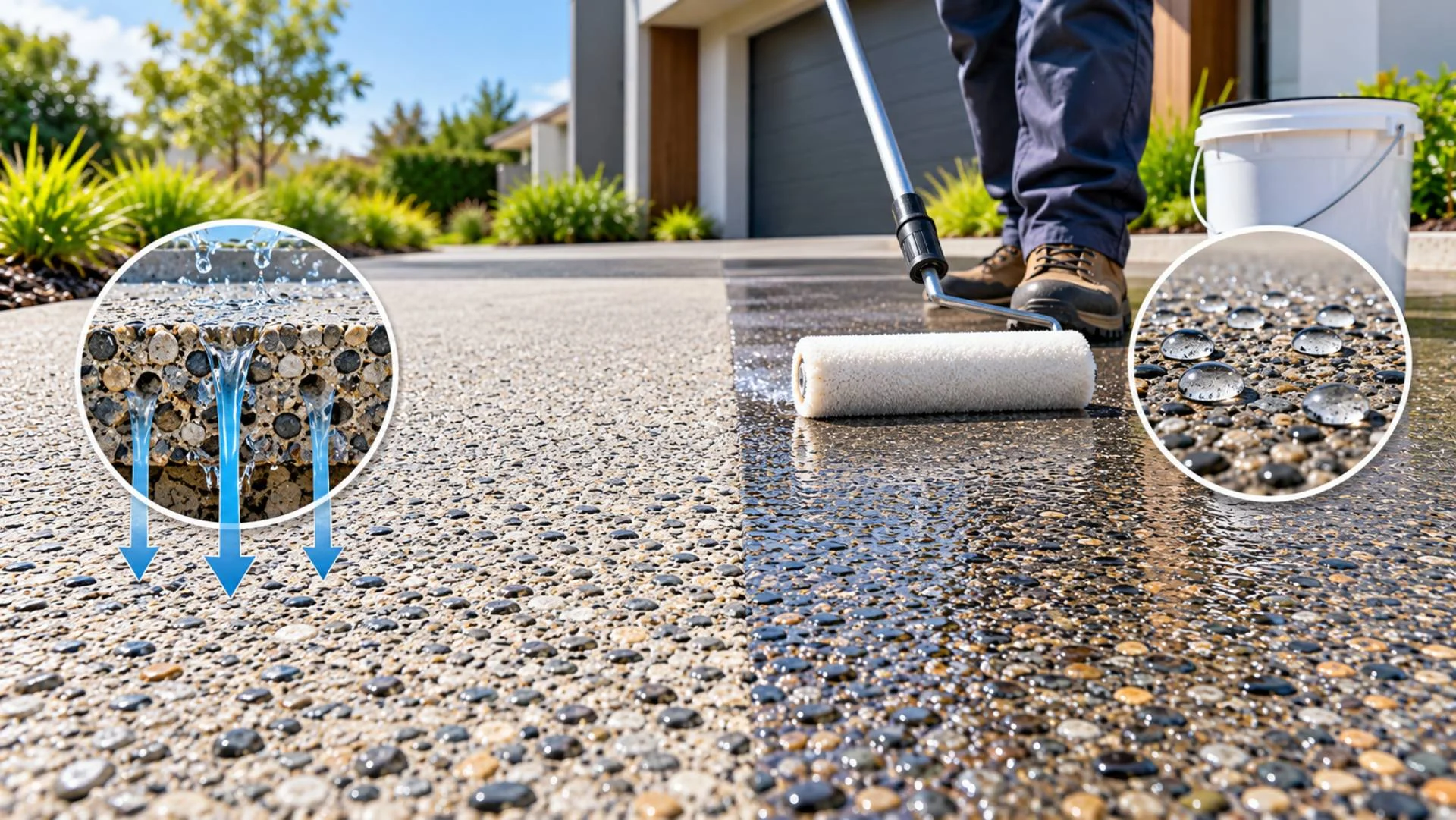
Walk down the sealer aisle of any hardware store and most of the tins promise the same thing: a glossy, protective coat that makes concrete look new again. On a standard driveway, that is exactly what you want. On permeable concrete, the same coat can undo the very feature you paid for.
Permeable concrete can be sealed, but only with the right type of product. Film-forming sealers, such as acrylics, polyurethanes and epoxies, should never be used, because they coat the surface and block the pores. Some penetrating sealers soak into the paste without filling the voids, and may be suitable when applied lightly. In many cases, permeable concrete does not need sealing at all.
The two main sealer types
| Sealer type | How it works | Suitable for permeable concrete? |
| Film-forming (acrylic, polyurethane, epoxy) | Builds a coating on the surface | No. It bridges and blocks the pores |
| Coloured or tinted topcoats | Film-forming sealer with pigment | No. Same problem, plus uneven colour |
| Penetrating water repellents (silane, siloxane) | Soak into the paste and line the pores | Possibly, if the product is labelled as breathable and applied lightly |
| Densifiers or consolidators | React inside the paste to harden it | Possibly, check with the supplier first |
The difference is simple. A film-forming sealer sits on top, like paint. A penetrating sealer goes into the paste and leaves the openings clear.
Why people want to seal it
Sealing permeable concrete is not part of routine care, but there are a few reasons people consider it:
- Colour. Some owners want to deepen the tone of a tinted surface. Most colour-enhancing sealers are film-forming, so this is rarely a good idea. Read our tips on keeping tinted surfaces looking fresh for safer approaches.
- Stain protection. Oil drips and leaf stains are a common concern on driveways. A penetrating water repellent can reduce how deeply stains soak into the paste.
- Surface wear. A densifier may help harden the paste on surfaces showing early signs of loose stones. Understanding what causes surface ravelling helps you decide whether sealing will actually help, or whether the cause is design or loading.
- Dust. Rarely an issue, but a light densifier can reduce surface dusting on a newly placed slab.
What happens when the wrong sealer is used
A film-forming sealer can cause several problems at once:
- Water stops draining. The coating bridges across the pores, so rain sits on top or runs off.
- The surface becomes slippery. A glossy film smooths over the coarse texture that gives permeable concrete its grip. We explain how texture keeps it grippy in more detail.
- Permit compliance may be lost. If the surface was counted towards your site’s permeable area or stormwater requirements, a blocked surface no longer meets them.
- Appearance suffers. Film sealers often look patchy on open-textured concrete, pooling in hollows and missing high points.
Applying a penetrating sealer safely
If you decide a penetrating product is worth using, take these precautions:
- Check the label. Look for a breathable, penetrating sealer that forms no surface film, and confirm with the manufacturer that it suits pervious or no-fines concrete.
- Clean first. Sealing over silt and debris locks it into the pores. Do a full clean and let the surface dry completely.
- Do a bucket test before and after. Pour water on a test patch before sealing, then again once the sealer has cured. Drainage should be unchanged.
- Apply lightly. Use a low-pressure sprayer and a single thin coat. Never roll it on thickly or let it pool in low spots.
- Trial a small area first. Check the appearance and drainage on an out-of-the-way patch before doing the whole surface.
Is sealing really necessary?
Often, no. Permeable concrete is designed to stay open and breathable, and its durability depends far more on a good base, the right thickness and regular cleaning than on any sealer. For most homes, cleaning instead of sealing keeps the surface looking and working well for years.
Standard concrete driveways are a different story. A quality sealer does protect a dense slab, especially exposed aggregate. If you have both surfaces on your property, ask which Broadmix sealer products suit each one, so the right product goes on the right surface.
What if it has already been sealed?
If a film-forming sealer has been applied by mistake, restoring drainage can be difficult. Options include:
- High-pressure cleaning to break up and lift the coating, taking care not to loosen surface stones
- Chemical strippers, but only those that can be fully rinsed out, so residue is not washed deeper into the pores
- Professional surface restoration for larger areas
Test a small section first. In severe cases, replacing the affected area may be more reliable than trying to strip it.
Frequently asked questions
Can I use a standard concrete sealer on permeable concrete?
Not if it forms a film. Most standard driveway sealers are film-forming and will block the pores.
Will sealing make permeable concrete last longer?
Not significantly. Lifespan depends mainly on the base, thickness, curing and cleaning. A densifier may help in specific cases.
Can I seal permeable concrete to stop oil stains?
A breathable penetrating water repellent may reduce staining. Clean spills promptly as well.
How do I know if my permeable concrete has been sealed?
Pour water on it. If the water beads up or sits on the surface instead of disappearing quickly, a coating or clogging is likely.