
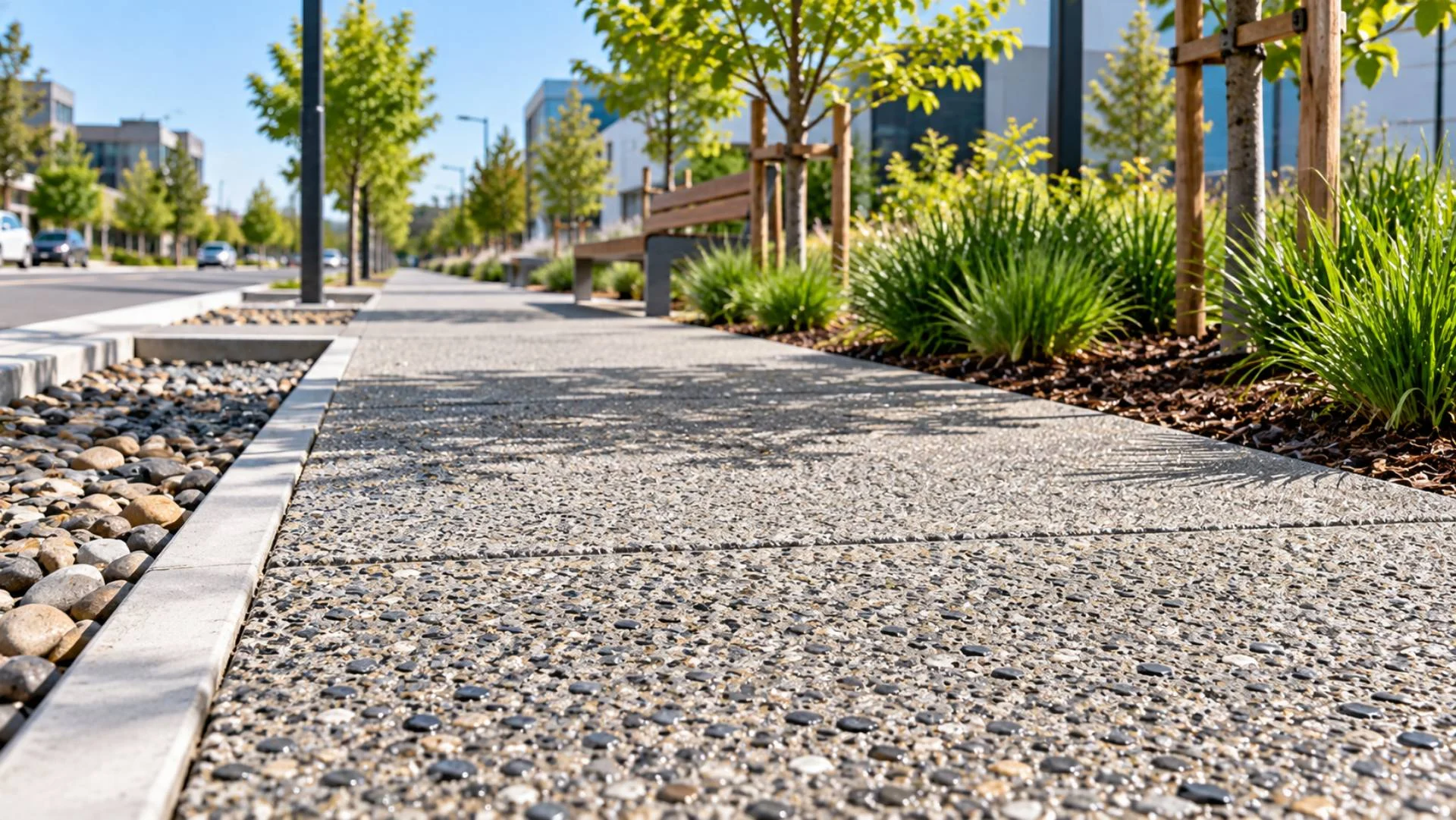
Most council footpath jobs start with a specification. It sets out the path width, thickness, strength, finish and testing, and the contractor’s supplier has to deliver concrete that meets it, load after load. When the specification calls for a permeable surface, the supply side needs more planning than a standard footpath pour.
Broadmix supplies permeable concrete for footpaths, shared paths, tree surrounds and other public works across the region. We work with civil contractors and council works teams to match the mix to the specification, plan deliveries around road reserve access, and provide the paperwork public projects require.
Where permeable footpaths make sense
Councils increasingly use permeable surfaces where a solid path would cause drainage or tree problems:
- Streets with mature trees, where roots need water and air. See our article on paving within street tree root zones for construction methods that protect them.
- Low points that pond after rain, where solid paths become puddled and slippery.
- Shared paths through parks and reserves, where runoff would erode nearby ground.
- Township streetscape upgrades, where councils want to reduce stormwater entering drains.
How councils treat these paths as public assets is covered separately in our article on how councils treat paths on public land.
Typical footpath specifications
Every council sets its own standards, but permeable footpaths commonly follow these patterns:
| Element | Typical approach |
| Path width | Around 1.5 m for footpaths, 2.5 to 3 m for shared paths |
| Slab thickness | Often 125 to 150 mm, thicker than a standard path because of lower strength |
| Base | Clean, open-graded stone over geotextile |
| Edges | Formed edges or edge restraints to stop ravelling at the sides |
| Testing | Trial panel, plus infiltration testing after construction |
| Where vehicles cross | Dense concrete, built to crossover standards |
Shared paths may also carry council maintenance vehicles, mowers or emergency access. Check the load limits for maintenance vehicles when setting the slab thickness.
Specifications may refer to the product as pervious, porous or no-fines concrete rather than permeable. These usually mean the same thing. Our explainer on pervious, porous and no-fines terminology clears up the differences.
Trial panels come first
Many councils ask for a trial panel before full construction. A small test section lets the council, contractor and supplier confirm:
- The appearance and surface texture
- How the mix places and compacts with the crew’s tools
- The infiltration rate once the panel has cured
- That the finish meets slip resistance expectations
For public walkways, slip resistance often carries extra weight. Our article on slip ratings for public walkways explains how surfaces are rated in Australia.
Delivery logistics on road reserves
Footpath pours have challenges that a driveway pour does not:
- Small, frequent volumes. Paths are often poured in sections, so delivery timing needs careful coordination between loads.
- A short placement window. Permeable concrete has little paste and dries quickly, so each load must be placed and covered promptly. Short travel times from the plant help keep it workable.
- Traffic management. Agitator trucks parked on the road may need traffic control. Factor this into delivery times and truck positioning.
- Access and reach. Narrow verges, overhead wires and parked cars can limit where trucks stand. Barrows, a small pump or conveyors may be needed.
- Weather. Hot, windy days shorten the working time further. Early starts and quick curing protection make a real difference.
Sharing these details early allows a clear delivery schedule. Our checklist of details to include in a supply enquiry covers what to send.
Documentation for public projects
Council works usually need a clear paper trail. Be ready to provide or request:
- Product specifications, including void content and strength
- Delivery dockets for each load, showing the mix, volume and batching time
- Test results, where the specification requires them
- Maintenance guidance for the council asset register
Agree on the documentation up front, so nothing holds up final inspection or handover.
Protecting a new public path
A new footpath is exposed from the moment it is poured. To protect it:
- Fence or barricade it until it has cured, because foot traffic and bikes can damage the surface early.
- Grade the nature strip away from the path, or edge it, so soil does not wash across.
- Keep construction sediment and stockpiles off the finished surface.
- Plan for leaf litter from street trees in the council’s cleaning program.
Frequently asked questions
Can permeable concrete be used for council footpaths?
Yes, where the council’s specification allows it. It is increasingly used near trees, at drainage low points, and on shared paths.
Do councils require trial panels?
Many do, especially on a contractor’s first permeable project. A trial panel confirms appearance, placement and drainage before full construction.
Can you supply small volumes for staged footpath pours?
Yes. Footpath works often run in sections, and deliveries can be scheduled to suit each pour.
What documentation do you provide?
Product specifications and delivery dockets as standard. Discuss any testing the specification requires before work starts.