
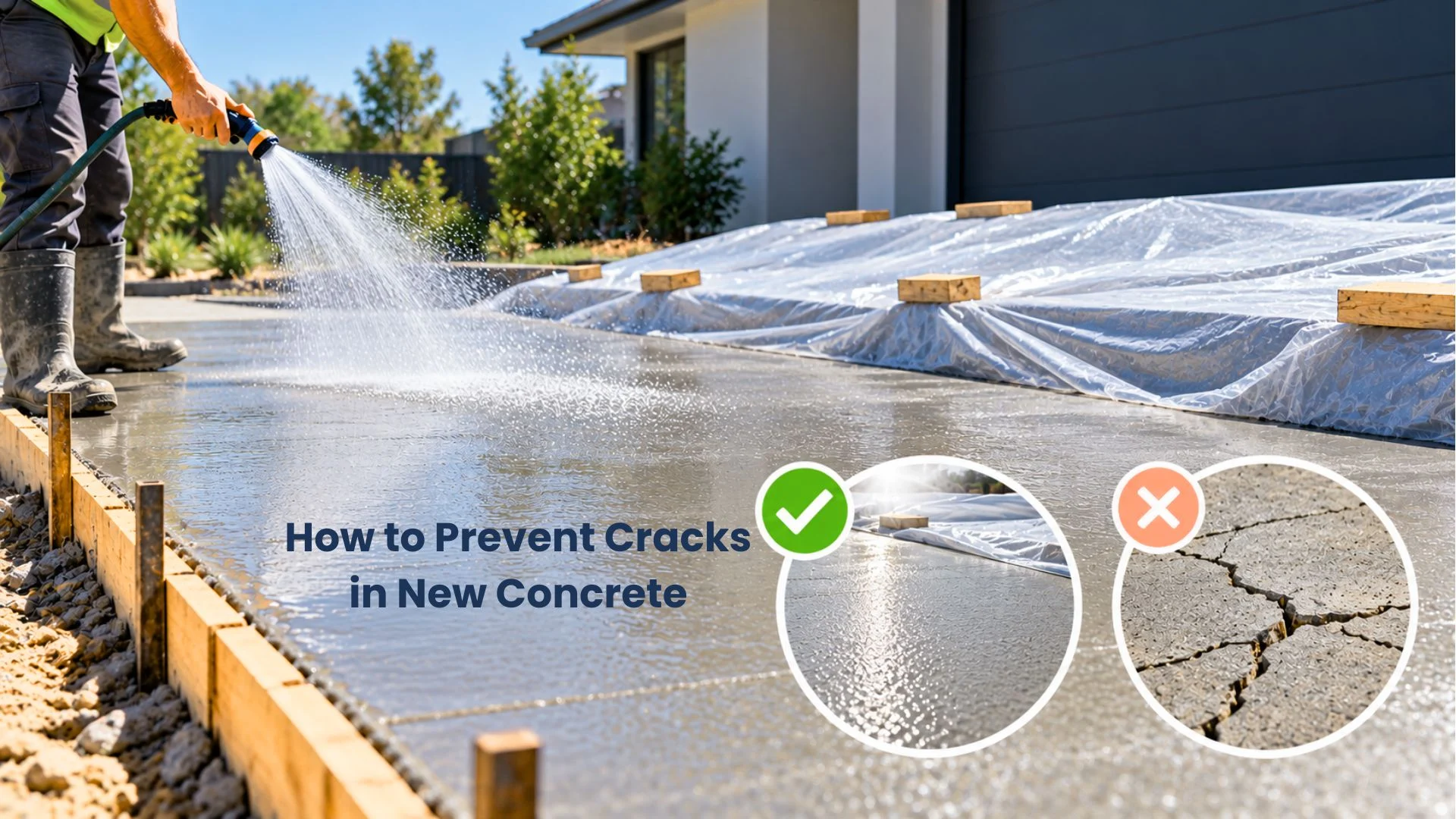
Many of the cracks a slab will ever show are decided in its first week. In those few days, the concrete is losing water, shrinking and gaining strength all at once. Every hot breeze, missed curing session or late joint cut adds stress that the slab will have to release somewhere.
You cannot stop concrete shrinking as it dries, but you can control it so cracks stay small or form only where you want them. The keys are a well-prepared base, planned control joints, the right mix with no extra water added, protection from fast drying on pour day, and keeping the slab moist for at least the first seven days.
Before the pour
Prepare a firm, even base
A slab is only as stable as the ground beneath it. Compact the subgrade and base thoroughly, so there are no soft spots that could settle later. Just before pouring, dampen the base lightly. A dry base draws water out of the bottom of the slab. Avoid leaving puddles, though, because pooled water weakens the concrete above it.
Plan your control joints
Control joints give shrinkage a planned place to crack. As a common rule of thumb, joint spacing in metres is roughly 24 to 30 times the slab thickness in metres. For a 100 mm slab, that is about every 2.4 to 3 metres.
- Keep panels as close to square as possible.
- Avoid long, narrow panels. Keep length under about 1.5 times the width.
- Add joints at inside corners, pits and changes in shape, where cracks tend to start.
Get the reinforcement right
Mesh must sit on bar chairs at the correct height, and extra bars at re-entrant corners help resist diagonal cracking. For help choosing, see our guide to picking reinforcement for your slab.
Order the right mix
Decide the workability you need when you order, rather than adding water on site later. Consider adding fibres when you order, because micro fibres reduce early shrinkage cracking. Getting the right concrete grade and mix for the job also helps.
Watch the weather
Hot, dry and windy days are the hardest conditions for fresh concrete. In summer, booking a morning pour avoids the worst afternoon heat. In winter, avoid pouring when frost is forecast overnight.
On pour day
| Do | Avoid |
|---|---|
| Place and finish promptly | Adding water to the truck or the slab surface |
| Set up shade or windbreaks on hot days | Finishing while bleed water is still on the surface |
| Use an evaporation retarder spray in hot or windy conditions | Overworking the surface with trowels |
| Have curing materials ready before the pour | Leaving the slab exposed to sun and wind |
Extra water is one of the biggest causes of shrinkage cracking. It makes concrete easier to place, but the extra water evaporates as the slab dries, so the slab shrinks more and ends up weaker.
Overworking the surface brings water and fine material to the top, which leads to crazing and a weaker surface layer.
The first 24 hours
Cut joints on time
Saw-cut joints need careful timing. Cut too early and the edges ravel. Cut too late and the slab may already have cracked. Saw cuts are usually made within the first day, as soon as the concrete is hard enough to cut cleanly. In hot weather that can be within a few hours. A common guide is to cut to about a quarter of the slab’s depth.
Tooled joints are formed while the concrete is still soft, during finishing.
Start curing as soon as you can
Begin curing as soon as the surface is firm enough not to be marked. The aim is simple: keep moisture in the slab while it gains strength.
The first week: keep it moist
| Method | How it works | Best for |
|---|---|---|
| Plastic sheeting | Traps moisture against the surface | Most slabs, especially driveways and paths |
| Wet hessian or curing blankets | Holds water on the surface | Hot weather, if kept damp |
| Regular wetting | Keeps the surface moist with a hose or sprinkler | Small slabs where someone is home |
| Curing compound | Sprayed film slows evaporation | Large areas, or where wetting is impractical |
Aim for at least seven days of curing. Overlap and weigh down plastic sheeting so wind cannot lift it. If you wet the slab, do not let it dry out between wettings. Alternating wet and dry is worse than steady moisture.
Check with your finisher before using a curing compound if you plan to seal, colour or coat the slab later, because some compounds affect adhesion.
The first month
- Keep vehicles off. Light foot traffic is generally fine after a day or two, but cars should wait at least seven days, and heavy vehicles longer.
- Avoid point loads. Keep skip bins, pallets of materials and machinery off the new slab.
- Hold off on sealing. Most sealers are applied once the concrete has cured. Ask about when to apply a sealer for your finish.
- Watch for cracks. Fine hairline cracks along or near joints are normal. If you see wider or uneven cracks, find out how to identify the type of crack you have.
Cold and wet weather
Concrete gains strength more slowly in cold conditions, so curing takes longer, and frost can damage a fresh surface. In winter:
- Ask about an accelerator in the mix to help the concrete set sooner.
- Cover the slab overnight with plastic and insulating blankets if frost is likely.
- Allow extra days before driving on the slab.
Light rain on a slab that has already been finished and covered is usually harmless. Heavy rain during placement can damage the surface, so reschedule if a downpour is forecast.
What you cannot prevent
Even with perfect practice, concrete may still show fine hairline cracks. They are a normal part of how concrete behaves and are usually cosmetic. The goal is to keep cracks small and to have them form in joints where they cannot be seen, not to eliminate them completely.
Frequently asked questions
How long should concrete be kept moist?
At least seven days for most slabs, and longer in cool weather.
Should I water new concrete?
Yes, if wetting is your curing method. Keep it consistently moist rather than letting it dry out between wettings. Plastic sheeting is easier and more consistent for most homeowners.
Do fibres stop concrete cracking as it dries?
Micro fibres reduce early plastic shrinkage cracking, but they do not replace good curing, joints and base preparation.
What is the biggest mistake that causes cracking?
Adding water to make concrete easier to place, followed by poor curing and joints that are too far apart.