
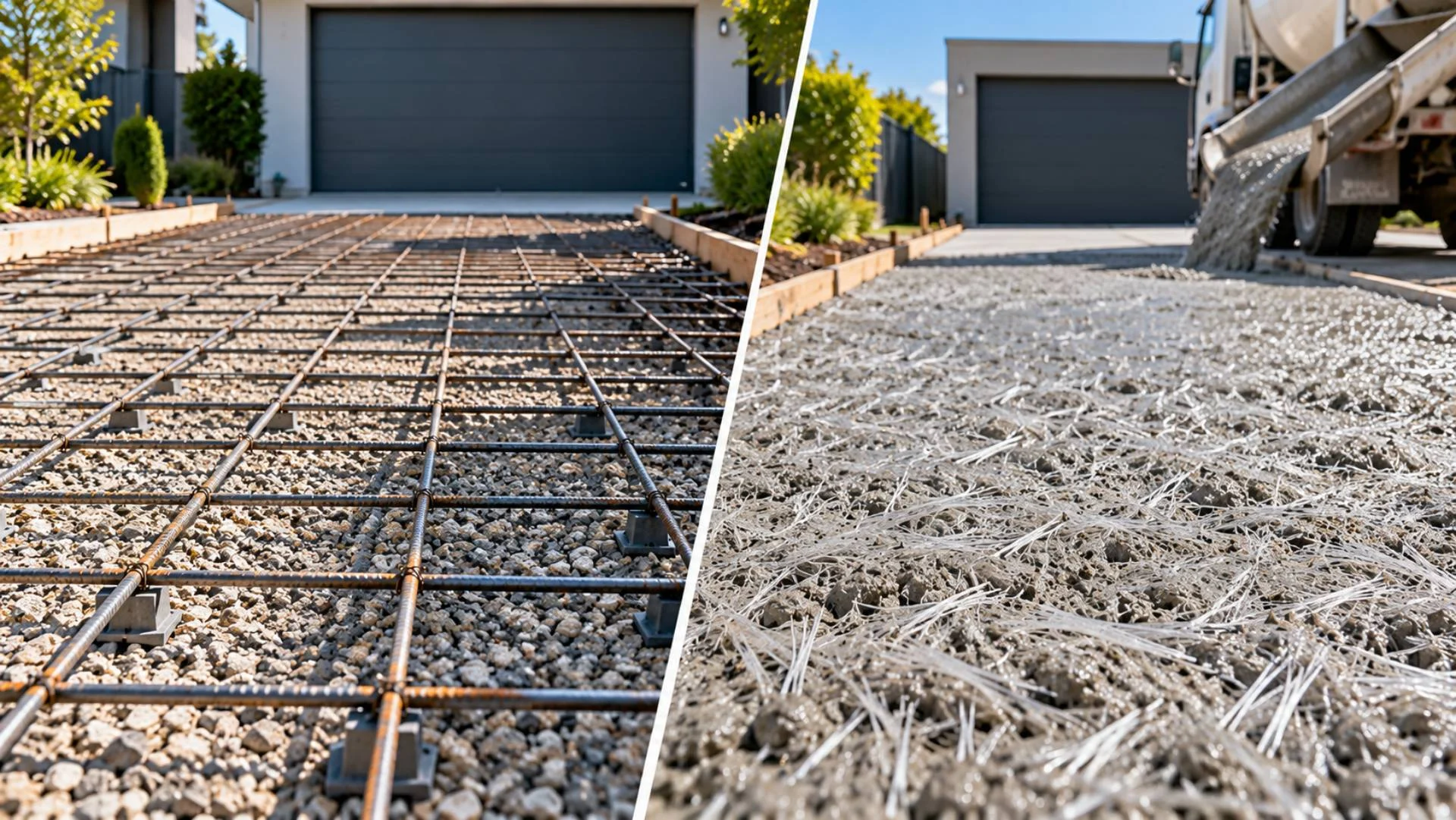
Ask three concreters how to reinforce a driveway and you may get three answers. One swears by SL72 mesh. Another says fibres have replaced it. A third says the best driveways use both. Each is partly right, because the best choice depends on what drives on the slab, the ground beneath it, and the finish on top.
For most Australian home driveways carrying cars, steel mesh remains the safest standard choice. Adding micro fibres to the mix gives extra protection against early surface cracking. Macro synthetic fibres can replace mesh in some light residential driveways, but only where your builder or engineer approves it. For heavy vehicles, reactive clay sites and council crossovers, steel mesh, or an engineered design, is the right answer.
The quick verdict
| Your situation | Recommended reinforcement |
| Standard driveway, cars and SUVs | SL72 mesh, with micro fibres added for crack control |
| Light driveway, approved design | Macro synthetic fibres in place of mesh |
| Caravans, boats, utes with heavy loads | SL82 mesh or an engineered design |
| Trucks or commercial vehicles | Engineered design, with mesh or bar |
| Reactive clay soils | Mesh as a minimum, plus engineering advice |
| Council crossover | Whatever the council’s standard drawing specifies, usually mesh |
| Exposed aggregate finish | Mesh, plus micro fibres if wanted |
| Paths and patios | Micro fibres, or light mesh |
What each one actually does
Steel mesh is a welded grid of steel wires placed inside the slab. It does not stop concrete cracking. Concrete shrinks and moves, and some cracking is normal. What mesh does is hold the slab together once a crack forms, so cracks stay tight and the two sides do not separate or drop.
Micro fibres are fine synthetic strands mixed through the concrete. They work in the first hours after pouring, reducing the small shrinkage cracks that form as fresh concrete dries. Once the concrete has hardened, they add very little strength.
Macro fibres are thicker and longer. Like mesh, they help hold cracks together after the concrete has hardened, but they are spread throughout the slab instead of sitting in one layer.
Neither option replaces good basics: a well-compacted base, the right thickness, and properly spaced control joints. The concrete grade matters too. Read about pairing reinforcement with the right concrete grade.
The mesh placement problem
Mesh only works if it sits at the right height in the slab. It must be supported on bar chairs so the concrete fully surrounds it. Mesh lying on the ground at the bottom of the slab does very little.
This is a common weakness on residential jobs. Crews walk on the mesh during the pour, or skip the bar chairs, and the steel ends up flattened against the base. Fibres avoid this risk entirely, because they are already mixed through the concrete when it arrives.
If you choose mesh, ask your concreter how it will be supported, and check the bar chairs are in place before the pour.
Cost and labour
| Factor | Steel mesh | Fibres |
| Material cost | Sheets bought separately | Charged per cubic metre of concrete |
| Labour | Cutting, lapping and chairing sheets | No placement work |
| Risk of installation error | Mesh placed at the wrong height | Uneven mixing if poorly batched |
| Speed | Slower preparation | Faster preparation |
Micro fibres added to a mesh-reinforced driveway cost relatively little, which is why many concreters use both. Macro fibres cost more per cubic metre, but they can save the time and labour of placing mesh. For more on dosages and how fibres are batched, see how fibres are dosed and added.
Situations that call for mesh
- Heavier vehicles. Caravans, boats, work utes and trucks put more load on the slab. SL82 mesh, a thicker slab, or an engineered design may be needed.
- Reactive clay. Ground movement places extra stress on a slab, and mesh provides more reliable crack control. On highly reactive sites, get engineering advice.
- Council crossovers. The section between your boundary and the road is usually built to the council’s standard drawing, which commonly specifies mesh. Check the council requirements at the kerb before ordering.
Decorative finishes
Fibres can show at the surface, particularly after an exposed aggregate wash. Micro fibres are usually less noticeable than macro fibres. For an exposed aggregate driveway concrete finish, mesh with optional micro fibres is the most common approach. Our article on fibre types and finish considerations explains how each fibre type affects the surface.
Questions to ask your concreter
- What reinforcement do you recommend for my driveway, and why?
- If using mesh, which type (SL72 or SL82), and how will it be supported at the right height?
- If using fibres, which type and dosage, and does the design allow them to replace mesh?
- Where will the control joints go?
- What does the council require for the crossover?
Frequently asked questions
Can fibre replace mesh in a driveway?
Macro synthetic fibres can, in some light residential driveways where the design allows it. Micro fibres cannot. They only control early shrinkage cracking.
Should I use SL72 or SL82 mesh?
SL72 is common for residential driveways carrying cars. SL82 is used for heavier loads or where specified by an engineer or council.
Can I use both mesh and fibre?
Yes, and it is a popular choice. Mesh holds the slab together structurally, while micro fibres reduce early surface cracking.
Will reinforcement stop my driveway cracking?
No reinforcement prevents all cracking. It keeps cracks tight and the slab together. Control joints guide cracking into neat lines.