
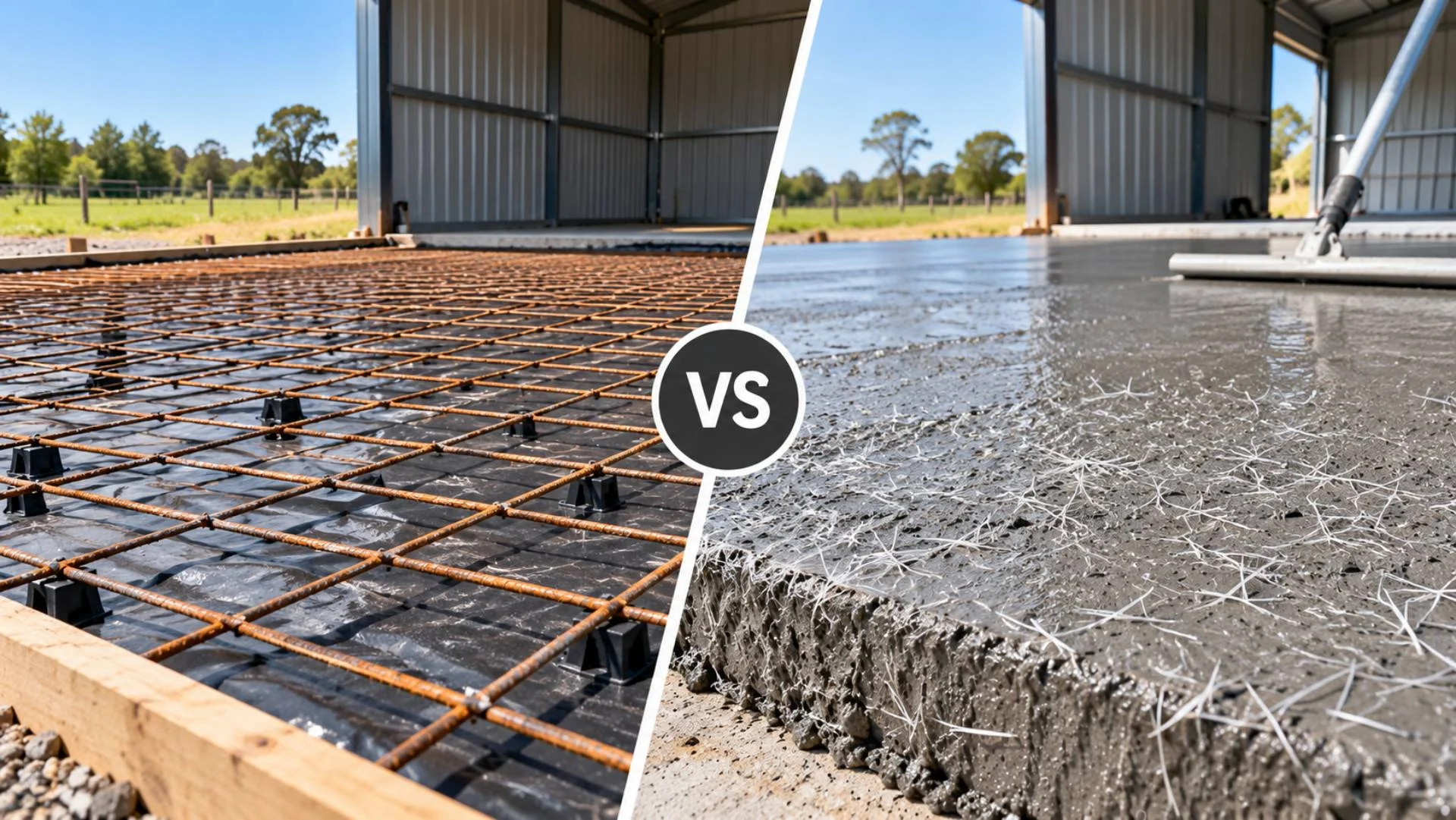
A “shed slab” can mean anything from a small pad under a garden shed to a large floor in a farm machinery shed. Those two slabs have very little in common, and the reinforcement they need is just as different.
Small garden and storage sheds can often use fibre-reinforced concrete without mesh. Sheds that house cars, utes, tractors or heavy equipment usually need steel mesh, often SL72 or SL82, and sometimes extra footings under the posts. Large sheds and those needing a building permit will usually come with engineering from the shed manufacturer or an engineer. That design decides the reinforcement for you.
The quick guide by shed type
| Shed type | Typical slab | Common reinforcement |
| Small garden or tool shed | Around 75 to 100 mm | Micro or macro fibres, or light mesh |
| Workshop or storage shed | Around 100 mm | SL72 mesh, or approved macro fibres |
| Garage for cars and utes | 100 to 125 mm | SL72 mesh, often with micro fibres |
| Shed for caravans, boats or trucks | 125 to 150 mm | SL82 mesh or an engineered design |
| Farm machinery shed | Engineered | As per the engineer’s design |
These are typical starting points only. Your shed’s engineering, soil conditions and permit requirements take priority.
Small sheds: fibre is often enough
Small garden sheds carry little more than foot traffic, a mower and some storage. The loads are light, and the slab’s main enemy is cracking from shrinkage and minor ground movement. For these slabs:
- Micro fibres help reduce surface cracking as the concrete dries.
- Macro fibres add some crack control in the hardened slab and can replace light mesh on small pads.
- Light mesh is still a simple, reliable option if you prefer steel.
Small sheds within certain size and height limits are often exempt from a building permit in Victoria, but always check with your council or a building surveyor first. If you are going with fibres, our article on fibre dosage options explains what to ask for.
Garages and vehicle sheds: mesh is the safer choice
Once vehicles drive into a shed, the slab works more like a driveway. Wheel loads, turning and jacks all stress the concrete. SL72 mesh, properly supported on bar chairs, is the usual standard for cars and utes. Many builders add micro fibres for extra early crack control.
Heavier loads, such as caravans, boats, horse floats and trucks, typically call for a thicker slab and SL82 mesh, or a design from an engineer. The driveway into the shed faces the same loads, so it is worth reading our guide on mesh or fibre for the driveway leading to the shed.
Larger sheds come with engineering
Most steel sheds that need a building permit are supplied with engineering drawings from the manufacturer. These usually specify:
- Slab thickness and reinforcement
- Pad or pier footings under the portal frame posts
- Hold-down bolt positions and edge distances
- Concrete strength grade
Follow these drawings exactly. Swapping mesh for fibres, or changing slab thickness, without the engineer’s approval can affect your permit and the shed’s wind rating. The approach is similar to a house slab, where how house slab reinforcement is designed depends on the engineer, not the builder.
Farm and rural sheds
Machinery sheds on rural properties carry some of the heaviest loads of any shed: tractors, loaded trailers, hay and grain. These floors are typically engineered, with thicker slabs, heavier mesh or bar reinforcement, and a higher concrete strength grade.
On rural blocks around Nagambie and the wider region, it is common for one shed to combine a workshop area, vehicle storage and machinery bays. In that case, design each area for the heaviest load it will carry.
Getting the concrete right
Reinforcement only works with the right concrete:
- Strength grade. Small sheds commonly use 20 or 25 MPa. Vehicle and machinery floors may need 25 or 32 MPa. Read more about strength grades for shed floors.
- Slump. Order the right workability rather than adding water on site, which weakens the concrete.
- Control joints. Larger slabs need saw cuts or joints at regular intervals, whatever reinforcement you choose.
- Curing. Keep the slab damp or covered for the first several days to limit cracking.
Frequently asked questions
Do I need mesh in a small shed slab?
Often not. Fibre-reinforced concrete is commonly used for small garden and storage sheds. Mesh is a reliable alternative if you prefer it.
What mesh should I use for a garage or vehicle shed?
SL72 is common for cars and utes. SL82, or an engineered design, suits heavier vehicles and machinery.
Can fibres replace mesh in a steel shed slab?
Only if the shed’s engineering allows it. For sheds supplied with engineering, follow the specified reinforcement.
How thick should a shed slab be?
Around 75 to 100 mm for small sheds, 100 to 125 mm for cars, and thicker for heavy vehicles. Large sheds follow the engineer’s design.