
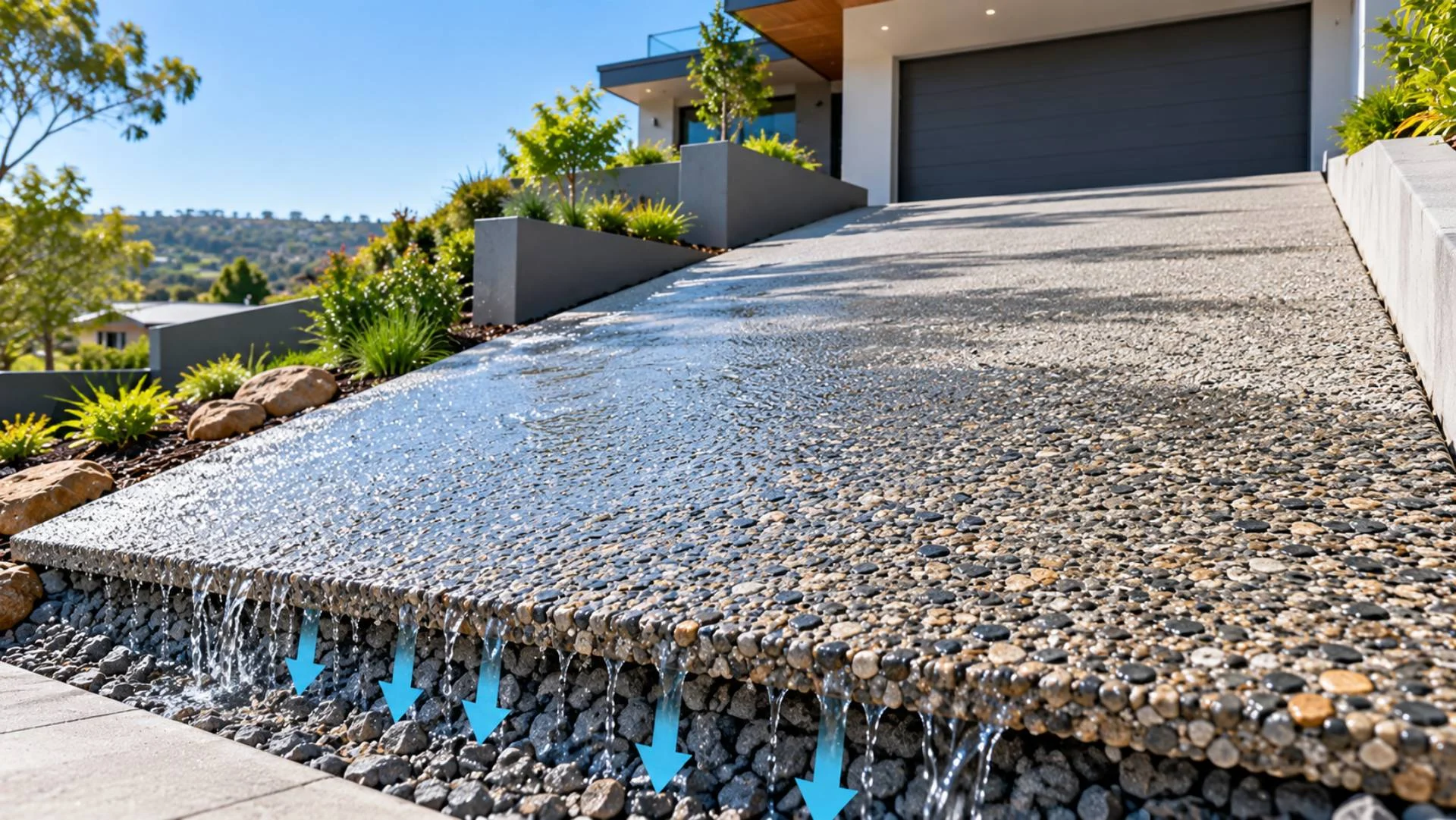
A common mistake on sloping blocks is to assume a permeable driveway will soak up rain just as it does on flat ground. On a slope, the water does go into the surface. But once it is inside, it keeps moving downhill through the stone base and comes out at the bottom of the driveway. If nobody plans for that, a garage or footpath at the low end can end up wetter than it would with plain concrete.
Permeable concrete works well on flat and gently sloping driveways. On steeper grades it can still work, but it needs a modified base design. On very steep driveways, it is usually better to combine it with standard concrete.
How slope changes the way it drains
On flat ground, rainwater passes straight down through the concrete and spreads across the stone base below. From there it slowly soaks into the soil.
On a slope, gravity pulls the stored water sideways through the base towards the low point. That causes three problems:
- The upper part of the base drains dry while the lower end overloads.
- Water re-emerges at the bottom, sometimes right where you least want it.
- Less water soaks into the soil, which reduces the stormwater benefit.
What gradients suit permeable concrete?
Slope is measured as rise over run. As a quick example, a 20 m driveway that drops 1 m from top to bottom has a 5% gradient, or 1 in 20.
| Gradient | Approximate ratio | Suitability | Design notes |
| 0 to 2% | Flatter than 1 in 50 | Excellent | Standard permeable design |
| 2 to 5% | 1 in 50 to 1 in 20 | Very good | Check where water exits at the low end |
| 5 to 10% | 1 in 20 to 1 in 10 | Possible | Needs internal barriers in the base and an engineered design |
| Over 10% | Steeper than 1 in 10 | Not recommended | Use a hybrid layout or dense concrete |
These figures are a general guide only. Soil type, driveway length and rainfall all affect the final design.
Design fixes for moderate slopes
For gradients in the middle range, engineers use a few proven methods to keep water spread evenly through the base.
Check dams or baffles. These are barriers built across the stone base at intervals, made from compacted clay, concrete or an impermeable liner. They divide the base into a series of terraced cells, so water pools and soaks in at each level instead of running to the bottom.
A deeper base at the low end. Extra stone storage where water collects helps the system cope during heavy rain.
A drain at the bottom. A grated strip drain or slotted underdrain at the low end collects any water that still emerges. It sends that water to the legal point of discharge rather than towards your garage or house.
The base is where all of this happens. Our article on how the stone reservoir is layered explains the materials and depths involved.
Is it harder to install on a slope?
Yes. Permeable concrete has very little paste, so it is stiffer and less forgiving to place than standard premix. On a slope it has to be spread, compacted and covered quickly, with the crew working from the bottom up.
Steeper grades make compaction and finishing harder still. That is another reason grades over about 10% usually suit dense concrete better.
Grip, braking and surface wear
On the positive side, permeable concrete has a naturally rough, open texture that gives good grip in the wet. That is useful on any incline.
The downside is that steep driveways bring more braking, accelerating and wheel spin. Those forces twist and scrub the surface, which can loosen stones over time. We cover this in more detail in our article on wheel loads and surface wear.
When a hybrid driveway works better
For steep blocks, many homeowners get the best result by combining two surfaces:
- Dense concrete on the steep section, where strength, grip and easy placement matter most. An exposed aggregate finish for steep sections gives excellent traction and a decorative look. Our article on how exposed aggregate grips on slopes explains why.
- Permeable concrete on the flatter areas, such as the parking pad, turning bay or a level landing at the top or bottom. That is where it can soak up runoff from the steep section above.
This layout is common on hilly blocks around Tallarook, where driveways often climb from the road before levelling out near the house. For a broader comparison of the two surfaces, read our article comparing permeable and dense driveway surfaces.
Protect your house at the low end
If your driveway slopes towards the house or garage, plan the drainage carefully. Water emerging from the base, or soaking into reactive clay next to your slab, can cause damp problems or ground movement. A drain across the bottom of the driveway, connected to your stormwater system, is a simple safeguard.
Frequently asked questions
What is the maximum slope for permeable concrete?
As a general guide, it works best below 5%. With an engineered base it can go up to about 10%. Steeper than that, a hybrid layout or standard concrete is usually better.
Will water run off a sloped permeable driveway?
Very little runs off the surface. Water can travel through the base and come out at the low end, unless the base includes barriers or a drain.
Is permeable concrete slippery on a slope?
No. Its open, textured surface gives good grip, including when wet.
Can I use permeable concrete for just part of my driveway?
Yes. Combining permeable concrete on flatter areas with dense concrete on steeper sections is a common and practical approach.