
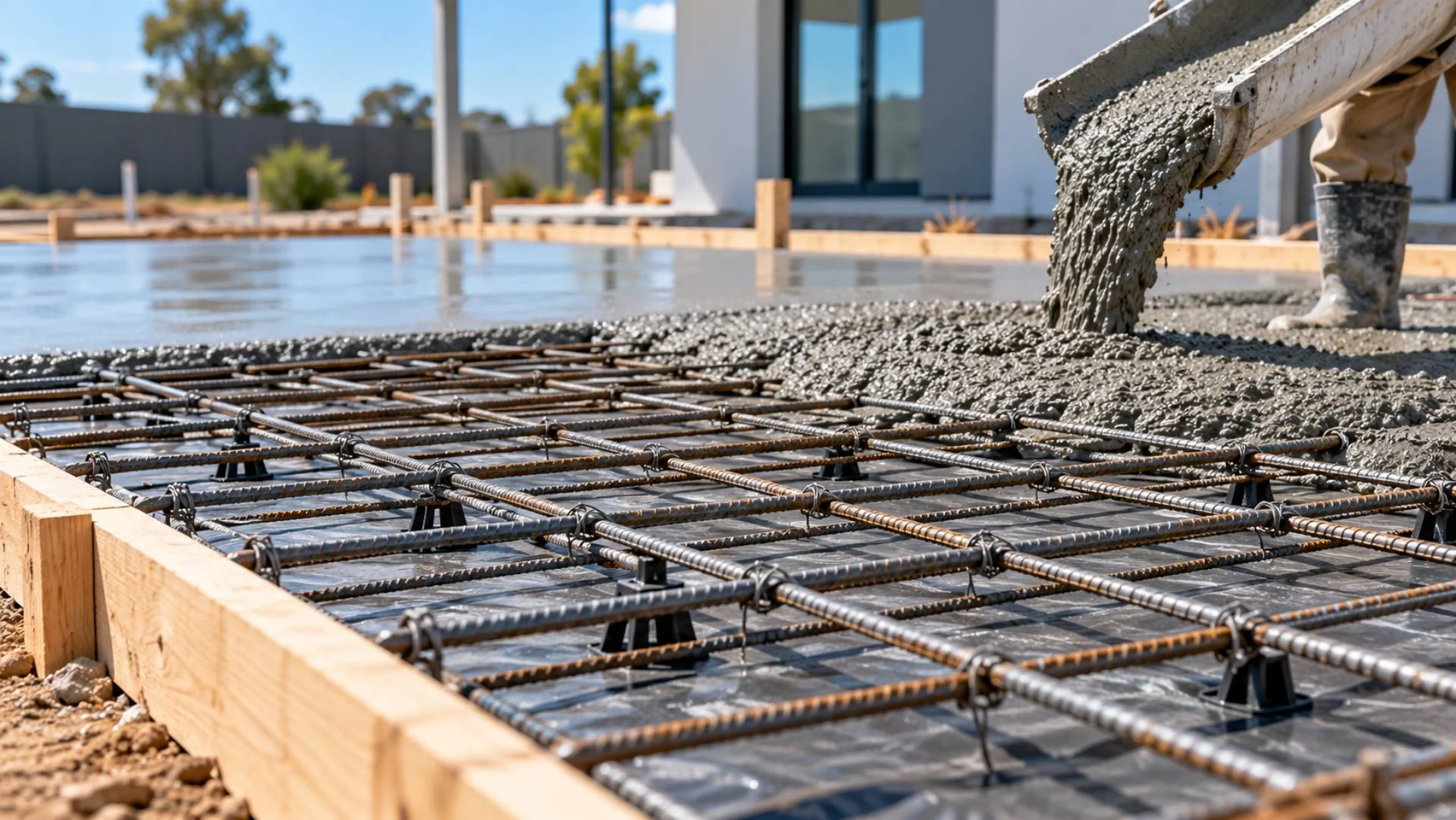
Every concrete slab cracks a little. Concrete shrinks as it cures, the ground beneath it moves with the seasons, and loads push and pull on it every day. Reinforcement is not there to stop that completely. Its job is to control how cracks form and to keep the slab working as one piece for decades.
The right reinforcement depends on five things: what the slab carries, the ground it sits on, who has to approve it, how it will be finished, and the conditions of the pour. Answer those five questions and the choice of steel mesh, fibres or a combination of both usually becomes clear.
The reinforcement toolkit
Before working through the questions, it helps to know what is available:
- Steel mesh is a welded grid such as SL72 or SL82, placed inside the slab on bar chairs. It is the standard reinforcement for most Australian slabs.
- Reinforcing bar and trench mesh go in beams, footings and thickened edges to add stiffness.
- Micro synthetic fibres are fine strands mixed into the concrete. They reduce cracking in the first hours after pouring.
- Macro synthetic fibres are thicker strands that help hold hardened concrete together once it cracks.
- Steel fibres are mainly used in engineered commercial and industrial floors.
Many slabs use more than one of these, because each works at a different stage of the slab’s life.
Question 1: What will the slab carry?
Load is the biggest single factor.
- Foot traffic and light storage, such as garden paths, small patios and garden shed pads, put little stress on a slab. Fibres alone are often enough.
- Cars and utes bring wheel loads, turning forces and jacks. This is where steel mesh becomes the usual choice, as in most driveways for everyday vehicles.
- Caravans, trucks and machinery need thicker slabs, heavier mesh or an engineered design.
- Concentrated loads, such as car hoists, heavy shelving and engine cranes, need extra thickness and strength exactly where the load lands.
If you are unsure what the slab may carry in the future, plan for the heavier option. Upgrading a finished slab is far harder than getting it right at the pour.
Question 2: What ground is it sitting on?
Soil movement can stress a slab as much as the loads on top. Much of Central Victoria has reactive clay, which swells when wet and shrinks when dry. That movement bends the slab from underneath.
- Stable sand or rock places little extra demand on reinforcement.
- Reactive clay calls for steel reinforcement and, on larger or structural slabs, engineering advice.
- Fill, soft ground or nearby trees create problem sites that should always be assessed by an engineer.
For new homes, a geotechnical report classifies the site, and that classification shapes the whole slab design. We explain how this works in our article on reinforcement for new house slabs.
Question 3: Who needs to sign off?
On many projects, the reinforcement has already been decided by someone else:
- House slabs and attached garages follow the structural engineer’s design, and are inspected before the pour.
- Steel sheds needing a permit usually come with engineering from the manufacturer that specifies the slab and footings. See how this applies to shed slabs of every size.
- Driveway crossovers on council land follow the council’s standard drawings, which usually specify mesh.
- Paths, patios and small outbuildings are typically left to the owner and builder.
If an engineer, council or manufacturer has specified the reinforcement, follow it exactly. Changing it without approval can affect your permit, warranty and insurance.
Question 4: How will it be finished?
The surface finish affects which reinforcement works best:
- Plain and broom finishes suit any reinforcement. Fine fibres may show at first but usually wear away.
- Exposed aggregate can reveal fibres when the surface is washed back. Mesh, sometimes with micro fibres, is the usual approach.
- Polished concrete exposes the top layer of the slab, so fibre choice needs care. Steel fibres are generally avoided.
- Epoxy and coated floors are ground before coating, which removes most surface fibres.
Garages are where finishes most often change the decision. Our article on reinforcing garage floors covers polished, epoxy and hoist-ready floors in detail.
Question 5: What are the pour conditions?
Practical details on the day also matter:
- Hot, dry or windy weather speeds up surface drying and increases early cracking. Micro fibres give useful extra protection.
- Thin slabs leave little room to position mesh correctly, and fibres avoid that problem.
- Crew size and access can make placing mesh on bar chairs slow, especially on tight sites.
- Pumping may need planning if higher doses of macro fibres are used.
Mesh only works if it sits at the correct height in the slab. If it is walked down onto the base during the pour, it does very little. Whatever you choose, check the bar chairs are in place before the first truck arrives.
Putting the answers together
Here is how the five questions typically play out for common projects:
- Garden path or small patio: fibres, or light mesh
- Small garden shed: fibres, unless the shed’s engineering says otherwise
- Driveway: SL72 mesh, often with micro fibres, and mesh in the council crossover
- Detached garage or vehicle shed: SL72 or SL82 mesh, often with micro fibres
- Attached garage or house slab: the engineer’s design
- Machinery shed or commercial floor: an engineered design
What reinforcement cannot fix
Even the best reinforcement will not save a slab that is let down by the basics:
- A poorly compacted base leads to settlement and cracking, whatever the reinforcement.
- Missing control joints let cracks form randomly instead of in planned lines.
- Too much water added on site weakens the concrete and increases shrinkage.
- Poor curing leaves a weaker surface that cracks and dusts more easily.
- The wrong strength grade undermines everything else.
Ordering the right concrete is part of the job. Our guide to ordering fibre-reinforced concrete covers fibre types and dosages.
Frequently asked questions
Does every concrete slab need reinforcement?
Most do. Very small, lightly loaded pads can sometimes be unreinforced or fibre-only. Driveways, garages and structural slabs need proper reinforcement.
What reinforcement is used most for home slabs in Australia?
Steel mesh, usually SL72 or SL82, often with micro fibres added to the concrete.
Can I decide the reinforcement for my own slab?
For paths, patios and small outbuildings, generally yes, with your builder’s advice. For house slabs and engineered sheds, the engineer decides.
Do fibres need to be ordered in advance?
Yes. Fibres are added at the plant or in the truck, so include them when you order your concrete.